XML technologies / XSL-FO / Reference / Attributes in XSL-FO / padding-after.length
(Excerpt from "XSL-FO ― Die Referenz" by Manuel Montero Pineda & Steffen Herkert, 2016, dpunkt.verlag)
A | B | C | D | E | F | G | H | I | J | K | L | M | N | O | P | Q | R | S | T | U | V | W | X | Y | Z
Recommendation section: 7.8.32
Category: 7.8 Common Border, Padding and Background Properties
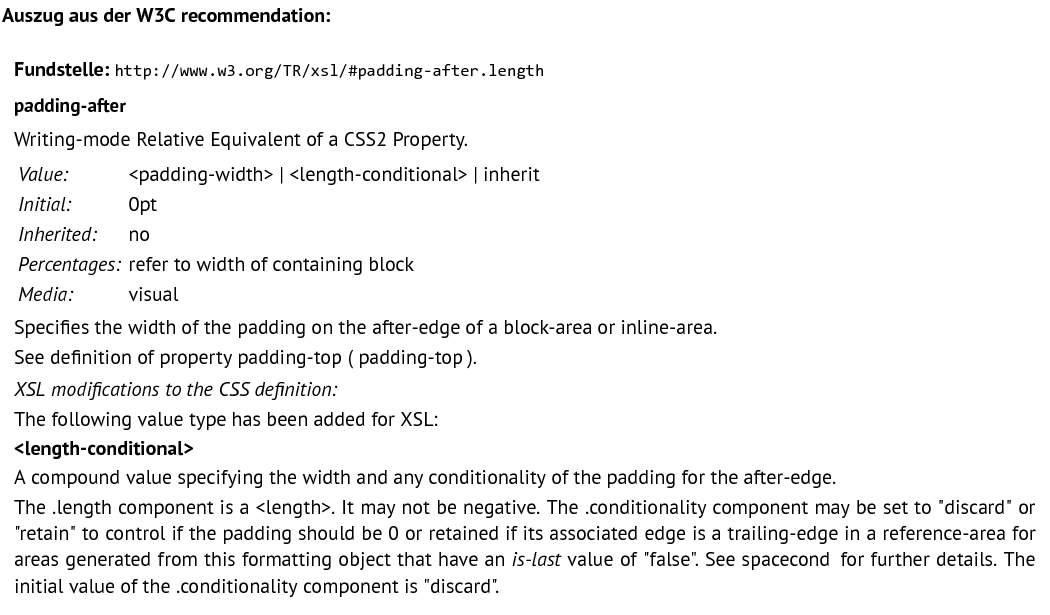
Description
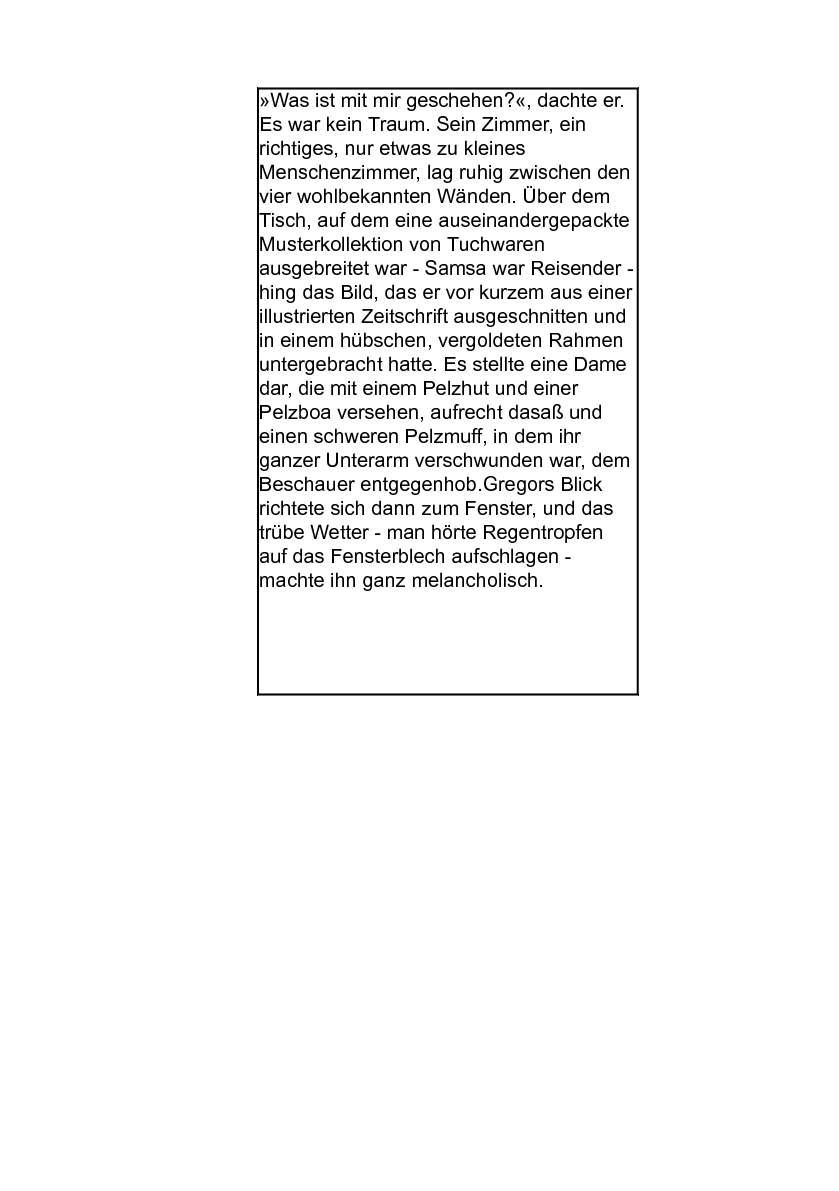
Padding is the space inside an area: the distance from the content to the border. (The border need not be visible.) An element can have a padding-after.length attribute specifying the space to the bottom border, depending on the writing direction selected by writing-mode. With lr-tb (within lines: left to right; lines: top to bottom) and rl-tb (within lines: right to left; lines: top to bottom), padding-after.length remains the space to the bottom border. With tb-rl (within columns: top to bottom; columns: right to left), it refers to the space to the left border. It therefore always concerns the border parallel to the line or column that closes the area.
Values
Length | A length consisting of a number and a unit. Common units are mm, pt, px, cm and pc. |
Default value: 0pt
XSL-FO version: 1.0
Allowed in:
<fo:basic-link> , <fo:block> , <fo:block-container> , <fo:character> , <fo:external-graphic> , <fo:initial-property-set> , <fo:inline> , <fo:inline-container> , <fo:instream-foreign-object> , <fo:leader> , <fo:list-block> , <fo:list-item> , <fo:page-number> , <fo:page-number-citation> , <fo:page-number-citation-last> , <fo:region-after> , <fo:region-before> , <fo:region-body> , <fo:region-end> , <fo:region-start> , <fo:scaling-value-citation> , <fo:table> , <fo:table-and-caption> , <fo:table-body> , <fo:table-caption> , <fo:table-cell> , <fo:table-column> , <fo:table-footer> , <fo:table-header> , <fo:table-row> and <fo:title>
Support:
Conformance level | Antenna House | FOP | RenderX XEP | Altsoft XML2PDF | Compart DocBridge |
Basic | Y | Y | Y | Y | Y |
XSL-FO example:
<fo:root font-family="Arial" font-size="10pt" line-height="1.2em" xmlns:fo="http://www.w3.org/1999/XSL/Format" xmlns:cpfo="http://www.compart.net/xmlns/cpfo" xmlns:svg="http://www.w3.org/2000/svg" xmlns:axf="http://www.antennahouse.com/names/XSL/Extensions">
<fo:layout-master-set>
<fo:simple-page-master master-name="Inhalt-Seiten" margin="0mm 0mm 0mm
                      0mm" page-height="210mm" page-width="148mm">
<fo:region-body margin="15mm 35mm 30mm
                        45mm"/>
</fo:simple-page-master>
</fo:layout-master-set>
<fo:page-sequence master-reference="Inhalt-Seiten">
<fo:flow flow-name="xsl-region-body">
<fo:block-container writing-mode="lr-tb">
<fo:block margin="1pt" padding-after.length="50pt" border-color="black" border-width="1pt" border-style="solid">
»Was ist mit mir geschehen?«, dachte er. Es war kein Traum. Sein Zimmer, ein
                richtiges, nur etwas zu kleines Menschenzimmer, lag ruhig zwischen den vier
                wohlbekannten Wänden. Über dem Tisch, auf dem eine auseinandergepackte
                Musterkollektion von Tuchwaren ausgebreitet war - Samsa war Reisender - hing das
                Bild, das er vor kurzem aus einer illustrierten Zeitschrift ausgeschnitten und in
                einem hübschen, vergoldeten Rahmen untergebracht hatte. Es stellte eine Dame dar,
                die mit einem Pelzhut und einer Pelzboa versehen, aufrecht dasaß und einen schweren
                Pelzmuff, in dem ihr ganzer Unterarm verschwunden war, dem Beschauer
                entgegenhob.Gregors Blick richtete sich dann zum Fenster, und das trübe Wetter - man
                hörte Regentropfen auf das Fensterblech aufschlagen - machte ihn ganz
                melancholisch.
</fo:block>
</fo:block-container>
</fo:flow>
</fo:page-sequence>
</fo:root>In the output:
Excerpt from the W3C Recommendation: