XML technologies / XSL-FO / Reference / Elements in XSL-FO / fo:root
(Excerpt from "XSL-FO ― Die Referenz" by Manuel Montero Pineda & Steffen Herkert, 2016, dpunkt.verlag)
A | B | C | D | E | F | G | H | I | J | K | L | M | N | O | P | Q | R | S | T | U | V | W | X | Y | Z
Recommendation section: 6.4.2
Category: 6.4 Declarations and Pagination and Layout Formatting Objects
Description
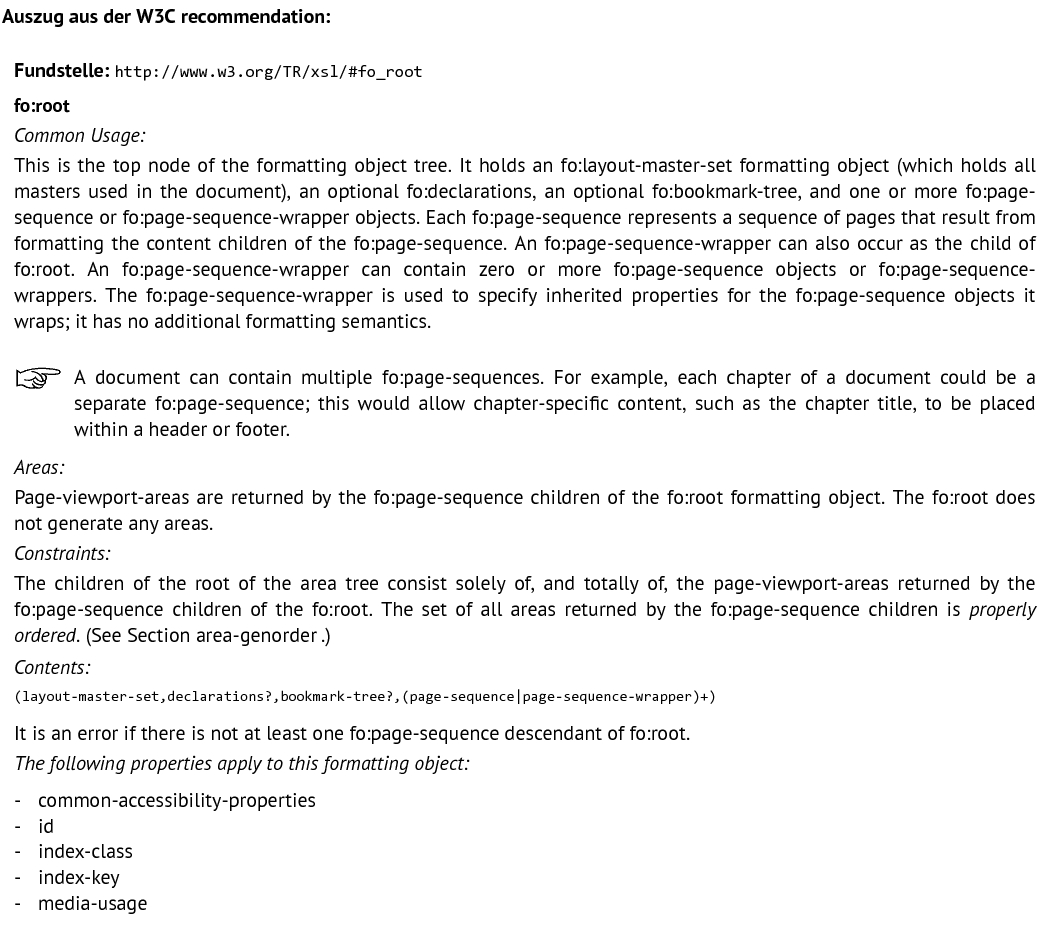
The root element or document node of an XSL-FO document.
XSL-FO version: 1.0
Child elements
This element contains a list of access points in the document, such as a table of contents or a list of figures or tables. Each access point is represented by a bookmark. | |
This element creates global declarations. | |
This element defines all the masters for the pages or page sequences to be used. | |
This element defines how page sequences are used within a document. It also embeds the document content in the page sequence. | |
This element specifies inherited properties for a group of fo:page-sequence formatting objects. It has no additional formatting semantics. |
Attributes
This attribute uniquely identifies an object so that other objects can reference it. | |
This attribute defines an index class for individual index entries (index-key) or an entire area. All index entries in that area belong to the class. When referencing index entries (fo:index-key-reference) belonging to different classes, their page numbers are listed separately even if they are consecutive. For example, "1-8" becomes "1-4,5-8" if entries on pages 1-4 belong to one class and pages 5-8 to another. This is useful when pages are grouped into sections with different numbering systems. A range such as "I-14" can thus be avoided and replaced with "I-V,1-14". | |
This attribute defines an index entry. The supplied value is used as the entry’s identifier. An index entry reference (fo:index-key-reference) can reference all entries with this identifier and add their page numbers to a page citation list (fo:index-page-citation-list). | |
In the root element (fo:root), this determines whether all content is output as a sequence of pages (paginate), left to the processing system (auto), placed on an "endless" page of fixed width or height (bounded-in-one-dimension), or given a page size determined by the output medium as on a website (unbounded). No common formatter supports this property. | |
This attribute creates content-related identifiers that provide alternative output devices, such as audio output, with information about the XML element’s content. | |
This attribute identifies an XML document as the source document. If the renderer cannot interpret the FO document, for example for a hypothetical speech output, the source document can also be consulted. It has no practical significance. |
Support:
Conformance level | Antenna House | FOP | RenderX XEP | Altsoft XML2PDF | Compart DocBridge |
Basic | Y | Y | Y | Y | Y |
XSL-FO example:
<fo:root>
<fo:layout-master-set>
<fo:simple-page-master master-name="Inhalt">
<fo:region-body/>
</fo:simple-page-master>
</fo:layout-master-set>
<fo:page-sequence master-reference="Inhalt">
<fo:flow flow-name="xsl-region-body">
<fo:block>
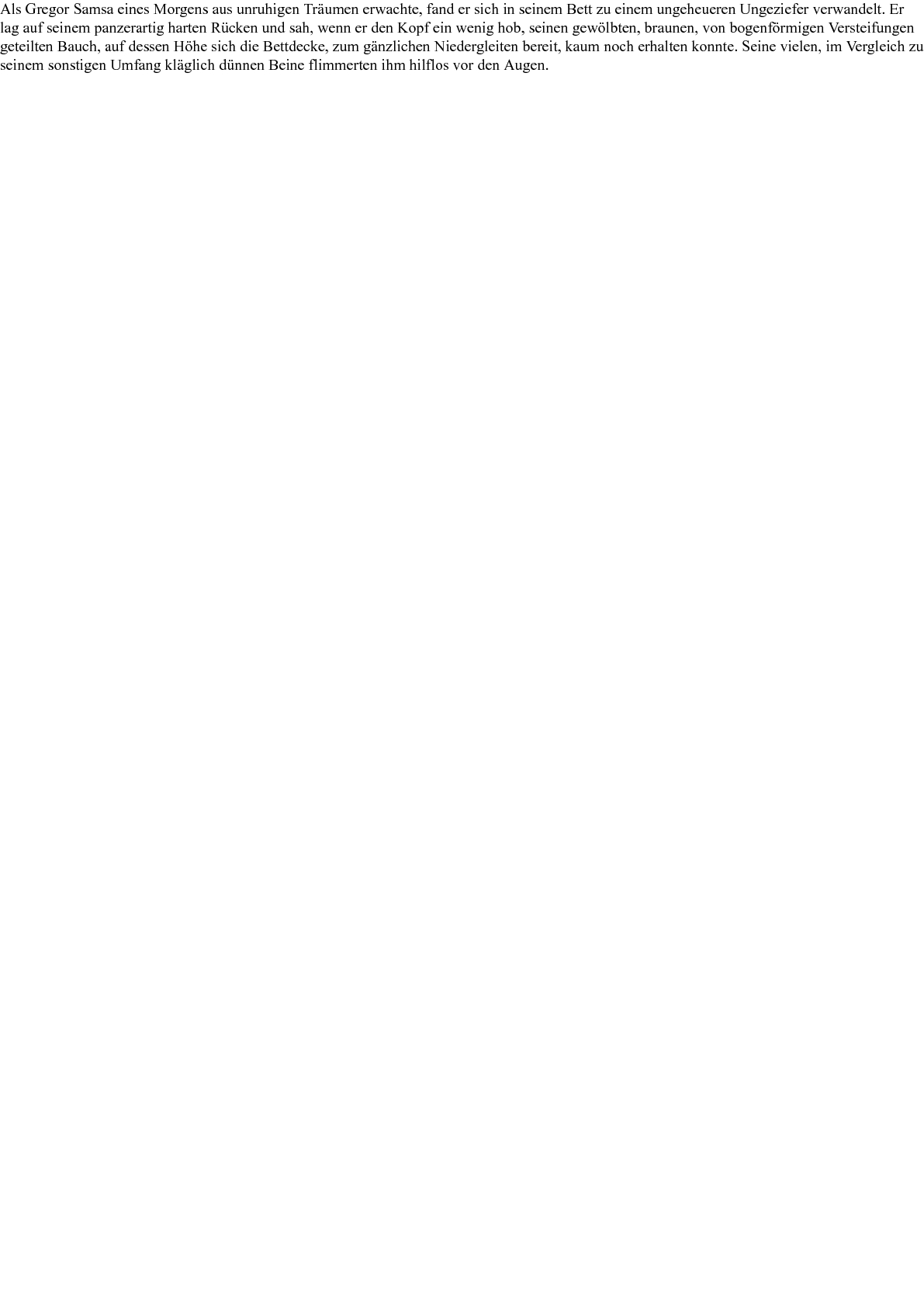
Als Gregor Samsa
                eines Morgens aus unruhigen Träumen erwachte, fand er sich in seinem Bett zu einem
                ungeheueren Ungeziefer verwandelt. Er lag auf seinem panzerartig harten Rücken und
                sah, wenn er den Kopf ein wenig hob, seinen gewölbten, braunen, von bogenförmigen
                Versteifungen geteilten Bauch, auf dessen Höhe sich die Bettdecke, zum gänzlichen
                Niedergleiten bereit, kaum noch erhalten konnte. Seine vielen, im Vergleich zu
                seinem sonstigen Umfang kläglich dünnen Beine flimmerten ihm hilflos vor den
                Augen.
</fo:block>
</fo:flow>
</fo:page-sequence>
</fo:root>In the output:
Excerpt from the W3C Recommendation: