

Publications / XML periodic table
An interactive SVG graphic with all common XML languages
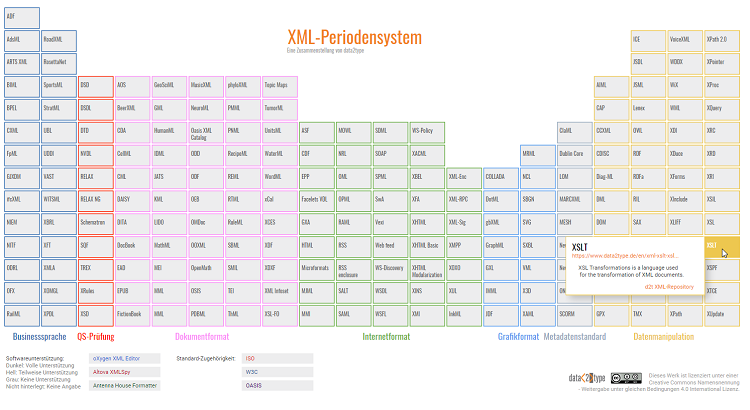
Figure: preview of the XML periodic table.
data2type has been tinkering again and would like to offer you the stylish XML periodic table free of charge for unrestricted use!
How do I get the XML periodic table?
The SVG graphic is available free under a Creative Commons license at the following links:
XML periodic table (German version)
XML periodic table (English version)


What is included?
The XML periodic table is an interactive graphic presenting a broad selection of common XML standards clearly.
To provide a quick, useful overview, the XML languages listed are divided into seven application groups also distinguished by color (from left to right):
Business language (e.g. XBRL)
Quality assurance (e.g. Schematron)
Document format (e.g. EPUB)
Internet format (e.g. HTML)
Graphics format (e.g. SVG)
Metadata standard (e.g. ONIX)
Data manipulation (e.g. XSLT)
Hovering over an XML language reveals the following information:
brief definition of the language (in English)
further link (to its Wikipedia entry, data2type’s XML online library or the language’s publisher)
link to XML Repository (a data2type online platform in beta collecting XML standard schemas in documentation)
The following figure shows the XSLT information in detail.
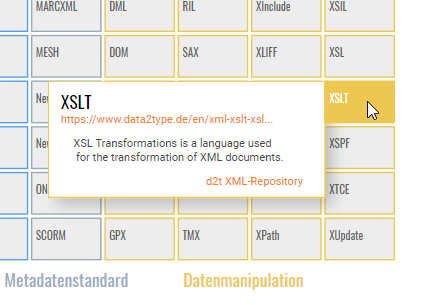
Figure: XSLT detail view.
Two more features appear below the table on the left: information on software support and standard affiliation.
Three of the most common XML programming tools are listed here: Oxygen XML Editor, Altova XMLSpy and Antenna House XSL Formatter. Hovering over the Oxygen entry, for example, highlights all XML languages supported by that software in the table, even using different brightness levels for full or partial support.
The following figure shows an excerpt of the languages supported by Oxygen.
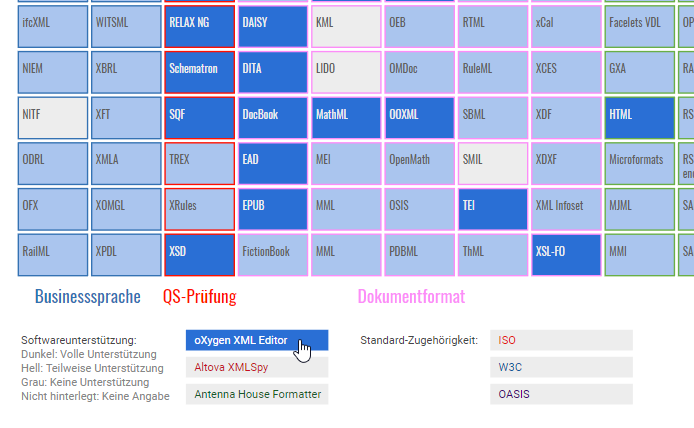
Figure: Oxygen support detail view.
To the right are the three main organizations publishing XML standards: the International Organization for Standardization (ISO), World Wide Web Consortium (W3C) and Organization for the Advancement of Structured Information Standards (OASIS). Hovering over W3C, for example, highlights all W3C standards in the table.
The following figure shows an excerpt of W3C standards.
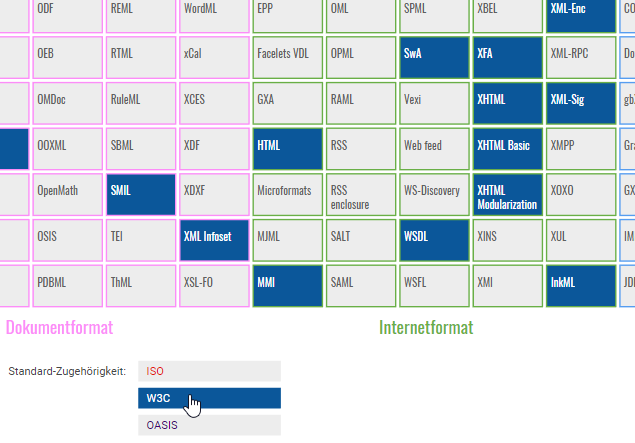
Figure: standard family detail view using W3C as an example.
How does it benefit me?
The XML periodic table primarily aims to bring visual order to the "chaos" of the vast XML world (without claiming to be complete!).
Anyone involved with XML languages soon notices how many different standards exist for very different purposes. One example is our beloved but probably less well-known BeerML, an XML standard for exchanging beer recipes.
With so many standards developed by different organizations, getting an overview can be difficult. Many are unfamiliar because their uses do not overlap with one’s own professional practice. Or a standard sounds interesting, but studying its specification ends up in the category "ToDo-List_13".
We hope this clear periodic table raises awareness of data exchange and transformation and gives the XML community a useful tool.
(It would also surely make a wonderful desktop background, screensaver or XXL poster for all you XML nerds out there.)