XML technologies / XSL-FO / Reference / Elements in XSL-FO / fo:bidi-override
(Excerpt from “XSL-FO ― The Reference” by Manuel Montero Pineda & Steffen Herkert, 2016, dpunkt.verlag)
A | B | C | D | E | F | G | H | I | J | K | L | M | N | O | P | Q | R | S | T | U | V | W | X | Y | Z
Recommendation section: 6.6.2
Category: 6.6 Inline-level Formatting Objects
Description
This element allows the desired writing direction to be set if the default Unicode bidirectional algorithm cannot be applied.
XSL-FO version: 1.0
Parent elements
<fo:basic-link> , <fo:bidi-override> , <fo:block> , <fo:folio-prefix> , <fo:folio-suffix> , <fo:index-page-citation-list-separator> , <fo:index-page-citation-range-separator> , <fo:index-page-number-prefix> , <fo:index-page-number-suffix> , <fo:inline> , <fo:leader> , <fo:marker> , <fo:multi-case> , <fo:multi-toggle> , <fo:title> and <fo:wrapper>
Child elements
This element creates a link in the document pointing to an internal or external reference. | |
This element allows the desired writing direction to be set if the default Unicode bidirectional algorithm cannot be applied. | |
This element creates a rectangular area that allows many kinds of elements, such as tables, lists and graphics. Attributes can be used to configure various aspects of its appearance. Blocks can be nested to any depth. Information from parent blocks is inherited unless different settings are specified for the child block (inheritance). | |
A block container can group any number of blocks. Attributes can be used to specify the container’s desired position in the document. | |
This element marks the start of a "change region", which is ended by its matching fo:change-bar-end. The change region has a change bar running along either the start or end edge of the column. The change bar’s appearance is determined by the values of the corresponding properties. | |
This element marks the end of a "change region" started by its matching fo:change-bar-begin. | |
This element provides separate rendering of individual characters. | |
This element inserts external graphics into the document. Attributes provide numerous configuration options. | |
This element positions content relative to a display block, for example to wrap text around graphics or create marginal notes. | |
This element creates a reference to a footnote. | |
This element groups the collections of cited page items generated by its fo:index-key-reference child elements. Ultimately, fo:index-page-citation-list is used to create a formatted list of page numbers and page ranges (a page citation list). | |
This element marks the start of an "indexed range" associated with an index key. The range is closed by a corresponding fo:index-range-end. | |
This element marks the end of an "indexed range" started by its matching fo:index-range-begin. | |
This element creates an inline area that applies separate formatting properties to specific portions of text in a block, for example to emphasize passages with italics. | |
This element creates a container in which shared settings can be applied to several inline areas. | |
This element allows inline graphics or other inline objects to be inserted into the document. | |
This element creates a line of repeated characters to separate two text formatting objects, for example headings and their page numbers in a table of contents. | |
This element creates an area for displaying a list or enumeration. | |
This element allows switching between different sets of properties. | |
This element allows switching between different subtrees of formatting objects. | |
When used inside a <fo:multi-case> element, this element provides access to other <fo:multi-case> elements. | |
This element displays the current page number in the document. | |
This element references the number of the page containing a specific formatting object, for example to display page numbers alongside headings in a table of contents. | |
This element references the number of the last page containing an area that (a) is returned by the referenced formatting object and (b) has an area-class compatible with the specified page citation strategy. | |
This element retrieves the area marked in <fo:marker>, for example for running headings. | |
Together with <fo:marker>, this element allows areas in tables to be repeated. | |
This element retrieves the scaling factor of the referenced fo:external-graphic. | |
This element creates a table. | |
This element creates a table with a caption above or below it. | |
Properties for a group of formatting objects can be specified in <fo:multi-properties>. |
Attributes
This attribute specifies the distance of a positioned object (fo:block-container) measured from the bottom edge of its immediate parent block area. | |
This attribute sets the displayed text’s color. The specified color also serves as the default for the region’s borders, if they are generated and their color is not otherwise defined. | |
This attribute sets a possibly different writing direction for an area. | |
This attribute is a shorthand font property in which the individual values for the attributes font-style, font-variant, font-weight, font-size, line-height and font-family can be specified together. Values must be specified for font-size and font-family. Values for the remaining properties are optional. Separate individual values with spaces. Only a value for line-height must directly follow the specified font-size value, separated from font-size by a slash (/) rather than a space. Alternatively, instead of assembling the properties individually, you can use system fonts if available. These already have predefined characteristics. The names of these system fonts reflect the contexts in which they are used. | |
This attribute specifies the font to use. Several fonts may be listed and tried in the specified order, allowing characters missing from one font to be taken from another. Names containing spaces, such as Times New Roman, must be enclosed in quotation marks. Multiple font names must be separated by a comma and a space. | |
This attribute defines the criteria for selecting a particular font. | |
This attribute specifies font size relative to the surrounding area, relative to the output medium’s settings, or as an absolute measurement (length). The absolute constants xx-small, x-small, small, medium, large, x-large, and xx-large represent fixed factors scaling the medium’s default font size. The relative constants larger and smaller are predefined factors applied to the surrounding area’s font size. An absolute measurement specifies the font’s maximum extent, defined as the distance between the p-line and k-line (http://de.wikipedia.org/wiki/Schriftgrad). | |
This attribute specifies a font’s x-height relative to its font size. It adjusts and harmonizes text appearance because different fonts may have different x-heights. | |
This attribute selects alternative font faces with a particular character width, allowing narrower or wider faces. Relative and absolute keywords are available. Absolute keywords expand or condense the width of normal by fixed factors (steps of 1.2, 1.2², 1.2³, and so on). Relative keywords expand or condense the width used in the surrounding area by a factor of 1.2. Formatters may also support percentage widths. | |
This attribute specifies a font style. The corresponding face may need to be available for the selected font. | |
This attribute displays small capitals. Intended for the Latin alphabet, it renders lowercase letters as capitals at lowercase height, distinguishing them from actual uppercase letters. | |
This attribute selects the font face by stroke weight (thickness). Relative and absolute keywords and certain numeric values can be specified. Absolute keywords represent fixed numeric values. Relative keywords increase or decrease the surrounding weight by 200 on the numeric scale. The scale runs from 100 to 900 in steps of 100, with 400 as normal. Few fonts provide a separate face for every step. If the required face is unavailable, the nearest available face is used. | |
This attribute uniquely identifies an object so that other objects can reference it. | |
This attribute defines an index class for individual index entries (index-key) or an entire area. All index entries in that area belong to the class. When referencing index entries (fo:index-key-reference) belonging to different classes, their page numbers are listed separately even if they are consecutive. For example, "1-8" becomes "1-4,5-8" if entries on pages 1-4 belong to one class and pages 5-8 to another. This is useful when pages are grouped into sections with different numbering systems. A range such as "I-14" can thus be avoided and replaced with "I-V,1-14". | |
This attribute defines an index entry. The supplied value is used as the entry’s identifier. An index entry reference (fo:index-key-reference) can reference all entries with this identifier and add their page numbers to a page citation list (fo:index-page-citation-list). | |
This attribute can restrict or extend an area at its left edge relative to its parent area. It takes effect only if attribute position is not static. The other values of position determine which area attribute left refers to. With no specification (0mm), the left edge equals the left edge of the parent area. A positive value reduces the area at its left edge; a negative value extends it. | |
This attribute determines the spacing between individual text characters. The spacing is fixed. For a flexible specification, the attributes letter-spacing.minimum, letter-spacing.maximum and letter-spacing.optimum can be used. | |
This attribute sets the height of text lines. For block areas, the value specifies the minimum height; for inline areas, it is used as an exact measurement. In addition, appending the components .minimum, .maximum, .optimum, .conditionality and .precedence to attribute names can establish relative conditions or priorities when conflicting specifications must be resolved, and generally accept or discard inherited settings. | |
This attribute specifies the positioning type or reference for the marked area on the page. Combined with attributes top, right, bottom and left, it allows positioning relative to the position determined by text flow, the enclosing area, or the page governing the text flow. | |
This attribute specifies how the marked area is positioned on the page. Unlike position, it only allows static placement or positioning relative to the text flow. In combination with top, right, bottom, and left, it specifies an offset from the position determined by the text flow. | |
This attribute shrinks or expands an area at its right edge relative to the parent area. It applies only when position is not static. The other values of position determine the reference area for right. Without a value (0mm), the edge coincides with the parent edge. A positive value shrinks the area at that edge; a negative value expands it. | |
If inline markup uses attribute text-decoration, this attribute specifies whether the marked whitespace is displayed as “decorated” or “undecorated”. | |
This attribute specifies the distance of a positioned object (fo:block-container) measured from the top edge of its immediate parent block area. | |
This attribute sets a writing direction different from the rest of the document, for example for Arabic passages in German text. | |
This attribute allows the spacing between words to be adjusted individually. |
Support:
Conformance level | Antenna House | FOP | RenderX XEP | Altsoft XML2PDF | Compart DocBridge |
Extended | J | J | J | J | N |
XSL-FO example:
<fo:root font-family="Arial" font-size="10pt" line-height="1.2em" xmlns:fo="http://www.w3.org/1999/XSL/Format" xmlns:cpfo="http://www.compart.net/xmlns/cpfo" xmlns:svg="http://www.w3.org/2000/svg" xmlns:axf="http://www.antennahouse.com/names/XSL/Extensions">
<fo:layout-master-set>
<fo:simple-page-master master-name="Inhalt-Seiten" margin="0mm 0mm 0mm
                      0mm" page-height="297mm" page-width="210mm">
<fo:region-body margin="26mm 55mm 41mm
                        55mm"/>
</fo:simple-page-master>
</fo:layout-master-set>
<fo:page-sequence master-reference="Inhalt-Seiten">
<fo:flow flow-name="xsl-region-body">
<fo:block>
<fo:bidi-override unicode-bidi="bidi-override" direction="rtl">
 »Was ist mit mir geschehen?«, dachte er. Es war kein Traum. Sein Zimmer, ein
                richtiges, nur etwas zu kleines Menschenzimmer, lag ruhig zwischen den vier
                wohlbekannten Wänden.
</fo:bidi-override>
</fo:block>
</fo:flow>
</fo:page-sequence>
</fo:root>In the output:

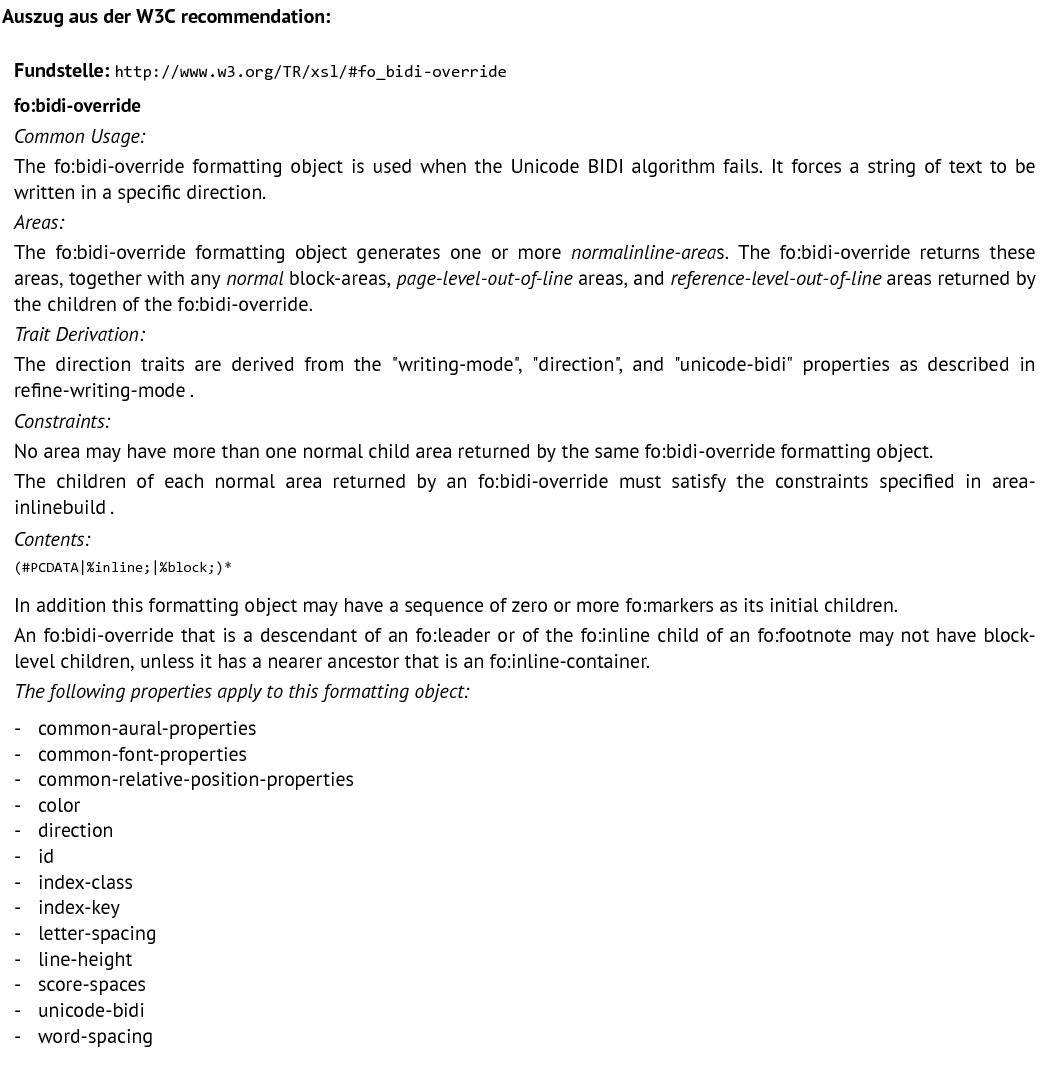
Excerpt from the W3C Recommendation: