XML technologies / XSL-FO / Reference / Elements in XSL-FO / fo:bookmark
(Excerpt from "XSL-FO ― Die Referenz" by Manuel Montero Pineda & Steffen Herkert, 2016, dpunkt.verlag)
A | B | C | D | E | F | G | H | I | J | K | L | M | N | O | P | Q | R | S | T | U | V | W | X | Y | Z
Recommendation section: 6.11.3
Category: 6.11 Formatting Objects for Bookmarks
Description
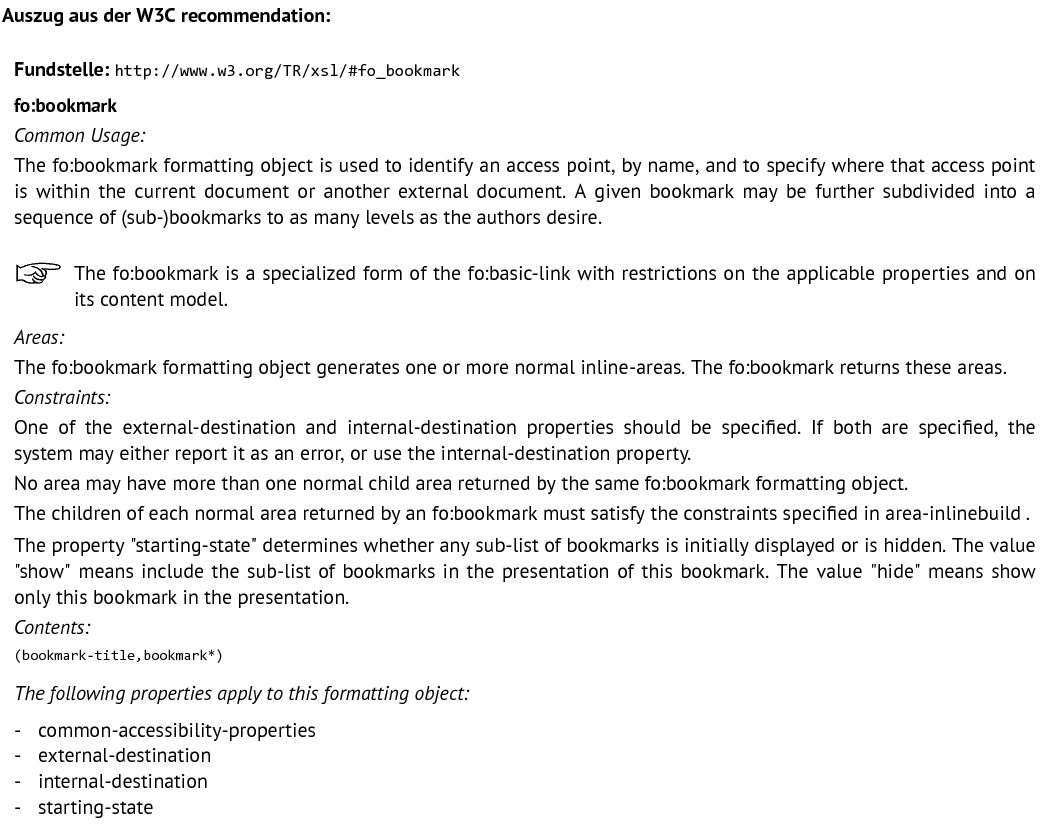
This element identifies an access point by name and specifies its location in the current document or another external document. A bookmark can be subdivided into a sequence of bookmarks or sub-bookmarks to as many levels as the author requires.
XSL-FO version: 1.1
Parent elements
This element identifies an access point by name and specifies its location in the current document or another external document. A bookmark can be subdivided into a sequence of bookmarks or sub-bookmarks to as many levels as the author requires. | |
This element contains a list of access points in the document, such as a table of contents or a list of figures or tables. Each access point is represented by a bookmark. |
Child elements
This element identifies an access point by name and specifies its location in the current document or another external document. A bookmark can be subdivided into a sequence of bookmarks or sub-bookmarks to as many levels as the author requires. | |
This element identifies an access point for a bookmark in human-readable form. |
Attributes
This attribute is a property of fo:basic-link that specifies a link’s external destination. | |
A link defined with fo:basic-link can be assigned an internal destination. Its value must match the value of an id attribute in the document. The link then points to the area containing that id attribute. | |
This attribute creates content-related identifiers that provide alternative output devices, such as audio output, with information about the XML element’s content. | |
This attribute identifies an XML document as the source document. If the renderer cannot interpret the FO document, for example for a hypothetical speech output, the source document can also be consulted. It has no practical significance. | |
In a fo:multi-switch element, only the content of the first fo:multi-case element with the starting-state attribute value show is displayed. Content of a fo:multi-case element whose starting-state attribute is hide is never displayed. For show, it matters whether this is the first fo:multi-case element in the corresponding fo:multi-switch box. |
Support:
Conformance level | Antenna House | FOP | RenderX XEP | Altsoft XML2PDF | Compart DocBridge |
Extended | Y | P | - | Y | Y |
XSL-FO example:
<fo:root font-family="Arial" font-size="10pt" line-height="1.2em" xmlns:fo="http://www.w3.org/1999/XSL/Format" xmlns:cpfo="http://www.compart.net/xmlns/cpfo" xmlns:svg="http://www.w3.org/2000/svg" xmlns:axf="http://www.antennahouse.com/names/XSL/Extensions">
<fo:layout-master-set>
<fo:simple-page-master master-name="Inhalt-Seiten" margin="0mm 0mm 0mm
                      0mm" page-height="297mm" page-width="210mm">
<fo:region-body margin="26mm 55mm 41mm
                        55mm"/>
</fo:simple-page-master>
</fo:layout-master-set>
<fo:bookmark-tree>
<fo:bookmark internal-destination="id1">
<fo:bookmark-title font-weight="bold">
Übersicht zu
                XSL-FO
</fo:bookmark-title>
<fo:bookmark internal-destination="id2">
<fo:bookmark-title font-style="italic">
 Einführung in
                die Sprache für Seitengestaltung und Umbruch
</fo:bookmark-title>
</fo:bookmark>
<fo:bookmark external-destination="http://www.antennahouse.com/">
<fo:bookmark-title>
http://www.data2type.de.com/
</fo:bookmark-title>
</fo:bookmark>
</fo:bookmark>
</fo:bookmark-tree>
<fo:page-sequence master-reference="Inhalt-Seiten">
<fo:flow flow-name="xsl-region-body">
<fo:block id="id1">
Übersicht zu XSL-FO
</fo:block>
<fo:block id="id2">
Einführung in die
                Sprache für Seitengestaltung und Umbruch
</fo:block>
</fo:flow>
</fo:page-sequence>
</fo:root>In the output:
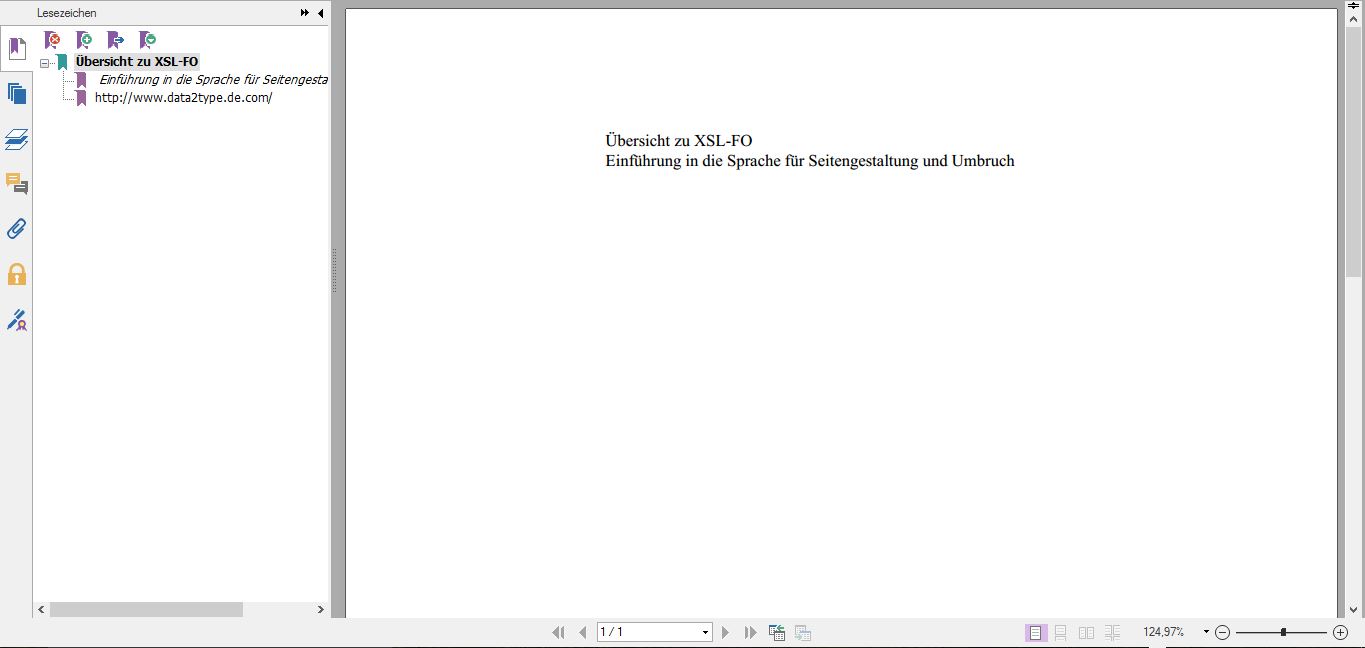
Excerpt from the W3C Recommendation: