XML technologies / XSL-FO / Reference / Attributes in XSL-FO / space-end.maximum
(Excerpt from "XSL-FO ― Die Referenz" by Manuel Montero Pineda & Steffen Herkert, 2016, dpunkt.verlag)
A | B | C | D | E | F | G | H | I | J | K | L | M | N | O | P | Q | R | S | T | U | V | W | X | Y | Z
Recommendation section: 7.12.5
Category: 7.12 Common Margin Properties-Inline
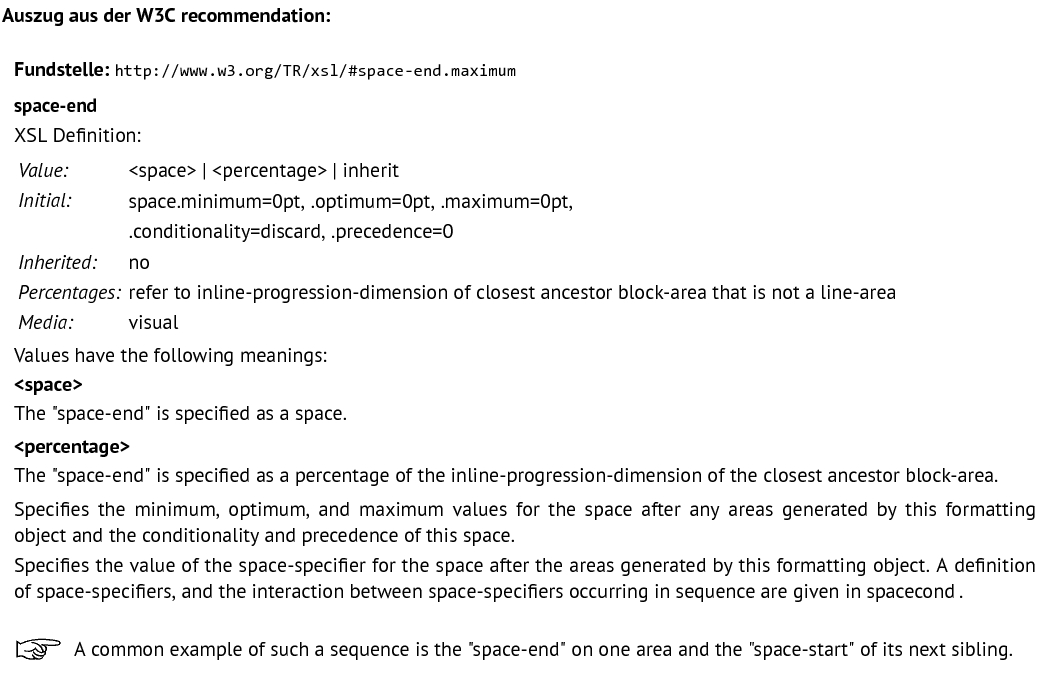
Description
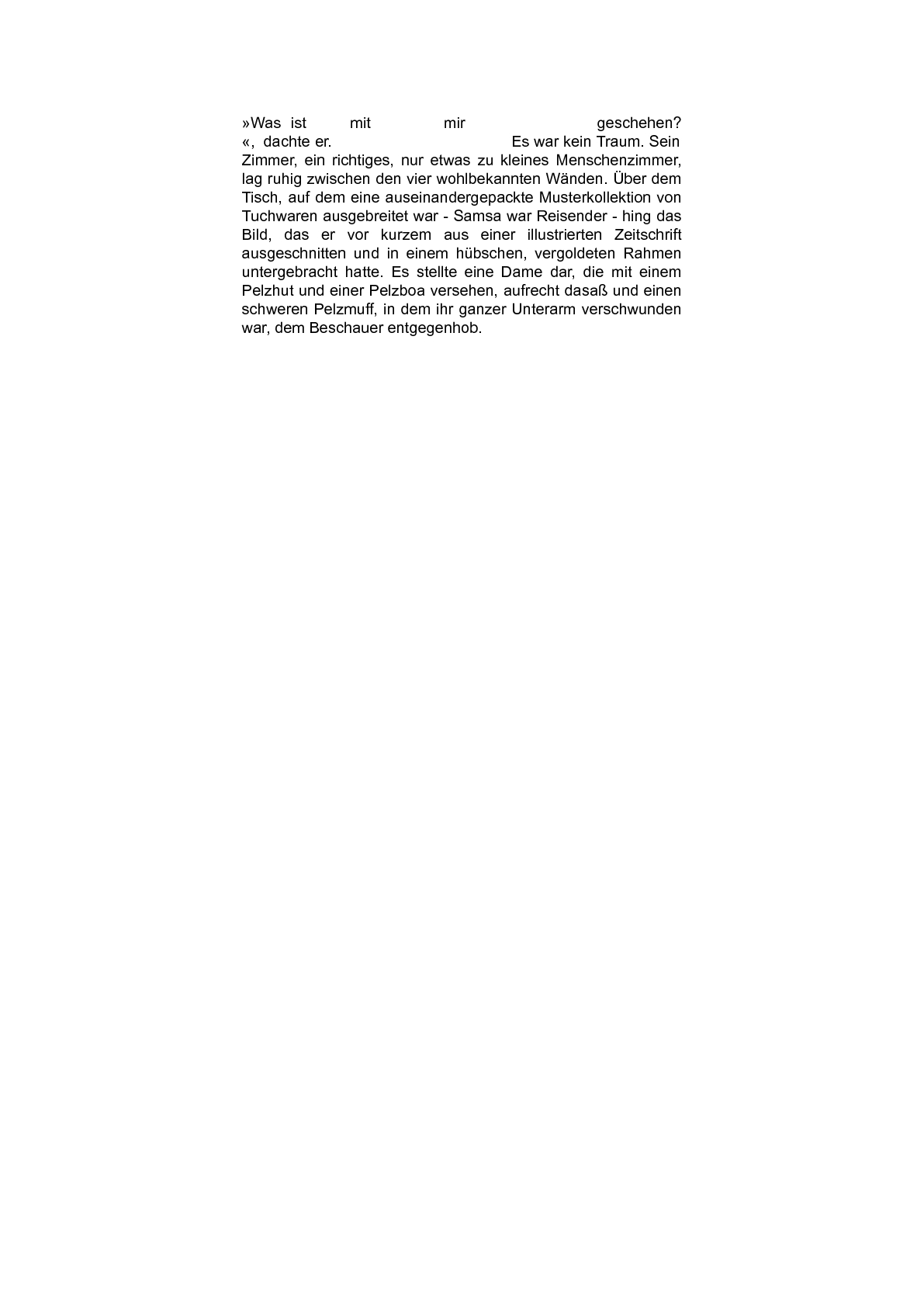
This attribute sets the maximum separation from the next inline area. When the processor distributes areas in a line automatically, it uses this as a limit. Unlike the margin attributes, this spacing is not inserted if a line break follows.
Values
Length | A length consisting of a number and a unit. Common units are mm, pt, px, cm and pc. |
Relative length | The maximum separation from the next inline area can be specified relatively. Percentages always refer to the line length. Values relative to the font size (em or ex) are also allowed. |
Default value: 0pt
XSL-FO version: 1.0
Allowed in:
<fo:basic-link> , <fo:character> , <fo:external-graphic> , <fo:inline> , <fo:inline-container> , <fo:instream-foreign-object> , <fo:leader> , <fo:page-number> , <fo:page-number-citation> , <fo:page-number-citation-last> , <fo:scaling-value-citation> and <fo:title>
Support:
Conformance level | Antenna House | FOP | RenderX XEP | Altsoft XML2PDF | Compart DocBridge |
Basic | Y | N | Y | Y | N |
XSL-FO example:
<fo:root font-family="Arial" font-size="10pt" line-height="1.2em" xmlns:fo="http://www.w3.org/1999/XSL/Format" xmlns:cpfo="http://www.compart.net/xmlns/cpfo" xmlns:svg="http://www.w3.org/2000/svg" xmlns:axf="http://www.antennahouse.com/names/XSL/Extensions">
<fo:layout-master-set>
<fo:simple-page-master master-name="Inhalt-Seiten" margin="0mm 0mm 0mm
                      0mm" page-height="297mm" page-width="210mm">
<fo:region-body margin="26mm 55mm 41mm
                        55mm"/>
</fo:simple-page-master>
</fo:layout-master-set>
<fo:page-sequence master-reference="Inhalt-Seiten">
<fo:flow flow-name="xsl-region-body">
<fo:block-container space-end.conditionality="retain">
<fo:block space-after="1em" text-align="justify" space-end="50%">
<fo:inline space-end.maximum="5mm" space-end.minimum="1mm">
»Was
</fo:inline>
<fo:inline space-end.maximum="30mm" space-end.minimum="1mm">
ist
</fo:inline>
<fo:inline space-end.maximum="30mm" space-end.minimum="3em">
mit
</fo:inline>
<fo:inline space-end.maximum="30mm" space-end.minimum="30mm">
mir
</fo:inline>
<fo:inline space-end.maximum="30mm" space-end.minimum="1mm">
geschehen?«,
</fo:inline>
<fo:inline space-end.maximum="5mm" space-end.minimum="1mm">
dachte
</fo:inline>
<fo:inline space-end.maximum="30mm" space-end.minimum="40mm">
er.
</fo:inline>
 Es war kein
                Traum. Sein Zimmer, ein richtiges, nur etwas zu kleines Menschenzimmer, lag ruhig
                zwischen den vier wohlbekannten Wänden. Über dem Tisch, auf dem eine
                auseinandergepackte Musterkollektion von Tuchwaren ausgebreitet war - Samsa war
                Reisender - hing das Bild, das er vor kurzem aus einer illustrierten Zeitschrift
                ausgeschnitten und in einem hübschen, vergoldeten Rahmen untergebracht hatte. Es
                stellte eine Dame dar, die mit einem Pelzhut und einer Pelzboa versehen, aufrecht
                dasaß und einen schweren Pelzmuff, in dem ihr ganzer Unterarm verschwunden war, dem
                Beschauer entgegenhob.
</fo:block>
</fo:block-container>
</fo:flow>
</fo:page-sequence>
</fo:root>In the output:
Excerpt from the W3C Recommendation: