XML technologies / XSL-FO / Reference / Elements in XSL-FO / fo:bookmark-title
(Excerpt from "XSL-FO ― Die Referenz" by Manuel Montero Pineda & Steffen Herkert, 2016, dpunkt.verlag)
A | B | C | D | E | F | G | H | I | J | K | L | M | N | O | P | Q | R | S | T | U | V | W | X | Y | Z
Recommendation section: 6.11.4
Category: 6.11 Formatting Objects for Bookmarks
Description
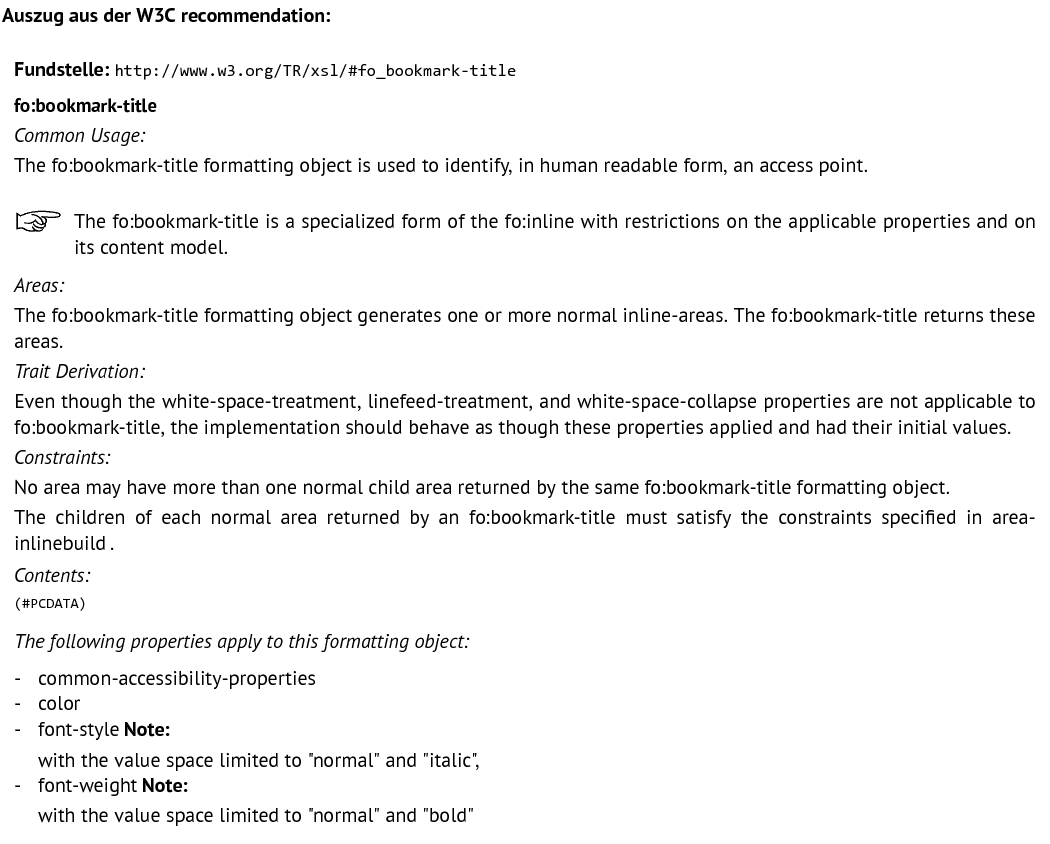
This element identifies an access point for a bookmark in human-readable form.
XSL-FO version: 1.1
Parent elements
This element identifies an access point by name and specifies its location in the current document or another external document. A bookmark can be subdivided into a sequence of bookmarks or sub-bookmarks to as many levels as the author requires. |
Child elements
Attributes
This attribute sets the displayed text’s color. The specified color also serves as the default for the region’s borders, if they are generated and their color is not otherwise defined. | |
This attribute specifies a font style. The corresponding face may need to be available for the selected font. | |
This attribute selects the font face by stroke weight (thickness). Relative and absolute keywords and certain numeric values can be specified. Absolute keywords represent fixed numeric values. Relative keywords increase or decrease the surrounding weight by 200 on the numeric scale. The scale runs from 100 to 900 in steps of 100, with 400 as normal. Few fonts provide a separate face for every step. If the required face is unavailable, the nearest available face is used. | |
This attribute creates content-related identifiers that provide alternative output devices, such as audio output, with information about the XML element’s content. | |
This attribute identifies an XML document as the source document. If the renderer cannot interpret the FO document, for example for a hypothetical speech output, the source document can also be consulted. It has no practical significance. |
Support:
Conformance level | Antenna House | FOP | RenderX XEP | Altsoft XML2PDF | Compart DocBridge |
Extended | Y | P | - | Y | Y |
XSL-FO example:
<fo:root font-family="Arial" font-size="10pt" line-height="1.2em" xmlns:fo="http://www.w3.org/1999/XSL/Format" xmlns:cpfo="http://www.compart.net/xmlns/cpfo" xmlns:svg="http://www.w3.org/2000/svg" xmlns:axf="http://www.antennahouse.com/names/XSL/Extensions">
<fo:layout-master-set>
<fo:simple-page-master master-name="Inhalt-Seiten" margin="0mm 0mm 0mm
                      0mm" page-height="297mm" page-width="210mm">
<fo:region-body margin="26mm 55mm 41mm
                        55mm"/>
</fo:simple-page-master>
</fo:layout-master-set>
<fo:bookmark-tree>
<fo:bookmark internal-destination="id1">
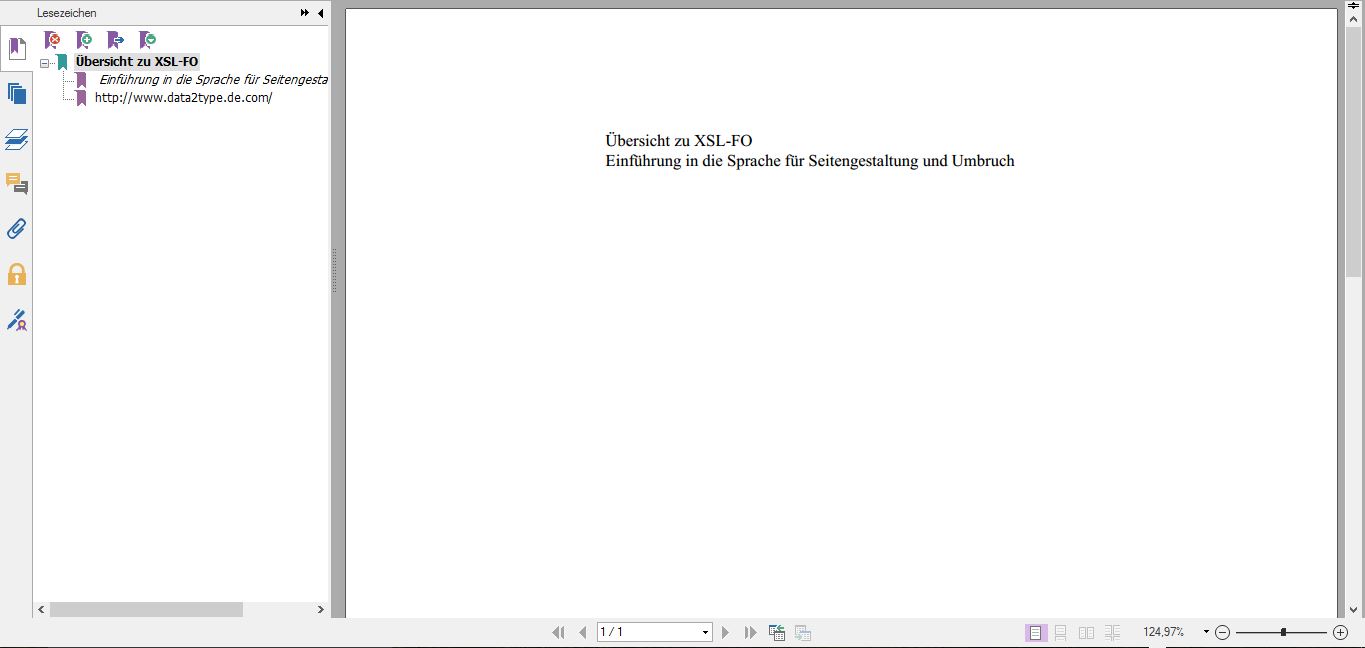
<fo:bookmark-title font-weight="bold">
Übersicht zu
                XSL-FO
</fo:bookmark-title>
<fo:bookmark internal-destination="id2">
<fo:bookmark-title font-style="italic">
 Einführung in
                die Sprache für Seitengestaltung und Umbruch
</fo:bookmark-title>
</fo:bookmark>
<fo:bookmark external-destination="http://www.antennahouse.com/">
<fo:bookmark-title>
http://www.data2type.de.com/
</fo:bookmark-title>
</fo:bookmark>
</fo:bookmark>
</fo:bookmark-tree>
<fo:page-sequence master-reference="Inhalt-Seiten">
<fo:flow flow-name="xsl-region-body">
<fo:block id="id1">
Übersicht zu XSL-FO
</fo:block>
<fo:block id="id2">
Einführung in die
                Sprache für Seitengestaltung und Umbruch
</fo:block>
</fo:flow>
</fo:page-sequence>
</fo:root>In the output:
Excerpt from the W3C Recommendation: