

Software / Octopus / Supported output formats / Educational formats
Overview of supported educational formats
In today’s digital world, providing flexible, interactive and standardised educational formats is crucial to the success of learning platforms and eLearning offerings. The following formats are specifically designed to meet the needs of learners and teachers:
LBook:
Octopus LBook is a responsive HTML5-based web format that works online and offline, supports all media formats and offers personalised learning units tailored to learners’ needs.Interactive PDF:
A format combining the functionality of a PDF document with interactive elements. Whether for self-assessment, tests with digital signatures or personalised content, interactive PDFs offer maximum flexibility.SCORM (Sharable Content Object Reference Model):
The globally recognised standard for eLearning content. SCORM enables the creation and exchange of learning materials compatible with almost all learning management systems (LMS).IMSCC (IMS Common Cartridge):
An open standard providing digital course content in a uniform structure. Ideal for integration into different LMS and easy content reuse.QTI (Question & Test Interoperability):
A standardised format for creating and exchanging tests and assessment data. QTI ensures seamless integration and validity in all common LMS.H5P:
Interactive learning modules that make learning exciting and engaging. H5P can create interactive videos, quizzes, presentations and much more – ideal for modern, dynamic learning.
Adaptive learning
Octopus provides a technical data and output foundation for adaptive learning, further developing and implementing the theory of object-oriented publishing.
Adaptive learning is an established concept in education (and marketing) according to which the way knowledge is conveyed must be adapted to learners’ knowledge, learning preferences and environment to achieve comparable learning outcomes for everyone (source: Wikipedia: Adaptive learning).
Using artificial intelligence, the Semantic Web, metadata in different formats and XML databases, Octopus therefore has the potential to display learning content adapted and individualised for each user, improving individual learning outcomes. As on Amazon, learners can also be shown suggestions about further topics of interest in the learning material or areas where their knowledge still has gaps.
The following use scenarios for Octopus educational formats are among the possible scenarios:
Teachers independently create tasks and tests through Octopus for school lessons or students’ self-study at home. Students log into a learning platform to access them.
Learners can submit online tests for teaching staff to mark.
Textbook publishers supplement their print offerings with digital content through websites or apps, allowing students to work through lessons and exercises online or offline (see LBook).
Online learning and e-testing platforms extend their offerings with, for example, interactive exercise PDFs, apps, websites, audio content, translated or multilingual content, linked content and content adapted to each user.
Customised AI bot – the personal learning assistant
Another Octopus highlight is its individually customisable chatbot. This intelligent assistant revolutionises how learners interact with content.
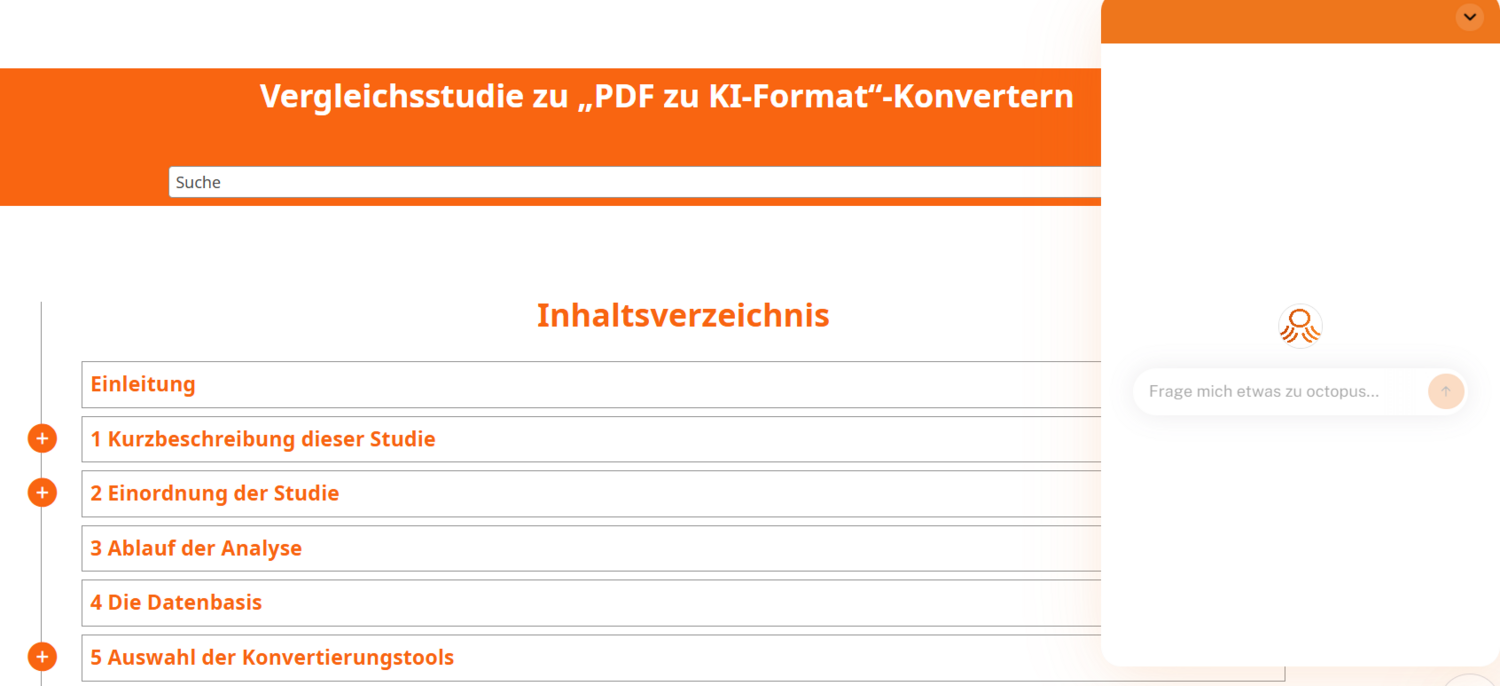
Fig.: Example AI chatbot window on the right in LBook.
The bot offers the following functions and benefits:
Personalised support: The AI bot is tailored to specific content and requirements. It provides answers, explains concepts and helps learners navigate complex topics.
Automated indexing and enrichment: The chatbot analyses documents and enriches them with keywords, index entries and metadata, ensuring that answers are optimally structured and easy to find.
Interactive communication: Engaging, motivating learning experiences let learners ask questions in real time, solve tasks or request summaries.
Regular fine-tuning: The AI bot is continuously updated with new content to stay current and provide the best possible support.
Flexibility: Support for online and offline learning.
Interoperability: The bot can be seamlessly integrated into different platforms, including LMS, websites and other digital environments.
Multilingual support: The AI bot supports multiple languages, making it widely usable for international audiences.
Scalability: The AI bot suits different requirements, from small learning groups to large organisations.
Data protection and security: The bot complies with strict data protection policies and ensures the security of sensitive data.
Octopus’s supported educational formats and customised AI bot enable learning content to be created, managed and distributed efficiently. For schools, universities, businesses or individual learners, our solutions provide the perfect foundation for successful learning in the digital age.