

Software / XSL Formatter

Antenna House’s XSL Formatter is the first and only tool that automatically processes and typesets even highly complex works
on the basis of the XSL-FO standard.
You can compare the Formatter’s XSL-FO support with other formatters on our formatter comparison page. It meets all print-related requirements of versions 1.0 and 1.1 of the XSL-FO standard. The Formatter also offers numerous additional functions outside the XSL-FO standard that are essential for professional typesetting.
What is XSL-FO?
XSL-FO (eXtensible Stylesheet Language - Formatting Objects) is an XML markup language. XSL-FO is a W3C standard. Version 1.0 was published as a Recommendation on 15 October 2001 and version 1.1 on 5 December 2006.
Page setup is central to XSL-FO. Page width and height can be freely chosen. An XSL-FO page can be divided into five regions: header, footer, left and right margins, and the “body” region reserved for the actual content. Different pages or page masters can then be combined into a page sequence, such as alternating left- and right-hand pages.
More detailed layout specifications are also possible. For example, rules can precisely control line breaking (with hyphenation in all languages), column breaking and page breaking.
The elements and attributes defined in XSL-FO can implement all major typographic requirements.
Concepts supported by XSL-FO include:
Page regions, margins and areas
Page width and height
Page sequences
Page numbering
Paragraphs, lists and tables
Borders, spacing, columns and blocks
Text formatting, including typesetting styles and hyphenation
Lines, images and other objects
and much more...
A detailed introduction to XSL-FO is available on our information pages.
The following graphic shows the complete workflow of automated formatting with XSL-FO. Processing takes place in several steps that, in practice, run fully automatically in the background, invisibly to the end user.
The starting point is two files: the XML document to be output and the XSL-FO stylesheet containing all formatting rules.
The XSL-FO workflow:
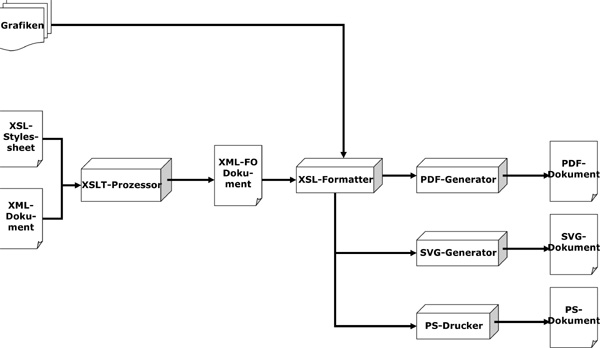
First, the two source files are loaded into an XSLT processor. This processor applies the rules defined in the XSL-FO file to the XML document. The result is a document referred to here as “XML-FO” (the file contains only elements and attributes defined in the XSL-FO standard). This XML file conforms to the W3C’s XSL-FO standard and contains all formatting properties and content to be output. This first step is where the actual automation takes place. For example, chapter headings are collected here and made available for a table of contents.
The generated XML-FO file, by contrast, is static. It is comparable to an HTML file, which is also static and is displayed only when loaded into a browser. The XML-FO file is likewise interpreted by a program, called a “formatter” or “renderer”. Programs such as XSL Formatter load an XML-FO file, calculate line and page breaks and hyphenation, and embed graphics, among other tasks.
In a final step, this XSL-FO formatter can generate various output formats. The graphic shows three examples. PDF is probably the most frequently used format; it can be linked fully automatically and provided with the appropriate bookmarks. These and other features are not part of the XSL-FO standard, but extensions supplied by XSL Formatter. Suitable printer drivers can also generate RTF, text, AFP, Postscript and many other formats.
Benefits of XSL-FO
Standardisation
Since XSL-FO is an international standard, you are not dependent on a single product and can switch formatters at any time. Further details are available on our page about XSL-FO support provided by different formatters and in our price list. Based on this price list, you can order all products directly from our partner. The benefits: you have a German business partner, pay in euros in Germany and, above all, have a competent contact in Germany for questions and support. The maintenance agreement provides German-language support with a guaranteed response within one working day.