XML technologies / XSL-FO / Reference / Attributes in XSL-FO / wrap-option
(Excerpt from "XSL-FO ― Die Referenz" by Manuel Montero Pineda & Steffen Herkert, 2016, dpunkt.verlag)
A | B | C | D | E | F | G | H | I | J | K | L | M | N | O | P | Q | R | S | T | U | V | W | X | Y | Z
Recommendation section: 7.16.13
Category: 7.16 Block and Line-related Properties
Description
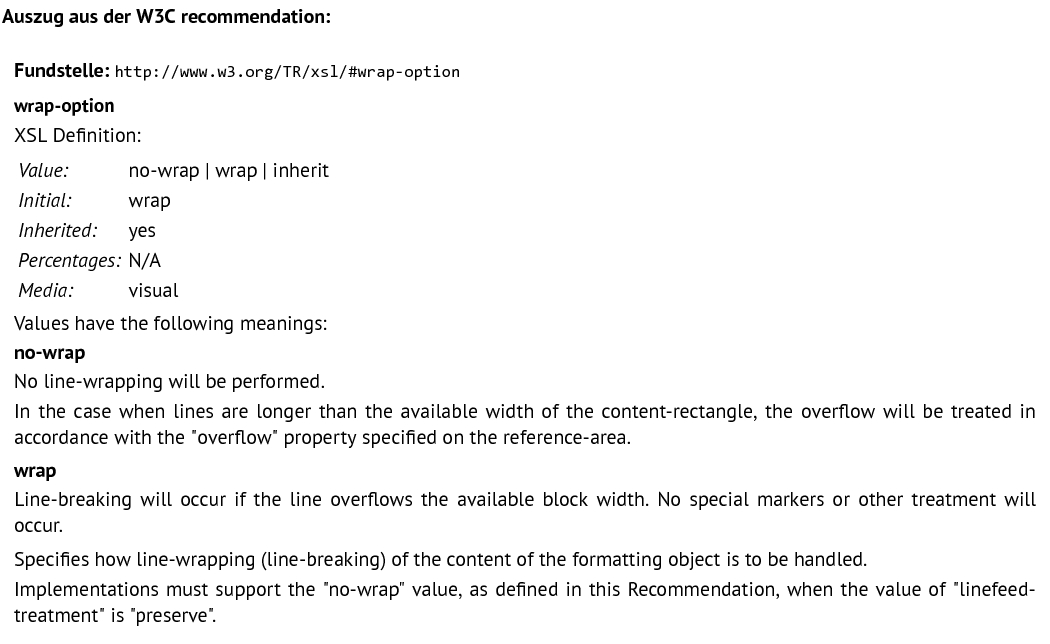
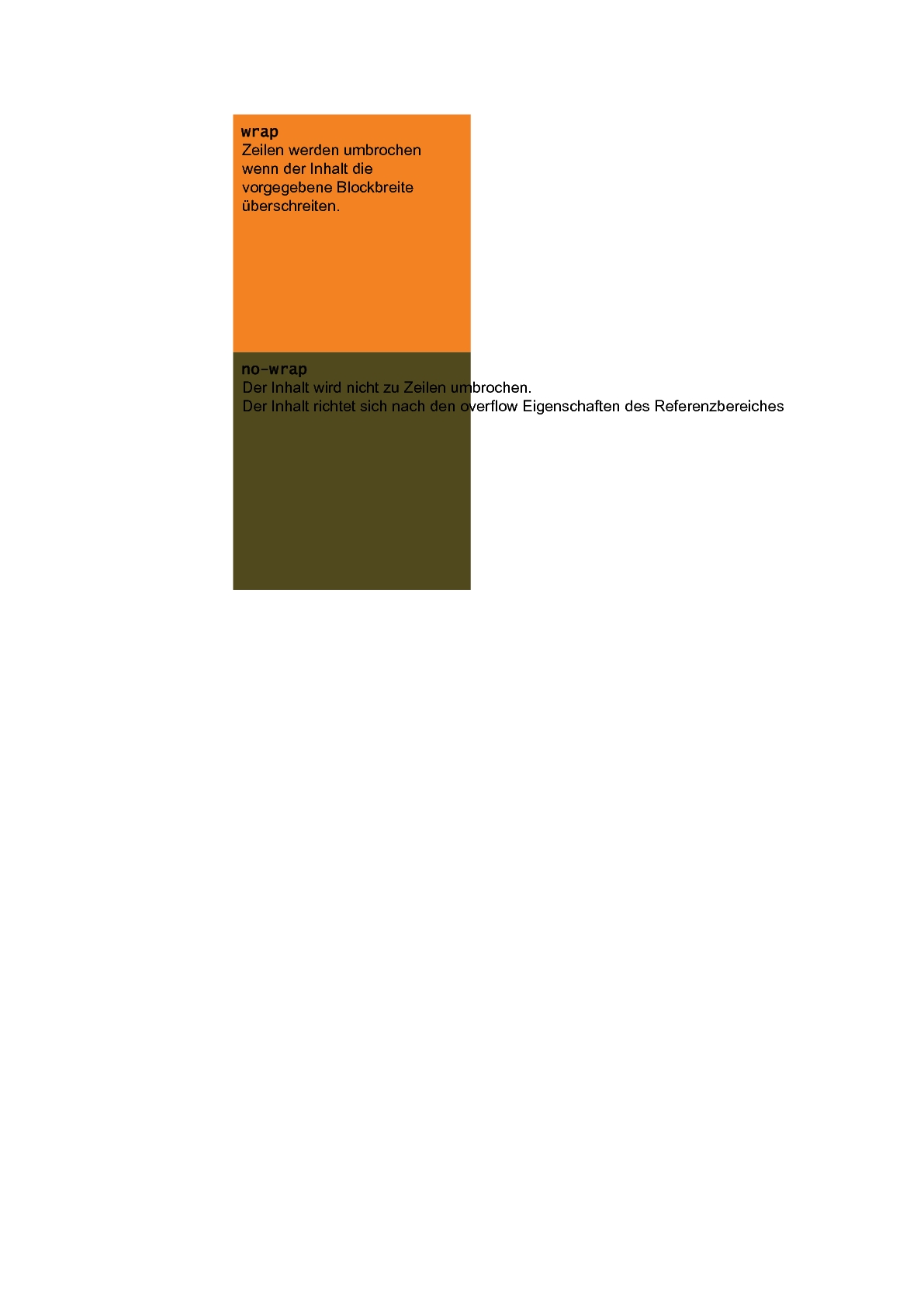
This attribute specifies whether line wrapping should be suppressed even when the defined block width is exceeded.
Values
no-wrap | Line breaks are suppressed. |
wrap | Line breaks are inserted automatically. |
Inherited: | yes |
Default value: wrap
XSL-FO version: 1.0
Allowed in:
This element creates a rectangular area that allows many kinds of elements, such as tables, lists and graphics. Attributes can be used to configure various aspects of its appearance. Blocks can be nested to any depth. Information from parent blocks is inherited unless different settings are specified for the child block (inheritance). | |
This element creates an inline area that applies separate formatting properties to specific portions of text in a block, for example to emphasize passages with italics. | |
This element displays the current page number in the document. | |
This element references the number of the page containing a specific formatting object, for example to display page numbers alongside headings in a table of contents. | |
This element references the number of the last page containing an area that (a) is returned by the referenced formatting object and (b) has an area-class compatible with the specified page citation strategy. | |
This element retrieves the scaling factor of the referenced fo:external-graphic. |
Support:
Conformance level | Antenna House | FOP | RenderX XEP | Altsoft XML2PDF | Compart DocBridge |
Basic | Y | P | Y | Y | Y |
XSL-FO example:
<fo:root font-family="Arial" font-size="10pt" line-height="1.2em" xmlns:fo="http://www.w3.org/1999/XSL/Format" xmlns:cpfo="http://www.compart.net/xmlns/cpfo" xmlns:svg="http://www.w3.org/2000/svg" xmlns:axf="http://www.antennahouse.com/names/XSL/Extensions">
<fo:layout-master-set>
<fo:simple-page-master master-name="Inhalt-Seiten" margin="0mm 0mm 0mm
                      0mm" page-height="297mm" page-width="210mm">
<fo:region-body margin="26mm 55mm 41mm
                        55mm"/>
</fo:simple-page-master>
</fo:layout-master-set>
<fo:page-sequence master-reference="Inhalt-Seiten">
<fo:flow flow-name="xsl-region-body">
<fo:block-container keep-together.within-line="1">
<fo:block-container top="25mm" left="25mm" height="50mm" width="50mm" z-index="2" writing-mode="lr" background-color="#F38222" padding="2mm">
<fo:block font-family="Arial Unicode
                    MS" wrap-option="wrap">
<fo:inline font-weight="bold" font-family="lucida console">
wrap
</fo:inline>
<fo:block/>
Zeilen werden
                umbrochen wenn der Inhalt die vorgegebene Blockbreite überschreiten.
</fo:block>
</fo:block-container>
<fo:block-container top="100mm" left="25mm" height="50mm" width="50mm" z-index="2" writing-mode="lr" background-color="#4F491D" padding="2mm">
<fo:block font-family="Arial Unicode
                    MS" wrap-option="no-wrap">
<fo:inline font-family="lucida
                    console" font-weight="bold">
no-wrap
</fo:inline>
<fo:block/>
Der Inhalt wird nicht zu Zeilen umbrochen.
<fo:block/>
Der Inhalt richtet sich nach den overflow Eigenschaften des Referenzbereiches
</fo:block>
</fo:block-container>
</fo:block-container>
</fo:flow>
</fo:page-sequence>
</fo:root>In the output:
Excerpt from the W3C Recommendation: