

Publications / Review: XSLT 2.0 & XPath 2.0
Author: Frank Bongers
Contents
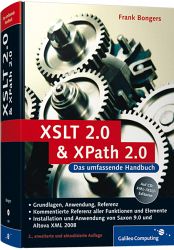
The book offers a comprehensive introduction to the complex subject of transforming XML data with XSLT. It extensively describes all XSLT language elements and instructions and the elements and functions of the XPath path-description language.
Three clearly organized chapters first explain XSLT 2.0 and XPath 2.0 fundamentals, providing an accessible introduction. Exercises with solutions then deepen understanding.
The handbook continues with a comprehensive XPath 2.0 grammar reference covering expression and path syntax, axes, location steps and operators. It also compares XPath 2.0 with XPath 1.0.
A complete annotated reference to all 122 XPath 2.0 functions complements the grammar reference, examining function arguments, return values and usage examples in detail.
A complete annotated reference to all XSLT 2.0 elements follows, covering all 49 instructions and every attribute. The author then presents usage examples and a comparison with XSLT 1.0.
The next section provides a reference to the XSLT processors Saxon and AltovaXML, with Saxon 9 installation and usage guidance, command-line options and further AltovaXML 2008 installation notes, including invocation and command-line options.
The final chapter introduces current XSLT 2.0 development environments, examining Oxygen-XML Editor 9.0, Stylus Studio 2008 and Altova XMLSpy 2008.
The appendix offers valuable guidance and solutions for the book’s examples and exercises, plus important W3C online resources. An extensive glossary completes the work.
About the author
Frank Bongers works as a freelance web designer, author and web programming instructor in Berlin, where he lives. He has worked on XML and XSLT development since 1999. Alongside this handbook, his current books "Einstieg in TYPO CMS 6", "jQuery - Das Praxishandbuch" and "HTML, XHTML, CSS - Handbuch und Referenz" were published by and are available from Galileo Computing (Rheinwerk Verlag since 2015).
next >> |