

Publications / Review: XSL-FO in der Praxis
XML processing for PDF and print
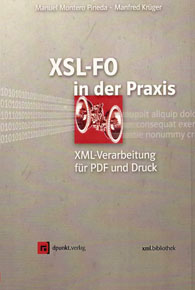
Authors: Manuel Montero Pineda and Manfred Krüger
Contents
Automatically turning XML-structured data into sophisticated page designs was extremely difficult with earlier technologies. The W3C standard eXtensible Stylesheet Language XSL and its Formatting Objects (XSL-FO) changed this. Powerful typesetting and pagination systems now support XSL-FO and produce attractive print and PDF products from XML data.
This book shows how to use XSL-FO for these purposes and realize its technical and economic benefits in practice. It focuses on providing extensively commented building blocks for creating powerful custom design templates (XSL style sheets) for PDF or print output.
A fundamentals section gives a concise, clear introduction to data transformation (XSLT) and data access (XPath), as well as XSL-FO processing. The core XSL-FO technology and its typesetting potential are described in detail. An extensive reference section covers all XSLT, XPath and XSL-FO constructs with German descriptions and explanations.
The book particularly addresses typesetting professionals and typographers in publishing and the graphic arts industry, as well as programmers preparing XML data for print or online PDF.
About the authors
Manuel Montero Pineda studied history, psychology and education in Heidelberg. After postgraduate computer science studies at FH Heidelberg, he worked in technical documentation and then joined MID/Information Logistics Group. There he focused mainly on XSL style sheet programming and Java and VB development. Since March 2005 he has been self-employed and the owner of data2type GmbH.
Dr. Manfred Krüger originally trained as a publishing bookseller, then studied business administration and worked as a research assistant at the University of Mannheim. He has been self-employed since 1983 and runs Heidelberg-based MID/Information Logistics Group. His main areas of work are SGML/XML, XSL and the industrialization of documentation and publishing.