

XML technologies / DITA / DITA authoring environments / Syntext Serna
(Excerpt from “DITA – Der neue Standard für Technische Dokumentation” by Johannes Hentrich)
The XML editor Syntext Serna from Syntext Inc. is available for Mac, Windows and Linux. Mac and Linux users can therefore also work with an XML editor for creating and editing DITA XML files, maps and bookmaps. Since the DITA Open Toolkit is also available for these three platforms, Syntext Serna can produce all output formats for which the toolkit provides stylesheets.
Syntext Serna has an exceptionally rich graphical interface. Its WYSIWYG editor offers practically all the facilities familiar from conventional word processors. It remains a native XML editor, however, allowing only operations valid in the context of a DTD. For example, it checks whether an attribute conref can be used at the desired location.
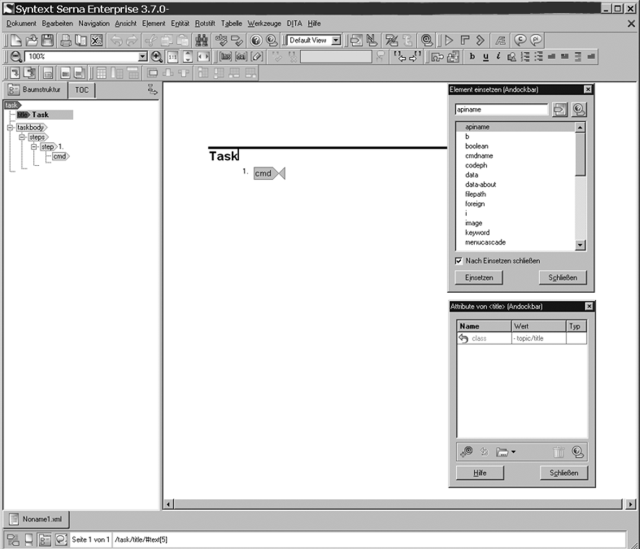
Figure: A task topic in Syntext Serna.
The current Syntext Serna version, 3.8, supports DITA 1.0 and 1.1 as well as other XML standards such as DocBook, TEI (Guidelines for Electronic Text Encoding and Interchange) and NITF (News Industry Text Format).
Syntext Serna fully integrates the DITA Open Toolkit. Its installation directory contains, under the /plugins/dita directory, the complete toolkit package for both DITA 1.0 and 1.1.
Newer versions of the DITA Open Toolkit can be stored in the /plugins/dita directory. Unless the new toolkit includes updated DITA DTDs, which normally happens only with a new DITA version, simply overwriting the existing toolkit directory is recommended. In Syntext Serna, the toolkit’s XML Schema files are linked to templates that make XML document creation and editing more convenient. Overwriting toolkit files in the /plugins/dita directory therefore preserves use of the existing templates.
New XML documents can also be created directly through a DTD rather than a template. However, this significantly reduces conveniences such as Syntext Serna’s WYSIWYG facilities. Functionality remains intact, but convenience suffers.
Producing output with Syntext Serna through the DITA Open Toolkit requires installation of the Java Development Kit. Installation instructions are provided in DITA Open Toolkit.
A standard Syntext Serna installation can produce the following output through the DITA Open Toolkit:
HTML files,
PDF files with the XSL-FO formatter Apache FOP.
Syntext Serna also supports PDF production through the RenderX XEP Engine and Antenna House XSL Formatter XSL-FO formatters. These must be installed and the corresponding environment variables set.
To work with specializations, Syntext Serna needs their XML Schema files. Syntext provides the program Dtd2Xs to generate the corresponding XML Schema files from DTDs. Since DTDs are currently more commonly used than XML Schema files for specialization, using DTDs and the program Dtd2Xs is also recommended for Syntext Serna.
Specialized XML Schema files let you create and edit XML documents directly in Syntext Serna. To use the editor’s full capabilities, link these files to a template. Templates store information such as metadata, WYSIWYG parameters and output parameters.
Syntext Serna supports a WebDAV file system when an internet connection is available. WebDAV (Web-based Distributed Authoring and Versioning) is a standard based on the internet protocol HTTP (Hypertext Transfer Protocol) for making files available over the internet. Users can store data as on an online disk. Its version control also makes WebDAV suitable for workgroup file management.
Copyright © 2008 XLcontent Verlag
You may print the online version for your private use.
Otherwise, this chapter from “DITA - Der neue Standard für Technische Dokumentation” is subject to the same conditions as the bound edition. The work, including all its parts, is protected by copyright. All rights reserved, including reproduction, translation, microfilming, and storage and processing in electronic systems.
XLcontent Verlag, Pflegerstraße 40, 81247 München
back to top