

XML technologies / SVG / Using complex graphic elements and formatting / Creating complex elements with Bézier curves / The G is the most complicated
(Excerpt from “Das Einsteigerseminar SVG — Webgrafiken mit XML” by Helma Spona)
The difficulty with the letter G is assembling it from many small pieces. Use a grid here too, so you can experiment with settings without later surprises caused by incorrect size or proportions.
Rotate the upper and lower arcs of the G relative to each other to obtain a smooth transition. Inserting a vertical line between the arcs also improves its appearance. The G shown below requires this code:
<desc>Der Buchstabe G</desc>
<g transform="translate(50,250)">
  <path id="konstruktion" d="M0 0 h+130 m-30 +0 v+140 m+30 -20 h-130 v-120 m 0 +50 h+130" style="stroke:gray;fill:none"/>
  <path d="M55 50 h+40 a10 5 0 0 1 +5 +5 v+5 A50 65 0 0 1 0 50 v-5 A35 25 -17 1 1 100 30 a10 5 0 1 1 -20 +0 A25 15 -25 1 0 20 50 v+3 A25 32 -15 1 0 80 75 a10 5 0 0 0 -5 -5 H55 a5 10 0 0 1 0 -20" style="stroke:rgb(0,0,0);stroke-width:1;fill:none"/>
</g>
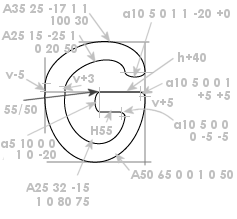
Figure: The G consists of 13 segments in total.
Copyright © verlag moderne industrie GmbH 2001
You may print the online version for your private use.
Otherwise, this chapter from “Das Einsteigerseminar SVG — Webgrafiken mit XML” is subject to the same conditions as the bound edition. The work, including all its parts, is protected by copyright. All rights reserved, including reproduction, translation, microfilming, and storage and processing in electronic systems.
verlag moderne industrie GmbH, Justus-von-Liebig-Straße 1, D-86899 Landsberg/Lech, fon ++49 (0) 81 91 / 125 – 0, leserservice(at)mi-verlag.de
back to top