

AI & XML / LLM test suite / Methodology study / 4 Capability model and test dimensions
This chapter classifies Testsuite cases by the capabilities examined: domain and standards competence, semantic skills, robustness to representation, formal output quality and operational properties.
Why a capability model is needed
A long format list does not explain what a model must do. The Testsuite organizes tasks by capability, using formats, standards and domains as test subjects.
The model has three main dimensions and several cross-cutting dimensions.

Figure: domain competence, semantic skills and representation robustness are the main dimensions. Formal output quality and operational properties are cross-cutting.
Dimension A: domain and standards competence
This tests practical application of a technical or domain subject.
Examples include:
Area | Examples |
|---|---|
XML languages | XPath, XSLT, XSD, Schematron |
Publishing standards | |
Metadata | Dublin Core, MARC21, LOM |
Web and syndication | |
Knowledge representation | RDF/XML, Turtle, XBRL |
Learning technologies | QTI, DITA Learning and Training |
Health | FHIR, ICD-11, HFIR-related structures |
Standards knowledge has levels: explaining a term, generating a minimal example or creating a complete valid structure with correct namespaces, versions and required components. Tests should assess these levels separately.
Dimension B: semantic and general capabilities
These capabilities are not tied to a single format.
Capability | Typical task |
|---|---|
Extraction | Find a value, person, place or bibliographic reference |
Classification | Assign a case to a category or code |
Structural understanding | Correctly associate hierarchies, table headers, footnotes or references |
Applying rules | Execute several conditions and calculate a target result |
Entity recognition | Recognize people, places, organizations or identifiers |
Transformation | Convert content into a required target vocabulary |
Instruction following | Generate only the requested output |
Multilingual capability | Preserve content and original spelling in several scripts |
The Testsuite can examine one semantic capability in multiple representations, distinguishing task-logic errors from presentation effects.
Dimension C: representation robustness
This examines capability stability when presentation changes.
Examples include:
comma vs. semicolon in CSV,
indented vs. compact XML,
HTML header cells with
tdvs.th,simple vs. spanning tables,
short vs. long context,
text vs. XML, JSON, YAML or Markdown,
Latin vs. non-Latin or right-to-left content.
Robustness is not an optional extra: it determines whether production works only on carefully prepared inputs or also on heterogeneous source data.
Cross-cutting dimension: formal output quality
Many tasks are usable only if output is machine-processable. Correct information can be unusable when a model adds explanations, Markdown code blocks or invalid XML.
Formal quality includes:
syntax and well-formedness,
correct namespaces,
standard versions,
required structures,
exact field names,
allowed additional information,
adherence to a required response format.
Cross-cutting dimension: operational properties
A model can suit the domain but not operations. The Testsuite also records:
technical success rate,
timeouts and empty answers,
median runtime,
P95 runtime,
answer length,
variation across repetitions,
differences by execution route.
These are not domain capabilities but affect deployment decisions.
Categories as multidimensional tags
Cases can have multiple categories. A spanning CALS table test may belong to xml, cals and table. A JATS literature task may combine xml, jats, semantics, multilingual and nonlatin.
Multiple categories support flexible analysis but are not disjoint: summing categories can count a run more than once. Categories are filters and perspectives, not additive subdivisions of the whole.
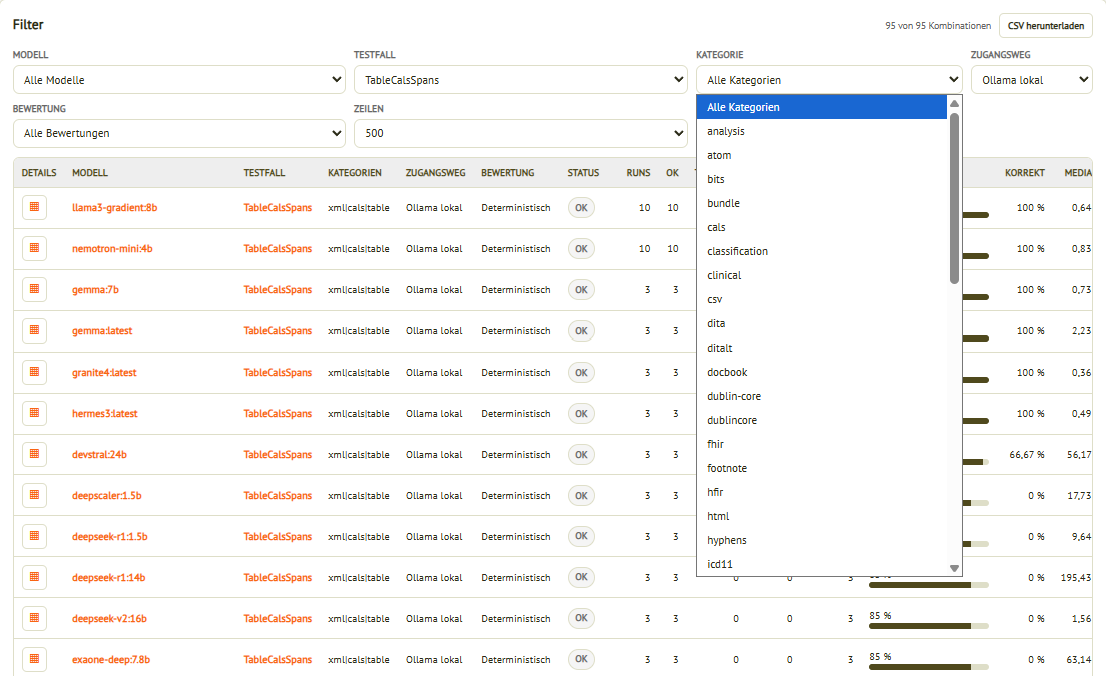
Figure: the category filter shows the multidimensional taxonomy. Categories describe domain, format, capability or task character and can coexist on a case.
Categories also help explore new questions. Users can view all tests with semantics, all tests with fhir or combinations of xml and table.
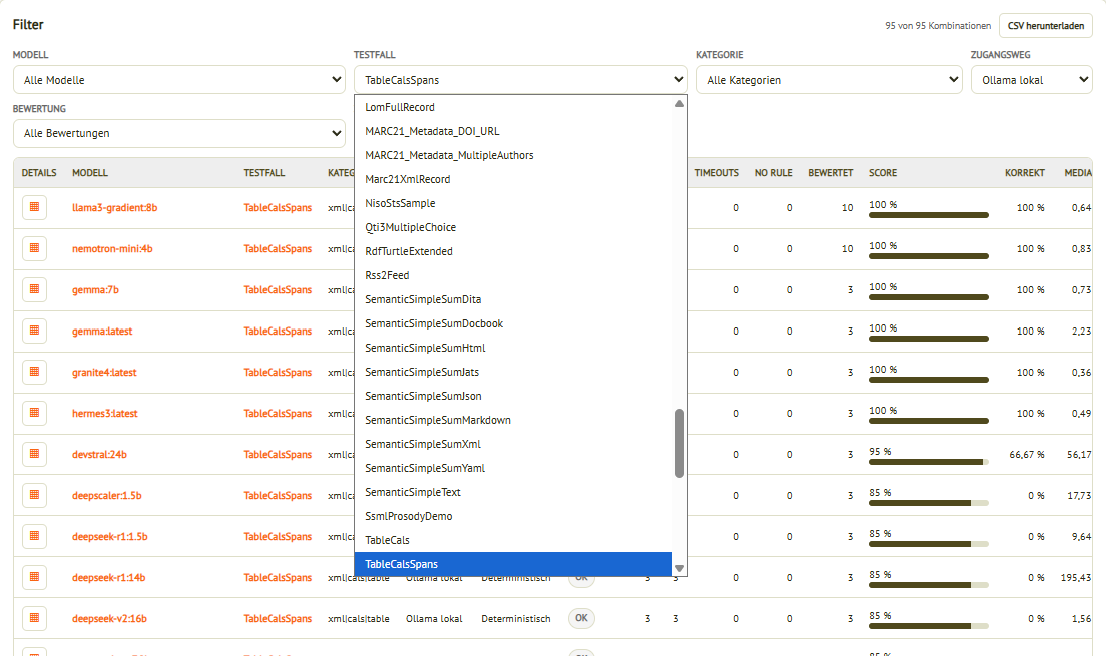
Figure: the test view can narrow the results matrix to one category, producing capability-specific comparisons rather than one global ranking.
Future capabilities
The model is open. New series can add capabilities absent or partially covered today, such as:
XPath 3.0 and XPath 3.1 with sequences, Maps, arrays and functions,
XQuery 3.1,
XSLT 3.0 with Streaming, Packages or Higher-Order Functions,
Schematron QuickFix (SQF),
SPARQL and SHACL,
tool use and structured function calls,
multistep agentic workflows,
validation and self-correction,
RAG tasks with controlled chunk strategy variations.
New tests should identify their capability, confounders and supporting evaluation.
Competence levels within a standard
Standard knowledge is not binary. At least five levels often exist:
Level | Observable performance |
|---|---|
Terminology knowledge | Explain purpose and basic concepts. |
Structure recognition | Recognize typical elements, attributes and relationships. |
Minimal generation | Generate a simple, plausible example. |
Conformant application | Meet required structures, namespaces and domain requirements. |
Complex application | Reliably solve nested, multipart or version-specific tasks. |
Generating minimal RSS does not imply mastering all variants; well-formed JATS does not imply semantically correct scholarly markup. Series should reveal these levels.
Knowledge, transformation and validation
Technical tasks involve three subskills:
Knowledge of concepts and rules.
Transformation of concrete inputs into a required structure.
Validation to detect and possibly correct errors.
A model can differ across these skills: explain XPath 3.1 correctly yet generate an unsuitable expression, or generate XML while missing an existing namespace error. Future series should separate these roles explicitly.
Capability profiles for applications
Dimensions form a profile, not one universal competence measure. RAG may prioritize semantic extraction, robustness and runtime; XML generation prioritizes conformance, validation and instruction following; research tasks may prioritize multilingual ability and entity recognition.
The LLM Testsuite Dashboard should enable application-specific perspectives on general results. Organizations can select relevant categories and compare models within that subset. Research Notes can demonstrate example profiles without presenting them as universally valid rankings.
Interactions between dimensions
Dimensions are not independent. Correct semantic extraction may fail formal output requirements; conformant structure may contain incorrect values; representation robustness can cost runtime.
Domain, formal and operational metrics are therefore stored separately. Only their combined assessment realistically indicates production suitability.