

AI & XML / LLM test suite / Methodology study / 5 Test cases, catalog and categories
This chapter explains how data2type LLM Testsuite test cases are structured and maintained: the test case as the smallest methodological unit, the catalog, series, controlled variants and criteria for adding and editorially reviewing new cases.
The test case as the smallest methodological unit
A test case combines a domain question with reproducible execution and transparent evaluation. It is more than a prompt file: its complete definition includes at least identity, purpose, categories, prompt version and expected behavior.
The supplied catalog export currently contains 127 test cases in three series. Entries use 51 different category terms. Prompt lengths range from 209 to 183,967 characters, with a median of 674. These figures describe the supplied catalog snapshot, not a permanent upper limit of the Testsuite.
Components of a test definition
Field | Methodological function |
|---|---|
Stable primary key of the test case | |
| Assignment to a test series |
| Shared purpose of the series |
| Technical prompt artifact |
| Multidimensional classification |
| Explanation of the capability tested |
| Fingerprint of the specific prompt version |
| Prompt size |
| Semantically expected answer or target description |
| Specific expected value for deterministic checking |
| Intended evaluation method |
Optional judge fields | Required criteria, exclusion criteria and notes |
The hash is crucial: a small prompt change can affect results. Without a fingerprint, runs from different versions would be difficult to distinguish.
Test series
Series group related purposes. The supplied catalog currently includes:
structured data, document formats, standards and semantic variants,
medical and FHIR-related tests,
scholarly and bibliographic extraction in JATS, Dublin Core, MARC21 and BITS.
Series aid organization and publication, but specific categories and capabilities often explain results better than series numbers alone.
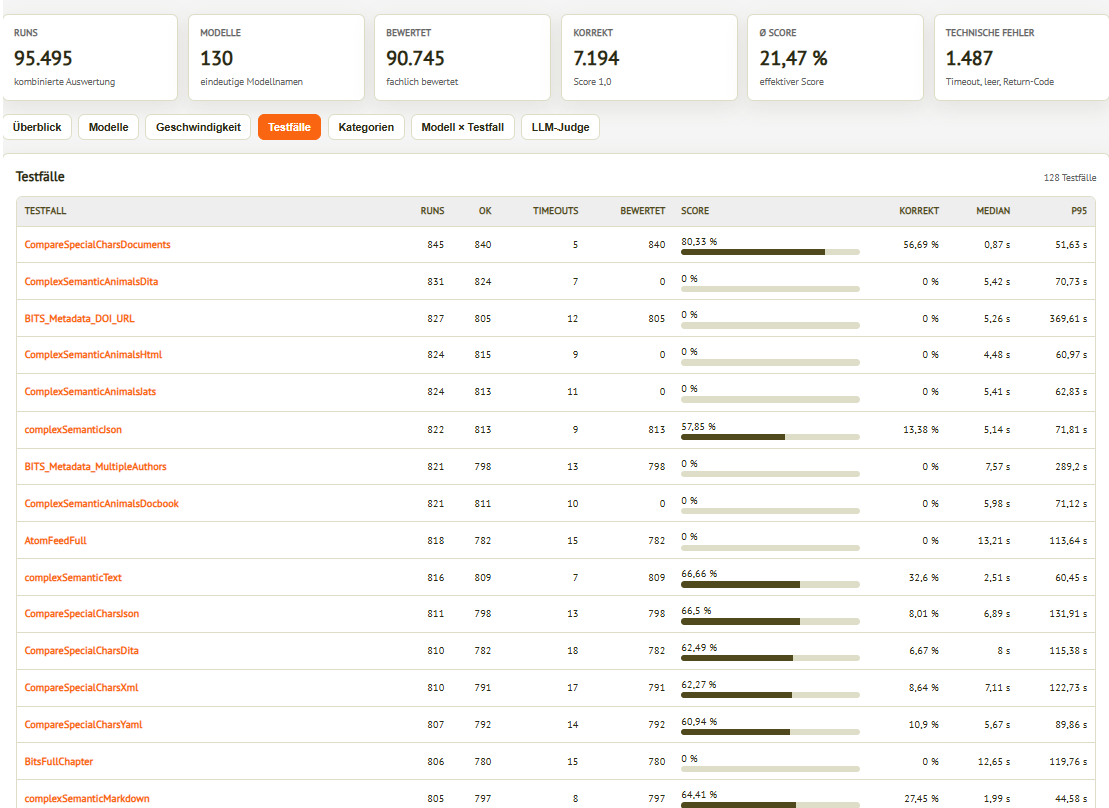
Figure: the test case view aggregates runs, technical successes, timeouts, evaluated runs, score, correct rate, median and P95. Visible values are a snapshot.
Example: TableCalsSpans
Test case TableCalsSpans tests extraction of one number from a CALS table: find the Labrador Retriever entry and determine its value in column Anzahl_Winterverlust, outputting only the number.
The test combines several requirements:
understanding the CALS table model,
correctly matching row and column,
handling spans and structural complexity,
precise extraction,
following a strict output instruction.
The expected value is specific, making deterministic evaluation suitable.
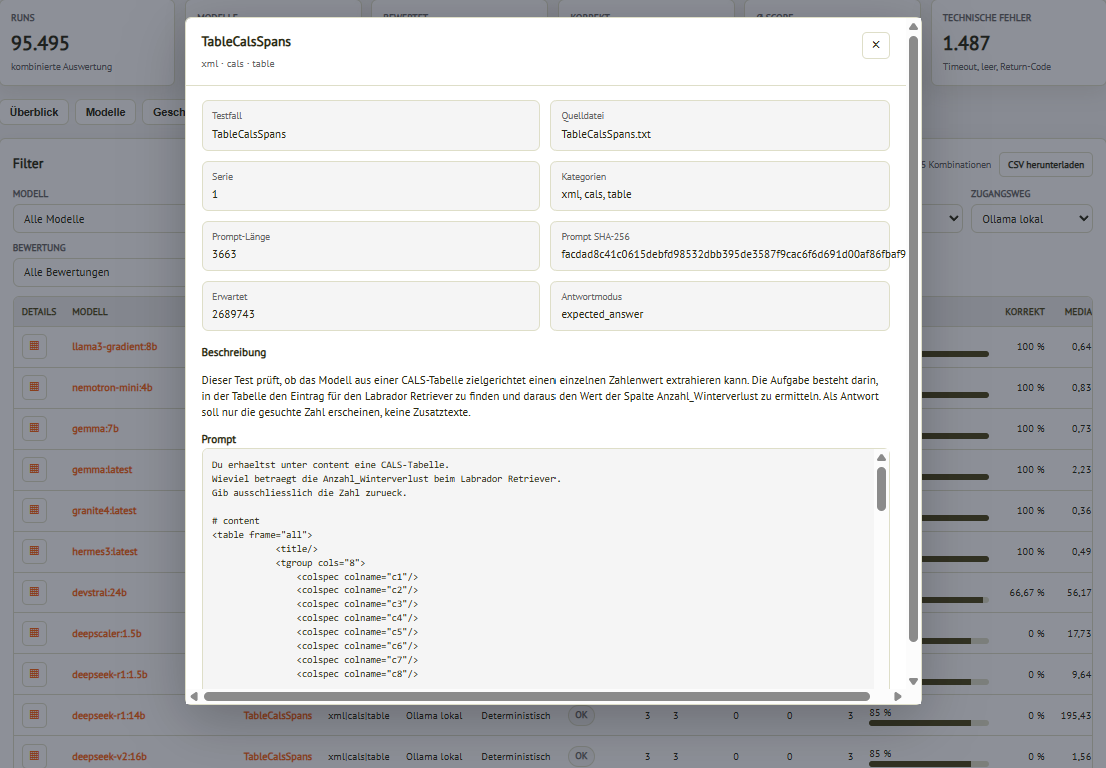
Figure: the detail view combines test ID, source file, series, categories, prompt length and hash, expected value, response mode, description and full prompt.
Test families and controlled variants
Several cases can form a family, which should document what remains constant and which feature varies.
Catalog examples include:
Family | Variation |
|---|---|
simple sum | |
complex semantics | Text, XML, JSON, Markdown, YAML and domain XML vocabularies |
special character comparison | Text, YAML, JSON, XML, Markdown, DITA, DocBook, JATS, HTML |
table analysis | |
FHIR-HFIR | XML, JSON and Turtle |
indented documents | formatted and compact XML or HTML variants |
A sound Research Note requires checking that variants truly have the same difficulty. Different prompt lengths, extra tags or differing instructions can themselves create effects.
Selection and filtering
A large test inventory needs targeted selection. The "Model x Test case" matrix in the dashboard narrows the selection to a specific test case.
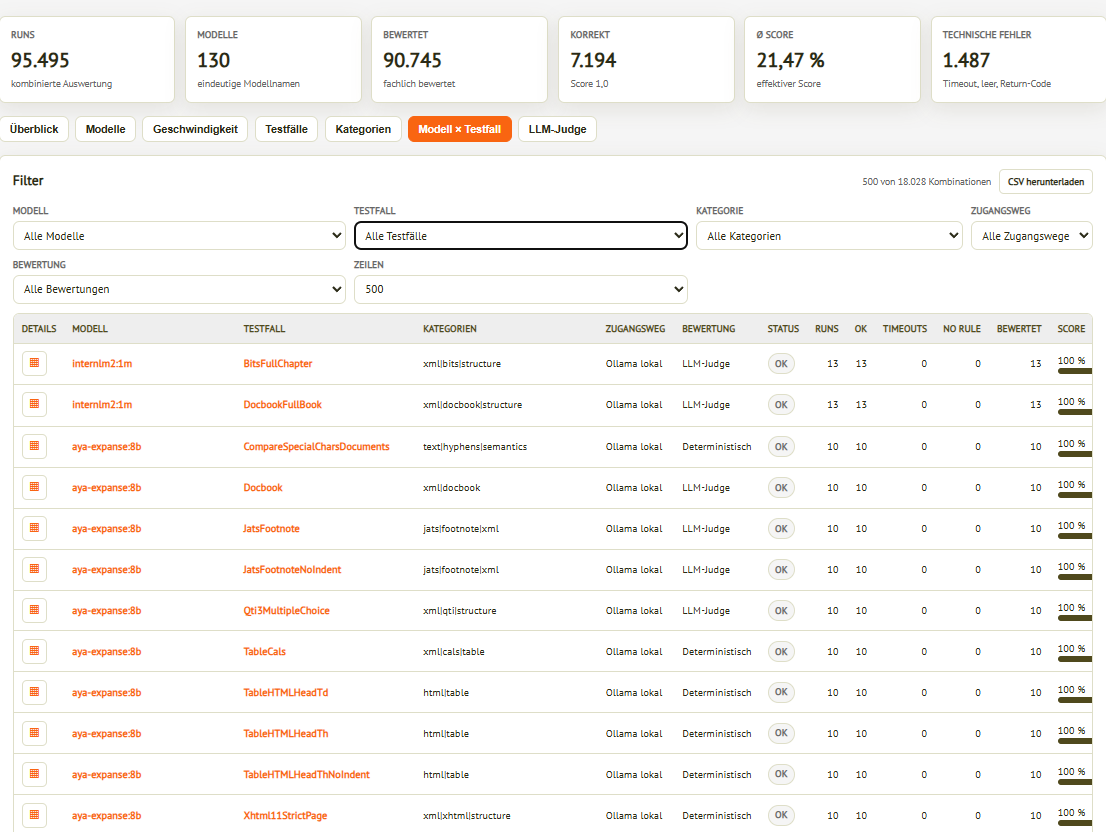
Figure: "Model x Test case" matrix in the LLM Testsuite Dashboard.
This compares models, execution routes and evaluation methods for exactly the same task.
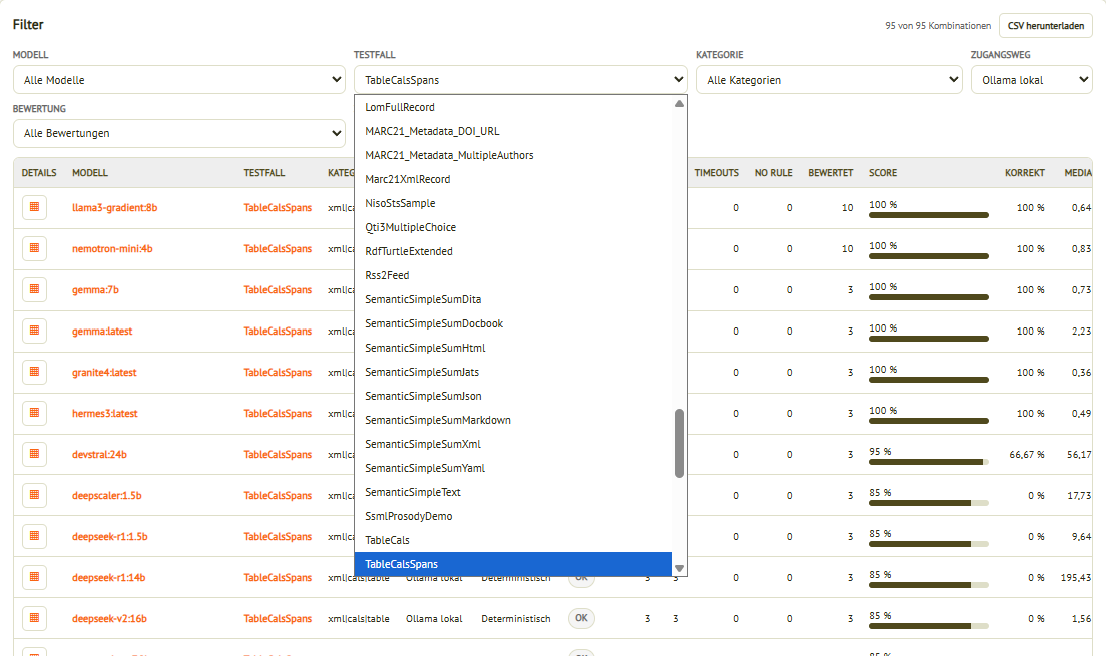
Figure: the filter shows part of the growing inventory, including LOM, MARC21, NISO STS, QTI, RDF, RSS, semantic variants and CALS.
Quality criteria for new test cases
Before inclusion, a new case should answer at least:
Which capability is tested?
Which input representation is used?
What counts as completely correct?
Are several solutions acceptable?
Can evaluation be deterministic?
Which error patterns matter for the domain?
How many repetitions are planned?
Which comparison tests form a controlled family?
Which model or context limits could distort the test?
How are changes versioned?
Test case lifecycle
Ideally, a case passes through these states:
State | Meaning |
|---|---|
Draft | Capability and prompt are developed |
Pilot | Small model selection, manual review |
Evaluable | Rule or judge rubric is defined |
Active | Regular execution in the Testsuite |
Revised | New version after documented change |
Archived | Preserved historically, excluded from current comparisons |
This lifecycle prevents experimental tasks silently entering global scores.
Examples rather than exhaustive raw-data analysis
This study uses individual runs, CSV rows or case combinations to explain the Testsuite. It does not analyze every row in the supplied result files. The complete results belong to the dynamic dashboard layer, where they can be filtered and examined.
This separation prevents methodology being dominated by one dataset. An example explains how a technical status, repetition or evaluation arises, rather than supporting general claims about all models.
Difficulty and discrimination
A good case need not be especially long or artificially complex. It must measure a clearly defined capability and reveal model differences. Simple tests assess basic reliability; medium tests combine requirements; complex tests examine nested structures, long contexts or multiple semantic steps.
Initial runs reveal discrimination. If all models always answer correctly, the test can remain a useful baseline but offers little differentiation. If no model can answer correctly, check whether it is too hard, ambiguous or incorrectly formulated.
Paired test families
Paired or multipart families are especially valuable. A baseline test receives targeted variants: identical data with another delimiter, the same XML with different indentation or the same task in multiple serializations.
Sound interpretation requires variants to be as equivalent as possible. Otherwise wording, data volume or target output can be confused with representation effects. The catalog should document related cases and the variable changed.
Editorial review of a test case
Before published evaluation, a case should undergo at least these checks:
Is the task unambiguous?
Has the expected result been checked for domain correctness?
Could another equally correct solution occur?
Has the rule been tested with positive and negative examples?
Are prompt and source data versioned through hashes?
Are categories and series chosen meaningfully?
Is it clear whether the test measures knowledge, semantics, representation or several dimensions?
Does it contain sensitive, personal or licensing-problematic content?
Editorial review is part of the Testsuite’s scientific quality. Automation does not replace domain review of tasks.