

AI & XML / LLM test suite / Methodology study / 6 Models, access routes and test execution
This chapter describes how large language models are identified, executed under comparable conditions and observed over repeated runs. It covers model metadata, access routes, timeouts, context conditions, provider differences and fair comparison groups.
Model identity is more than a name
A comparison is traceable only if the tested model is clearly described. A family name alone is insufficient. Relevant features include:
tested model name and tag,
model family,
size and, where applicable, quantization,
context window,
supported input type,
provider,
access route,
test date,
relevant run parameters.
Two variants of the same family can differ significantly. Likewise, an external service can update the model behind the same visible name. The LLM Testsuite therefore stores variant and run metadata separately from result values.
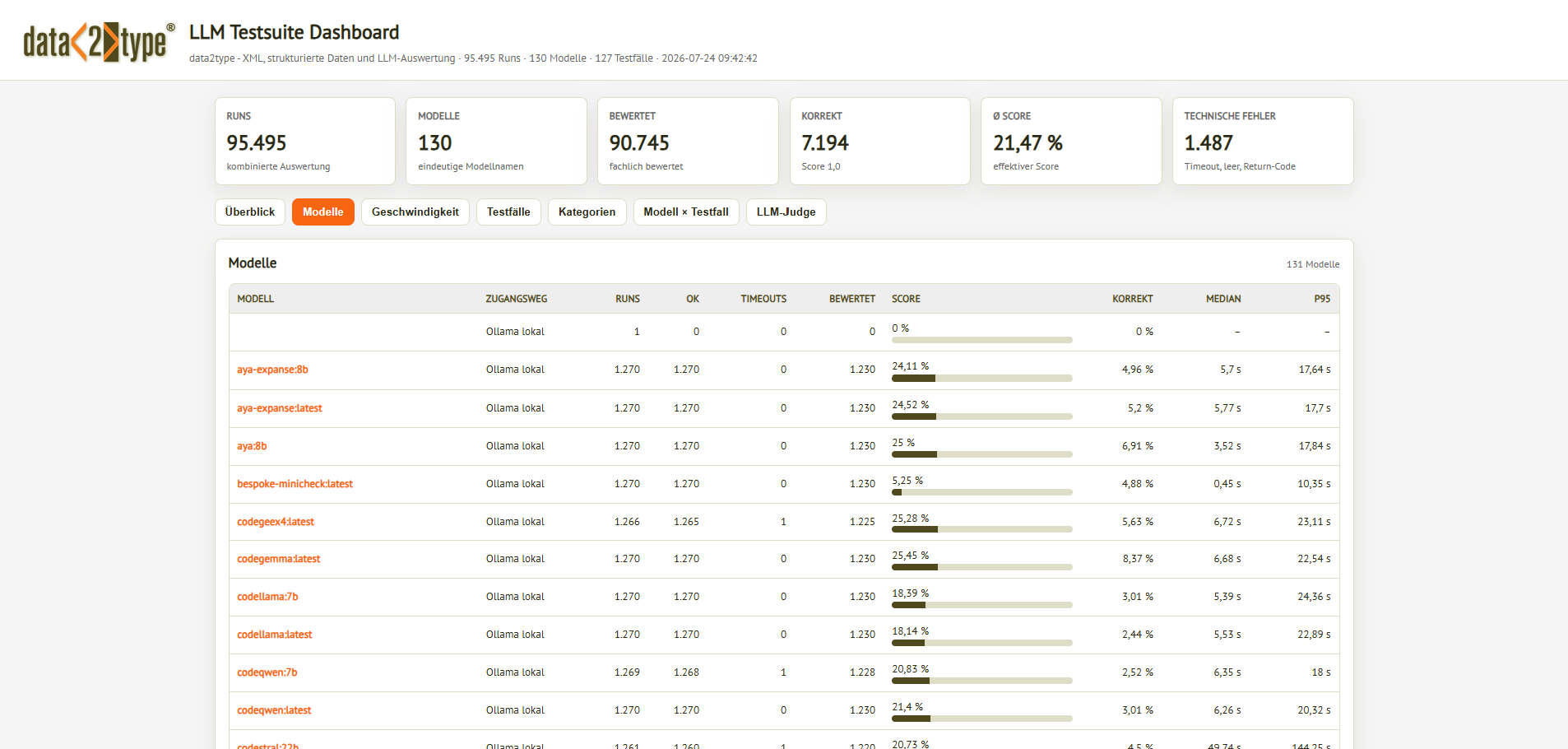
Figure: for each LLM used, the model view compares access route, number of runs, technical successes, timeouts, assessed runs, score, correct rate and runtime metrics.
Model metadata
The technical model source contains families, variants, sizes, context information, input types, short descriptions and excerpts from model information. These metadata are not evidence of quality. They help put test limits and differences in results into context.
A large context window, for example, does not automatically mean that a model interprets long structured documents correctly. It initially shows only that a certain input length is technically supported. Practical capability must be tested.
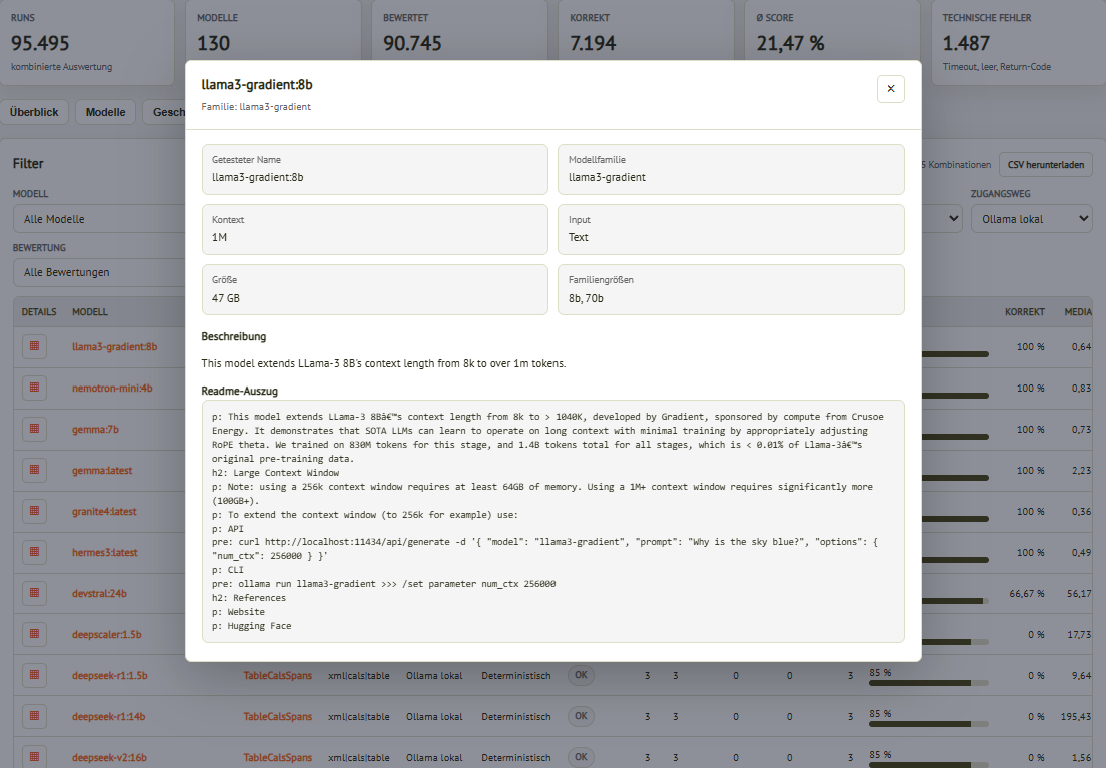
Figure: a model’s detail view in the LLM Testsuite Dashboard shows the tested name, family, context, input type, size, family sizes, description and a Readme excerpt. Such metadata support interpretation but do not replace measurement.
Access routes
The LLM Testsuite distinguishes between model and access route. In the current system, three routes are particularly relevant:
Access route | Characteristics |
|---|---|
Ollama local | Execution on own hardware, extensive control over the environment |
Ollama Cloud | External execution through a cloud-based model access |
OpenAI | API-based execution through the respective provider access |
The access route designation matters because runtime, availability, limits, model version and error profiles can depend on it.
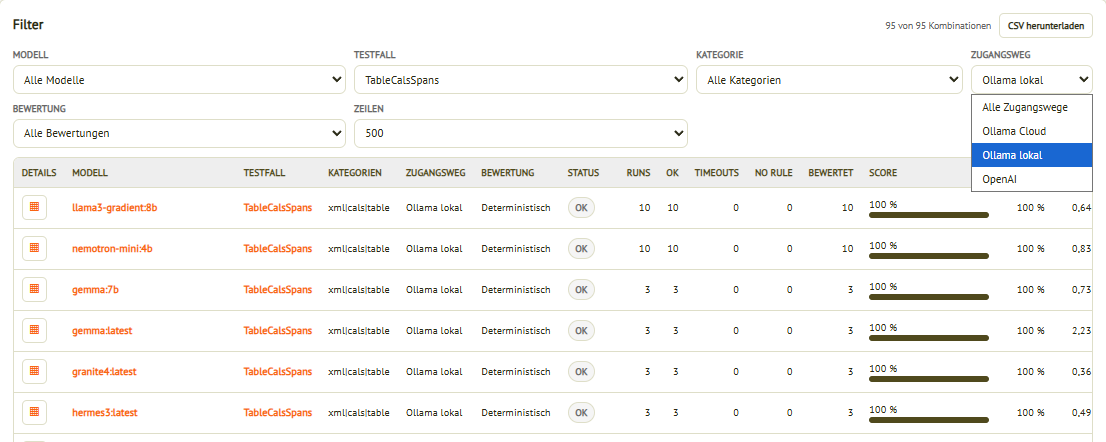
Figure: the model–test case view can be restricted to Ollama Cloud, Ollama local or OpenAI. This allows technical operating models to be analyzed separately.
Local and external execution
Local execution provides control over hardware, model artifacts and data storage. Results nevertheless depend on CPU, GPU, memory, quantization, Ollama version and system load.
External services reduce local operational effort but introduce further influencing factors. These include network latency, rate limits, server-side model updates and incompletely visible inference configurations.
For this reason, comparing runtime across access routes must be understood as a system comparison. It measures observed end-to-end duration, rather than solely the computation speed of the model core.
Generating identical prompt artifacts
The authoritative test definitions are stored in XML. Prompt files are generated from them. The filename carries the test case ID, and the file content contains only the prompt text. This procedure ensures that all models receive the same task description within a given prompt version.
The prompt hash is also stored in the catalog and run data. This reveals whether tests with apparently identical names actually use the same prompt version.
Repetitions
Local execution supports a configurable number of repetitions and a fixed time limit per run. For example, one documented run used ten iterations and a timeout of 1,200 seconds. The results may contain other counts depending on the test phase, model and execution route.
Comparisons must therefore report the actual number of runs. A 100 percent correct rate over three runs has different statistical stability from the same rate over ten or a hundred runs.
Timeouts and cancellation behavior
A timeout is recorded for each repetition. In the documented local execution, the affected run is saved. The remaining repetitions for that test case may then be canceled before processing continues with the next test case.
This behavior protects long test series against permanent blocking. It also means model–test case combinations may have different numbers of runs. Aggregation must keep this difference visible.
Uniform conditions and their limits
Within an execution route, prompt, system instruction, temperature, timeout, iteration count and other parameters should remain as constant as possible. Complete equality across providers and local systems is not always achievable, however.
The methodology therefore does not demand pretended homogeneity. Instead, conditions are documented and comparisons restricted accordingly. A specific research question can use a balanced subset containing only models with identical test coverage and comparable settings.
Model updates and repetition
Models and APIs change continually. Repeating the same tests later may therefore produce different results. This is not an LLM Testsuite error, but a relevant subject of investigation.
For long-term comparisons, model version, test date, prompt hash and assessment rule should be frozen together. This makes progress, regression or changed operational behavior traceable.
Parameters and response conditions
A model name alone is insufficient to reproduce a run. Context length, temperature, response limit, system instructions, timeout and API mode are therefore also documented where available. For local models, quantization, runtime and hardware are added.
Not every provider permits the same control. Some parameters are set server-side or influenced only indirectly. Such differences are documented as part of the execution route rather than hidden behind apparent equality.
Context window and prompt size
Test cases range from short tasks to very large structured documents. A model may have the domain competence for a task yet fail because the input is too large. Prompt length and, where available, token counts are therefore recorded.
When comparing large Office or XML serializations, check whether every model received the complete input. Truncation, server-side shortening or differing tokenization could otherwise appear as domain errors. Tests that deliberately examine the context window must be distinguished from unintended overflows.
Provider-related differences
Cloud providers may use moderation, rate limits, queues, automatic retries or model routing. Local environments depend more strongly on hardware, memory and runtime. Both groups therefore have their own technical error profiles.
The LLM Testsuite Dashboard identifies the access route (Ollam Cloud, Ollama local or OpenAI), allowing domain and operational differences to be examined separately. A direct speed comparison is meaningful only if the starting point, measured duration and parallelization are comparable.
Resources and costs
Besides response time alone, computation requirements, memory use and API costs may matter when selecting models. These values are not complete in every data version, but could be added as an extra operational dimension in future.
Very high domain quality may be economical for rare specialist tasks, while a faster, smaller model may better suit large volumes of simple extractions. The LLM Testsuite should enable such trade-offs without combining domain score and operating costs into an opaque metric.
Fair comparison groups
For sound conclusions, models are preferably examined within meaningful comparison groups. These may share provider routes, similar size classes, identical test coverage or the same model family. A global comparison remains possible but must disclose differing conditions.
Research Notes should therefore specify exactly which models were included in the analysis and why. Selecting solely by conspicuous results can lead to biased conclusions.