

Software / Octopus / Technical concepts / exHTML
exHTML (short for “exchangeHTML”) is the pivot format developed by data2type for data conversion with Octopus. Based on HTML5, exHTML is used in Octopus as both an import and an export format. It forms the basis for managing, extending and linking digital content with Octopus, providing a flexible, future-proof solution for efficiently organising data and integrating it with other technologies. Once generated, it can be reused and configured specifically for each application scenario.
exHTML as an import interface
exHTML is used as an import interface in Octopus. The exHTML format is a simplified but valid form of HTML5. For example, inline elements are marked up with the HTML <span> element, and block elements with the HTML <div> element. Input data is converted into the exHTML exchange format. An XML Schema file and a Schematron file are also created. exHTML can now serve as the input format for the conversion pipeline to generate further output formats such as PDF, EPUB, JATS, BITS, TEI, HTML5, LBook and many more.
Using exHTML as an import interface allows external content to be used for fully automated output generation with Octopus.
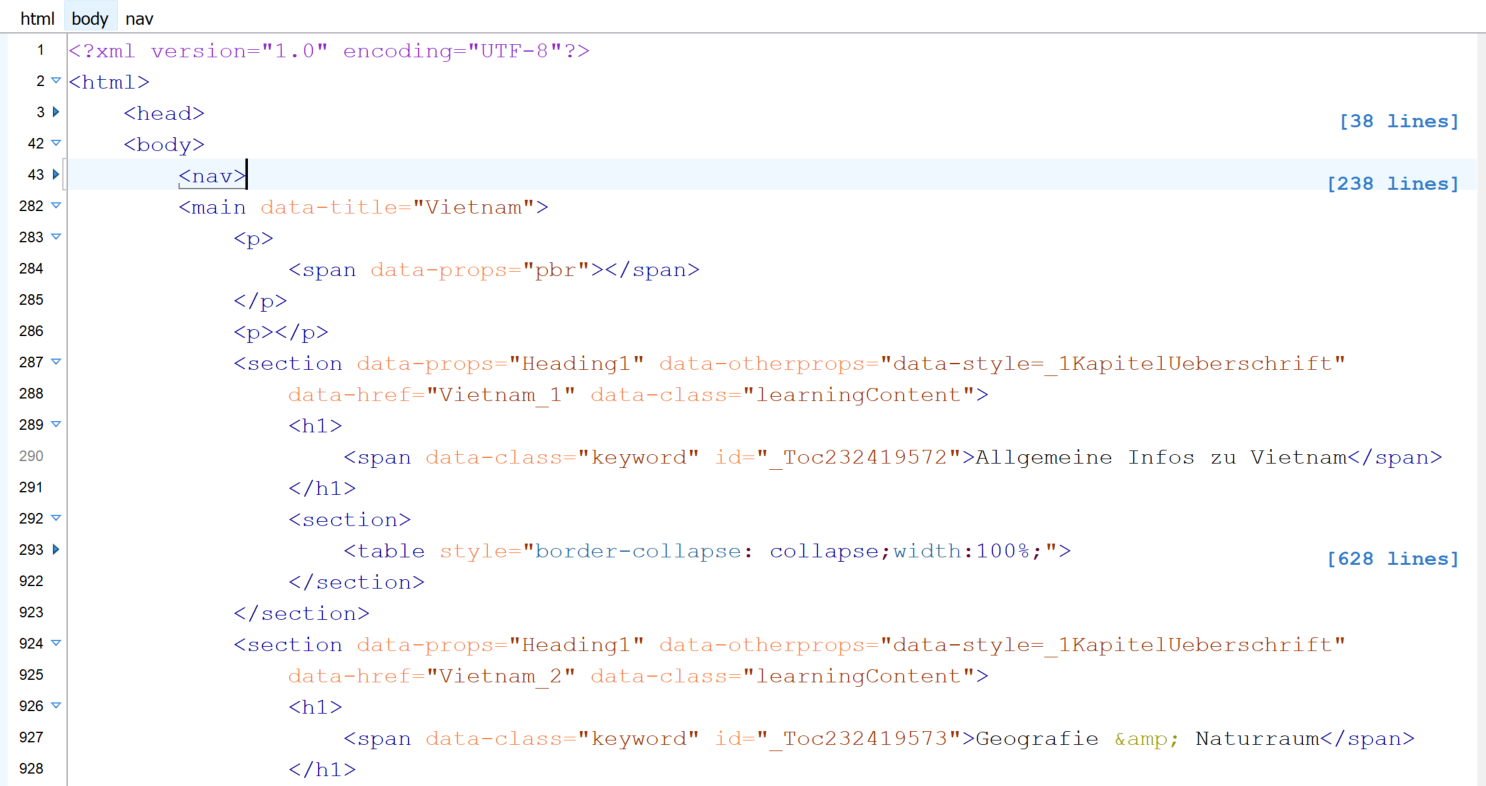
Fig.: Example excerpt from an exHTML file.
exHTML as an export interface
The exHTML exchange format is also used in Octopus as an export interface. It serves as the input format for media-neutral generation of all other output formats and features, such as translation. The desired outputs can be easily adapted using the configuration file, for example:
Metadata:
With exHTML, metadata can be supplied in different formats or disabled entirely. Supported metadata formats are JSON, RDF and Dublin Core.
Support for further metadata standards is possible.
Metadata can be output as either elements or attributes.
The exHTML format allows additional output components to be enabled or disabled as required:
Table of contents: a table of contents is generated from headings up to level 6 in the Word document.
Index
List of figures: all image captions in the Word document marked with a defined paragraph style are included in a list of figures.
List of tables: all table titles in the Word document marked with a defined paragraph style are included in a list of tables.
CSS stylesheets can be output within the output files or as an external stylesheet file for the exHTML and HTML5 output formats.
Images can be output within the output files as Base64 image files or as external image files.
Elements: can be deleted or filtered. Entire elements can be deleted together with their content, or the tags of the surrounding parent element can be removed. The element itself and its content are retained in the latter case.
Central data management
Octopus exHTML acts as a hub system, enabling content to be stored and structured centrally. It forms the basis for efficiently organising and supplying data for different applications. Its flexible architecture supports functions such as storing, transforming and enriching content.
Extensibility and future readiness
exHTML stands out for its extensibility. As an HTML5-based format, it is designed to make integrating new technologies and data formats easy. Existing workflows can be extended flexibly, allowing the system to adapt to new requirements.
Technology openness and flexibility
Thanks to its HTML5 foundation, exHTML is technology-open and supports numerous applications and interfaces. It enables seamless integration of external services and tools, allowing data to be linked to other systems. This makes exHTML a future-proof solution for existing and new technologies.
Benefits of Octopus exHTML
Central data management: Efficient organisation and structuring of digital content.
Seamless integration: Easy integration of external services and formats.
Flexibility: Adaptation to individual requirements and workflows.
Future readiness: Support for new technologies and XML standards.
HTML5 standard: Stability, interactivity and compatibility through the globally recognised HTML5 standard.