

AI & XML / LLM test suite / Methodology study / 3 Methodology and core concept
This chapter describes the methodological foundation of the data2type LLM Testsuite: what is examined, how runs are organized, how controlled comparisons are created and how individual results can be traced to specific runs.
Object of investigation
The object is a large language model’s observable behavior in a defined test case. The Testsuite makes no claims about internal weights, training corpora or hidden representations. It measures the answer generated under documented conditions and how it can be evaluated.
The smallest observation unit is one run. A run combines at least:
a test case,
a prompt version,
a model and model variant,
an execution route,
a repetition number,
a technical status,
a model answer,
a domain evaluation if a rule is available,
a runtime.
All higher-level analyses aggregate these runs.
End-to-end process
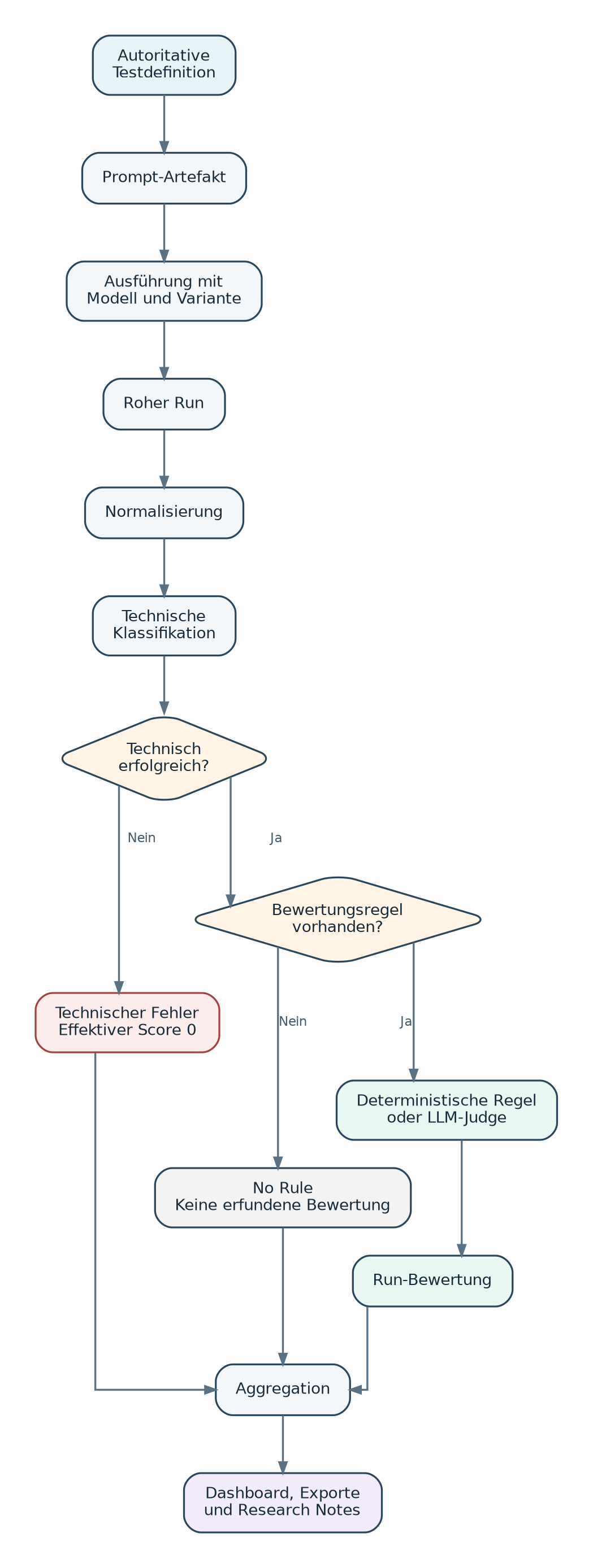
Figure: a run is first classified technically. Only technically successful answers receive domain evaluation. Missing rules remain visible as transparent evaluation gaps.
Technical and domain levels are deliberately separate. An empty answer, timeout or incorrect return code is not a semantic error; conversely, a technically successful answer can be wrong in content.
Comparison levels
Data are examined at several levels.
Level | Example statement |
|---|---|
Run | The third repetition was technically successful and correct in content. |
Model and test case | The model solved seven of ten repetitions correctly. |
Test case | The test case strongly discriminates between models. |
Model | The model is stable in some categories but not others. |
Category | Models show different patterns for tables than for metadata. |
Execution route | Local and cloud-based runs differ in runtime and error profile. |
Representation family | The same task is solved differently in XML, JSON and Markdown. |
These levels must not be mixed without control. A model score is meaningful only if its constituent tests and evaluated runs are clear.
Controlled variation
Test families changing only one feature are particularly informative. Examples include:
identical table content with different delimiters,
the same semantic task in text, XML, JSON, YAML or Markdown,
a structurally identical XML document with and without indentation,
the same data table in CSV, HTML, Markdown, XLSX, WordML or RTF,
the same FHIR task in XML, JSON and Turtle.
Such comparisons help separate representation effects from task requirements. Complete isolation requires genuinely equivalent content, instructions, difficulty and evaluation rules. Equivalence must therefore be documented during test design.
Repeated execution
Identical inputs can produce different model answers. One answer shows only that a result occurred once; multiple runs allow conclusions about stability.
Automated processes particularly need to know:
whether a model always answers,
whether it repeatedly reaches the same correct solution,
whether format errors are occasional or systematic,
whether runtimes vary widely,
whether timeouts are isolated outliers or a recurring pattern.
Repetition counts can vary by test phase and execution route. They are therefore disclosed in each aggregation rather than silently standardized.
Evaluation neutrality through transparent gaps
Not every test case immediately has a complete evaluation rule. The Testsuite marks such cases as no_rule rather than assigning an apparently objective score. This matters methodologically: a missing evaluation is a data gap, not an incorrect answer.
Publications must therefore distinguish three sets:
all executed runs,
technically successful runs,
runs evaluated for content.
Only then are denominators and meaning transparent.
Deterministic and probabilistic components
Model answers are probabilistic, but parts of evaluation can be deterministic. An exact number, regular expression, parser or schema validation yields the same result for identical inputs. An LLM judge is itself a language model and can vary or misjudge even at low temperature.
The methodology therefore prefers deterministic checks when tasks permit. LLM judging is used when multiple domain-valid outputs are possible or simple rules cannot adequately capture semantic criteria.
Example of a complete checking chain
In test case TableCalsSpans, the model receives a CALS table and must output a specific number. The chain can be:
Identify the test by unique ID and prompt hash.
Supply the prompt to several models.
Execute each model repeatedly.
Classify timeouts and empty answers technically.
Compare successful answers with the expected number.
Give exact or contained matches a documented label and score.
Aggregate by run, model and test case.
Retain traceability to each individual answer.
This applies whether the subject is a table, XML standard, semantic extraction or future XPath task.
Operationalizing a capability
A capability must yield observable criteria. The statement "the model can handle RSS" is too vague: it could mean explaining the term, generating a syntactically plausible feed, setting required fields, formatting dates to the standard or semantically evaluating an existing feed.
Each capability area therefore defines concrete operations: input, expected processing, allowed outputs and evaluation logic. Several tests of different difficulty can cover a broad capability; their combined pattern provides a sounder capability profile.
Test matrix and coverage
The Testsuite is a matrix of models, test cases, repetitions and execution routes. Not every cell must always be filled: context limits, missing provider support, failures, costs or gradual expansion can leave gaps.
Each analysis must disclose coverage. Models are directly comparable only when metrics use the same or methodologically equivalent test sets. With unequal coverage, partial rankings, paired comparisons or category profiles are more informative than a global order.
Confounders and comparability
Other factors besides the intended variable can affect results, including:
prompt length,
tokenization,
context window,
system prompt,
response limit,
temperature,
provider filters,
quantization,
hardware and
network conditions.
The methodology has two goals: document controllable parameters and keep them as constant as possible, while making uncontrollable differences visible. A cloud model can be compared with a locally quantized model, but interpretation must account for differences beyond architecture.
Traceability from chart to run
Each published metric should trace to its underlying runs. A bar in the LLM Testsuite Dashboard is an aggregation that must trace to model, test case, repetitions, technical statuses, evaluation rule and dataset version.
This matters especially for surprising results. A low score can reflect incorrect answers, timeouts, missing rules or few evaluated runs. Only drilling down reveals the actual cause.