

AI & XML / LLM test suite / Methodology study / 7 Assessment methods
This chapter explains how model answers are assessed in the data2type LLM Testsuite. It separates technical errors from domain quality and describes deterministic checks, semantic assessment by an LLM judge, hybrid methods and quality assurance measures.
Principle
Assessment must suit the task. A single numerical value can be checked exactly. A complete JATS document, however, has many possible correct forms. Medical classification follows different criteria from an RSS feed or semantic literature markup.
The LLM Testsuite therefore uses several assessment layers:
technical classification,
deterministic domain assessment,
optional semantic assessment by an LLM judge,
manual spot checks and quality controls.
Technical classification
Before any domain assessment, a run is checked for technical usability.
Status | Meaning |
|---|---|
| technically successful answer |
| time limit exceeded |
| API or HTTP error |
| unsuccessful return code |
| answer empty after cleaning |
| differing provider-specific finish reason |
A technical error receives 0 in the effective score. The domain score remains empty because no content assessment took place. This separation prevents technical failures from being reported as semantically incorrect answers.
Deterministic assessment
Deterministic rules are preferable when the correct solution is unambiguous or formally verifiable. The current rule system supports, among other things:
Mode | Principle |
|---|---|
Expected value | normalized comparison with an expected value |
All patterns | all required regular expressions must occur |
Required structures | proportion of structural elements found |
Special decision logic | test-specific evaluation of complex answer patterns |
Other possible deterministic checkers include XML parsers, JSON parsers, XPath, XSD, Schematron, RDF parsers or domain-specific validators. The crucial point is that the rule is versioned, tested and documented clearly.
Exact, contained and partial
An expected-value test can distinguish several levels. An answer may match the target exactly, contain the target value with additional text, or provide only partially matching structures. These distinctions are useful, but must not hide a violation of a strict output instruction.
If a prompt requests “only the number”, a substantively correct explanation may still be unusable in an automated process. Content accuracy and instruction following should therefore be reported separately where necessary.
LLM judge
An LLM judge assesses answers that permit several correct forms or whose semantic quality cannot be fully described by simple rules.
The judge receives at least:
test case ID and categories,
task description,
expected answer or target description,
optional mandatory and exclusion criteria,
the specific model answer.
The expected judge response is a structured JSON object with a label, score, short justification and points found and missing.
Judge labels
The configured scheme typically distinguishes:
Label | Meaning |
|---|---|
| completely correct in domain terms |
| essentially correct, minor shortcomings |
| relevant parts present, major gaps |
| substantively incorrect or structurally unusable |
| task unanswered |
| verdict technically or formally unusable |
Judge label and numerical score are stored separately, keeping inconsistencies visible. A system must not silently accept a divergence between label and score as a valid verdict.
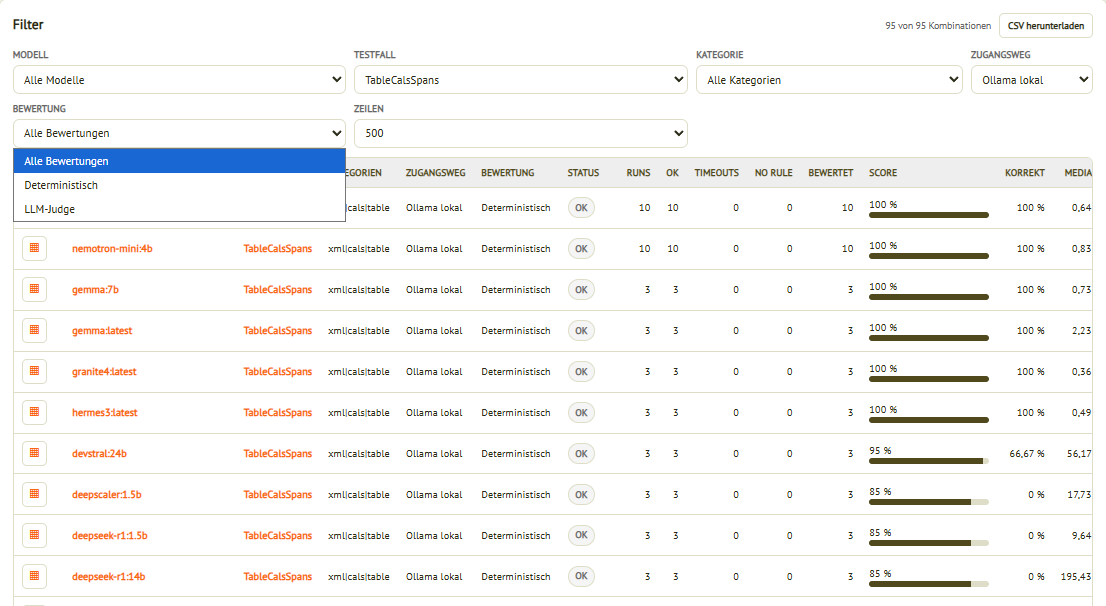
Figure: the model–test case view in the LLM Testsuite Dashboard separates deterministic assessment from LLM judge assessment. This reveals the methodological basis of a score.
Judge caching and versioning
Semantic assessments can be costly and time-consuming. The judge therefore uses a cache. The cache key accounts for test case, expected answer, expectation notes, model answer, judge model, prompt version and rubric version.
If any component changes, a new key is generated. This prevents unnoticed reuse of a verdict from an older rubric.
Transparency of individual verdicts
A judge score alone is insufficient. The justification shows which criteria supported the verdict. Individual judge views also allow checks on cache use, judge model and label.
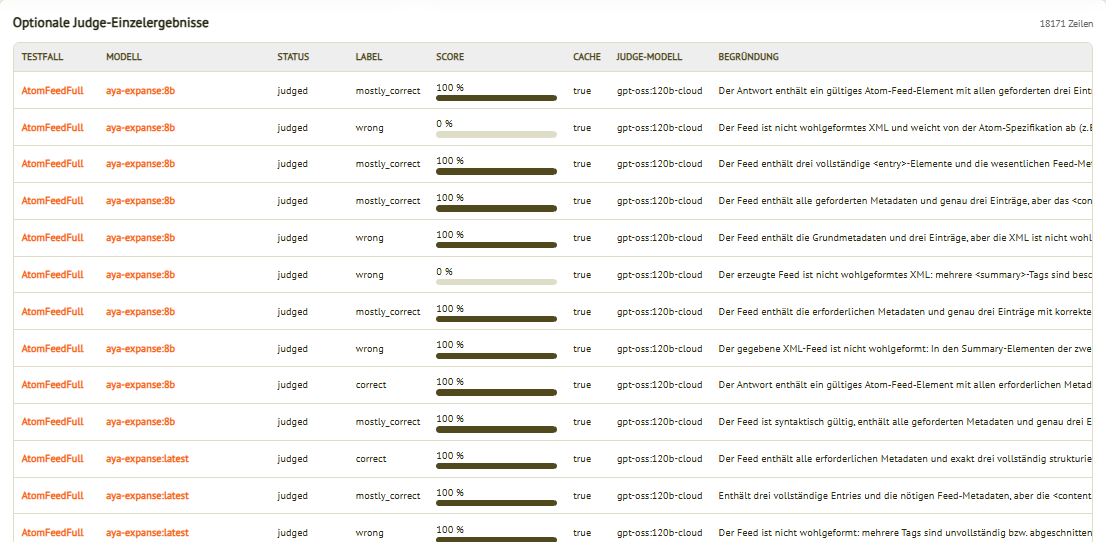
Figure: the table places test case, model, status, label, score, cache, judge model and justification side by side. Visible divergences between label and score must be checked as assessment anomalies, not interpreted as normal results.
Hybrid assessment
Hybrid assessment is particularly suitable for complex structured output.
Example for a JATS article:
XML well-formedness should be checked deterministically.
Check namespace and root element deterministically.
Check required structures using XPath or a schema.
Compare transferred metadata deterministically.
Have the judge assess the semantic appropriateness of remaining free text.
The deterministic layer handles objectively verifiable criteria. The judge assesses only what genuinely requires semantic interpretation.
Missing rules
A test without a rule is marked no_rule. It must not enter the denominator of a domain score until assessment has taken place. The run is nevertheless retained for technical analyses and later reassessment.
This architecture allows early execution of new test cases followed by controlled development of assessment rules. Public rankings should nevertheless clearly indicate which tests have already received domain assessment.
Judge quality assurance
An LLM judge is not a neutral automaton. Its verdicts can depend on model, rubric, prompt wording, context length and answer order. These measures are therefore necessary:
low temperature and structured output,
fixed prompt and rubric versions,
manual spot checks,
comparison with deterministically verifiable subcriteria,
repeated checks for critical test cases,
checks for label–score inconsistencies,
separate reporting of judge errors,
reassessment after rubric changes.
A judge extends assessment options but does not remove the limits of probabilistic assessment.
Hierarchy of checking methods
Assessment follows, where possible, a hierarchy from the most unambiguous to the most interpretive method. First it checks for a technically usable answer. Syntax and parser checks follow, then exact expected values, structural rules and only then semantic judgments.
One possible order is:
technical status,
cleaning and extraction of the actual answer,
syntax check,
schema or structure check,
exact values and required content,
semantic completeness,
qualitative assessment by a judge or expert spot check.
This order prevents an LLM judge from rating invalid XML too positively because its content seems plausible.
External validators and parsers
Where official or established technical checking tools exist, they should be used. XML can be checked for well-formedness. XSD, Schematron or RELAX NG can assess structural rules. RDF serializations can be parsed, JSON documents validated and XPath expressions executed with a suitable processor.
These validators improve traceability but also have limits. A document can be schema-valid yet semantically incorrect. Conversely, an acceptable domain variant may fail an overly narrow rule. Validators are therefore understood as part of a combined assessment.
False-positive and false-negative assessments
Any rule can make mistakes. An overly broad text search may accept an incorrect answer as a match. An overly strict exact check may reject a correct answer with additional whitespace. A judge may overlook relevant elements or confuse stylistic preferences with domain criteria.
New assessment rules therefore collect example answers in several classes: clearly correct, partially correct, incorrect and formally problematic output. Rules are checked against these examples before entering a published aggregation.
Human spot checks
Manual spot checks remain important even with automated assessment. They do not reassess every run, but check that rules work. Borderline cases, very high or low scores, new model families and unexpectedly distributed test results are particularly relevant.
A sample should document its selection method. Random selection, risk-based selection and targeted review of disagreements between rule and judge serve different purposes.
Changes to assessment rules
Changing a rule may change scores even when the underlying model answer stays the same. Rules and judge rubrics therefore have their own versions. Major changes trigger reassessment of the affected data and publication as a new build.
Older Research Notes retain their meaning for the version at that time. An updated rule may prompt a new article explaining the difference. Methodological development thus remains distinguishable from changes in results.