

XML technologies / DITA / DITA overview / The architecture of DITA
(Excerpt from “DITA - Der neue Standard für Technische Dokumentation” by Johannes Hentrich)
DITA’s development criteria led to an architecture consisting of these building blocks:
Information objects that capture and mark content: in DITA these are topics and domains.
Information structures organizing information objects and content: in DITA these are maps, the
conrefmechanism and information segmentation (chunking).Information structures processing content: in DITA this includes conditional processing (conditional processing).
Procedures extending or combining existing information structures and objects: specialization, its reverse mechanism generalization, and integration.
The following sections present each component in more detail.
Topics
As noted earlier, the topic is DITA’s central information object for capturing and storing information. Its essential feature is self-contained information. Topics can therefore be created
independently, with each topic initially having no contextual relationship to others.
In general, a topic answers one question. Its type determines the question. DITA provides five topic types by default:
Generic topic: The base for all other topic types and a container for content that the other four cannot accommodate when no further types have been specialized. It does not prescribe a particular kind of question, but should still answer a question.
Concept: Describes concepts, terms and so on. The task topic type asks “What is ...?” The concept type specializes the generic topic.
Glossary: Added in DITA 1.1, this type incorporates term definitions into technical documentation. It answers “What does ... mean?” and specializes concept.
Task: holds the instructions common in technical documentation. It answers “How can I ...?” or “How do I ...?” and also specializes the generic topic.
Reference: Holds tables, parameter lists and so on, answering questions such as “What values does ... have?” or “What properties does ... have?” Like concept and task, it specializes the generic topic.
The figure shows how the types are related. Glossary alone has a lineage of two preceding topic types.
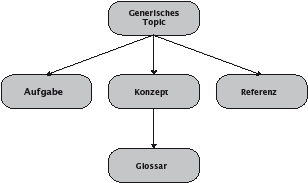
Figure: DITA’s five topic types.
Further topic types can be created by specialization. Specializing a topic always produces another topic, never a different information structure.
Creating and organizing topics explains in detail how to create DITA’s different topic types.
Domains
Domains group elements by subject for marking content in topics. They exist independently of topic types, so a domain and its markup are not restricted to one type.
DITA provides several markup elements familiar from HTML, plus many more covering particular subjects and enabling semantic markup according to meaning.
Writers with HTML experience can therefore use many DITA elements without first studying their meaning in detail. Bold, for example, uses <b> (bold), as in HTML, while italics use the familiar <i> element (italic).
Many more elements provide semantic markup. Since DITA originated in software documentation, its default domains mainly supply markup for that field.
DITA provides the following domains:
indexing domain: Added in DITA 1.1 for index entry markup. Its elements also reference other index entries.
highlighting domain: Provides elements for text with no particular semantic meaning. Like utilities, it has a special role: it alone provides exclusively typographic markup. Most elements are familiar from HTML, such as the
<b>element for bold or the<i>element for italics.programming domain: Marks content typical of descriptions of programming languages and their use, such as code blocks, parameter lists and parameter names.
software domain: Marks software operations, for example messages output by a program.
user interface domain: Marks software elements visible to the user, such as menus or window names.
utilities domain: Contains elements for content unsuited to either typographic or semantic markup. In particular, it marks parts of an image map. Familiar from HTML, image maps provide interactive graphics: clicking a region follows a link.
xNAL domain: Its elements derive from the eXtensible Name and Address Language, also developed under OASIS to store address information. Added in DITA 1.1, xNAL stores author addresses in bookmaps.
Maps
Maps organize collections of topics in an order or hierarchy and provide a way to establish context between them.
A map specifies which topics belong in a document and should appear in the output medium after processing by the DITA Open Toolkit.
Maps can organize topics for online help, websites or PDFs, for example.
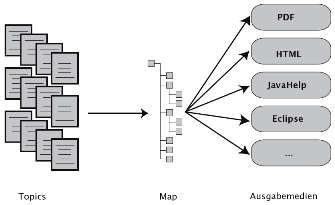
Figure: A map organizes topics.
Maps contain only references to topics, enabling content reuse. A topic can easily be referenced multiple times in one map or used in different maps.
Like topics, maps can include metadata to account for particular contexts during output production. This toolkit processing is called conditional processing. Conditional processing describes toolkit processing of topics and maps in detail.
DITA 1.1 added bookmaps, a specialization of maps. They provide a framework for organizing book topics, with elements such as title pages and prefaces.
For instructions on creating maps and bookmaps, see Reusing content with maps and conref.
The conref mechanism
Like maps, the conref mechanism references element content. Maps reference only topics and other maps, but the conref mechanism references any content.
It uses the conref attribute, whose name derives from content reference (referencing content).
The conref mechanism can reference these information objects and structures:
Topics
Elements in topics
Elements in maps
Although the conref mechanism is simple to understand and use, practical use requires strict organization and management. Topics and elements referenced through the conref mechanism generally need central storage accessible to all writers. Their editing status must also be marked to ensure only the “right”, for example approved, topics and elements are used in production.
Because the conref mechanism may reference large amounts of data, a suitable
content management system may become indispensable.
Reusing content with maps and conref explains how to use the conref mechanism. For more on content management systems, see Content management.
Information segmentation
Topics may be stored individually or several together in one DITA XML file.
In practice, one topic per file is common to ensure easy access at any time.
Several topics in one file can be useful when their elements are to be referenced using the conref mechanism, since all elements are then in one place. Related topics may also be grouped this way.
A map can use topics stored alone or together. The chunk attribute accesses specific topics and controls how topics or whole files are processed. Multi-topic files can be split into separate documents, or topics combined into one document, for example to display several topics on one HTML web page.
The chunk attribute gives map authors another way to control topic distribution across output media.
For more on the chunk attribute, see “Reusing content with maps and conref”, section “The chunk attribute”.
Conditional processing
A major part of DITA’s architecture handles processing DITA XML files. The toolkit performs the actual processing, generating output such as HTML and PDF.
Topics are processed through maps: only referenced topics are used in output production. By default all their content is published unless specified otherwise.
DITA also marks content for filtering or flagging during processing. Attributes and their values classify elements and content by audience, product version and so on. Specialized domain attributes can add further classification criteria.
A ditaval file, named after its extension, tells the toolkit how to process content. Besides filtering, content can be flagged or passed through unchanged, for example for further processing by another program after the toolkit.
For details of the ditaval file and conditional processing, see Conditional processing.
Specialization
With five topic types, seven domains and two map types, standard DITA provides a solid foundation for technical documentation, but is not limited to these structures.
Specialization provides a way to supplement and extend existing structures. The following
information structures can be specialized in DITA:
Topics
Maps
Domains
Domain attributes
Specializing topics or maps is called structural specialization. Specializing domains or domain attributes is called domain specialization.
Specialization resembles inheritance in object-oriented programming. Specializing a topic produces another topic. Specializing reference, for example, produces a reference-related type such as an API or database reference.
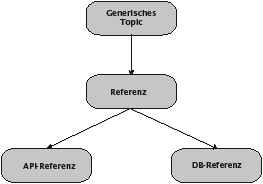
Figure: Two specializations of the reference topic type.
The same applies to domains, domain attributes and maps: each specialization yields another instance of the same structural kind.
Unlike object-oriented inheritance, DITA specialization always restricts the inherited structure. An object-oriented class can inherit another class’s properties and add new ones. DITA can only modify existing information structures. A specialized topic remains a topic, and its DTD always restricts the original DTD.
Technically, specialization does not modify existing DTDs or modules but creates new ones, often by copying, renaming and editing the originals. The results are separate, independent DTDs and modules used and processed independently of existing ones.
A key feature is that specialized topics, maps and domains can be processed by the toolkit’s existing XSLT (Extensible Stylesheet Language Transformation) stylesheets without first modifying them.
Specialized DITA XML files therefore cause no output-production errors and can be processed immediately. Stylesheets can still be changed later, for example to give a specialized element particular formatting.
Because specializing DTDs or modules does not require changing the downstream stylesheets, specialization is very flexible. A domain specialization can immediately mark content semantically without first deciding its output formatting.
Specialization explains topic, domain and domain-attribute specialization in detail.
Generalization
Generalization reverses specialization, dissolving specialized structures to recover more general ones.
All information structures can be generalized: topics, maps, domains and domain attributes.
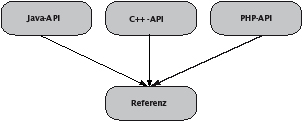
Figure: Generalization can return specialized topic types
to the original topic type.
Generalization can help merge two specializations. First dissolve their specialized structures so documents from both can be processed centrally. Then specialize the general structures again, leaving just one specialization.
The section “Generalization” explains how to generalize topics and domains.
Integration
Specialized elements and attributes are defined in separate modules, independent of existing ones. This improves maintainability and preserves information-structure modularity.
Existing and specialized modules can be combined into new document types through shell DTDs. This combination process is called integration.
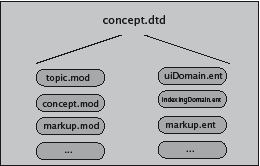
Figure: A shell DTD integrates existing and
new module and entity files.
Integration determines which topic types and domains a shell-defined document type can use. Care is needed to avoid, for example, nested modules, which would drastically increase complexity.
For more on specialization and integration, see Specialization.
Copyright © 2008 XLcontent Verlag
You may print the online version for your private use.
Otherwise, this chapter from “DITA - Der neue Standard für Technische Dokumentation” is subject to the same conditions as the bound edition. The work, including all its parts, is protected by copyright. All rights reserved, including reproduction, translation, microfilming, and storage and processing in electronic systems.
XLcontent Verlag, Pflegerstraße 40, 81247 München