

XML technologies / ePUB / Open Publication Structure / Structure and organization / File splitting
(Excerpt from “E-Books mit ePUB ─ Von Word zum E-Book mit XML” by Dr. Victor Wang)
Behind semantic organization lies a technical question: whether and how far OPS data should be split into separate files.
A single OPS file initially seems natural. Why split it?
Reader software and hardware impose technical performance limits on large files. Books exceeding 1,000 pages quickly produce many megabytes of XML, particularly with deep semantics. These data consume memory and often overwhelm readers.
XML splitting therefore predates e-books. Organization provides a natural splitting criterion.
File division, or file splitting, follows a defined logic. The simplest writes a new file for every structural level, yielding as many files as structural units. Our example would look as illustrated below.
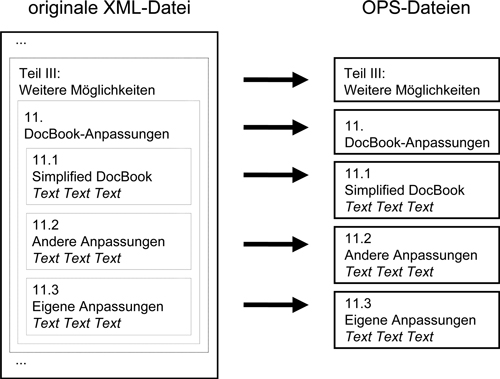
Figure: Splitting at every structural level.
Too many files and tiny units are often undesirable. Instead choose a specific splitting depth, here the second level.
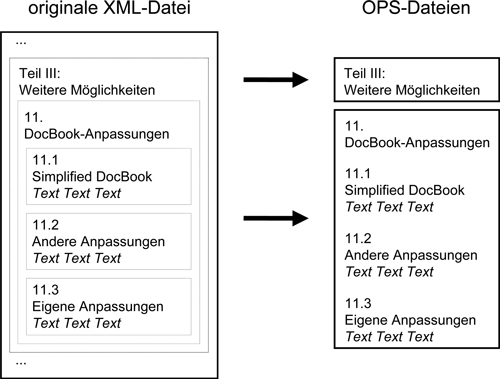
Figure: Splitting through level 2.
Both approaches have a problem: when headings directly follow one another without text, files contain only the higher heading. Both examples affect Teil III, and the first also Abschnitt 11. Reduce this by splitting at a high level, or insert a brief linked contents list for the following subchapters, improving navigation.
Copyright © mitp 2011
You may print the online version for your private use.
Otherwise, this chapter from “E-Books mit ePUB” is subject to the same terms as the printed edition: the work and all its parts are protected by copyright. All rights reserved, including reproduction, translation, microfilming, and storage and processing in electronic systems.
Verlagsgruppe Hüthig Jehle Rehm GmbH, Im Weiher 10, 69121 Heidelberg, kundenbetreuung(at)hjr-verlag.de
back to top