

XML technologies / ePUB / Open Publication Structure / Construction and hierarchy / Structuring with DTBook
(Excerpt from “E-Books mit ePUB ─ Von Word zum E-Book mit XML” by Dr. Victor Wang)
As we have seen, DTBook structures content using a genuine markup-supported hierarchy. Two approaches express it:
For limited hierarchy depth, use the elements
<level1>,<level2>,<level3>through<level6>.For deeper hierarchies, use the element
<level>, which can be nested without limit.
The two approaches cannot be mixed, so choose one at the outset. For the element <level>, use the attribute depth="Hierarchietiefe" to identify its hierarchical depth.
Each level must contain a heading. Numbered levels use the elements <h1>, <h2> through <h6>. With the arbitrarily nestable element <level>, place the heading in the element <hd> (Heading).
Assign level semantics with the attribute class="Bedeutung der Ebene". Although unrestricted, conventional names are sensible.
Within the preliminary pages (Frontmatter), the following class attributes may be useful. All the following meanings follow the DAISY Structure Guidelines:
| Suggested German | Meaning |
|---|---|---|
|
| Title page with full title, author, editor if applicable, publisher and edition |
|
| Author’s thanks to people or institutions supporting the writing; may also form part of the preface |
|
| Author’s personal dedication |
|
| Author’s preface |
|
| Table of contents |
Table: class attribute values in DTBook preliminary pages
A table of contents in the preliminary pages could look like this:
<level class="Inhaltsverzeichnis">
  <hd>Inhaltsverzeichnis</hd>
  <list type="ul">
    <li>
      <lic class="Inhalteintrag">Vorwort</lic>
      <lic class="Seite">343</lic>
    </li>
    <li>
      <lic class="Inhalteintrag">Erster Streich</lic>
      <lic class="Seite">344</lic>
    </li>
  </list>
</level>
Code example: DTBook table of contents
For the main text (Bodymatter), there are no fixed class attributes, since hierarchy depends heavily on content. Chapters are usual, so the following class attributes might apply:
| Suggested German | Meaning |
|---|---|---|
|
| A higher-level division grouping several chapters or sections; in print, a part usually starts on its own sheet on a new right-hand page. |
|
| A higher-level division grouping chapters to avoid excessively long chapters; in print, a section usually starts on a new page, but its chapters follow immediately. |
|
| The most important and widespread textual division. Chapters usually follow without page breaks. |
Table: class attribute values in DTBook main text
Other level meanings, such as subchapters, subsections, letters or numbers, depend on the chapter structure’s use or conventions of particular genres.
As an example, consider this computer textbook’s printed layout and hierarchy:
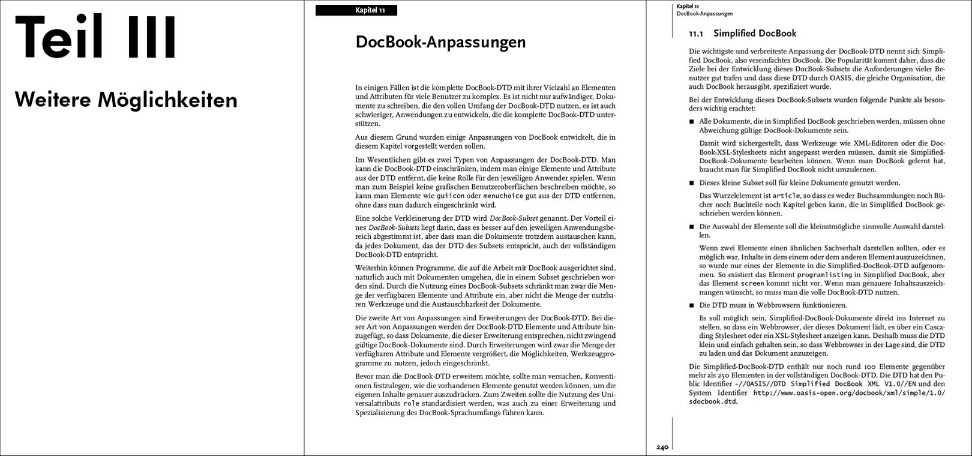
Figure: Layout of a three-level book hierarchy.
Structure it in DTBook as follows, heavily shortened for clarity with paragraphs only suggested:
<level1 class="Teil">
  <h1>Teil III: Weitere Möglichkeiten</h1>
  <level2 class="Abschnitt">
    <h2>11. DocBook-Anpassungen</h2>
    <level3 class="Kapitel">
      <h3>11.1 Simplified DocBook</h3>
      <p>Text Text Text</p>
    </level3>
    <level3 class="Kapitel">
      <h3>11.2 Andere Anpassungen</h3>
      <p>Text Text Text</p>
    </level3>
    <level3 class="Kapitel">
      <h3>11.3 Eigene Anpassungen</h3>
      <p>Text Text Text</p>
    </level3>
  </level2>
</level1>
Code example: Proposed three-level book hierarchy in DTBook
The reference section (Rearmatter) may finally contain:
| Suggested German | Meaning |
|---|---|---|
|
| Appendices often contain detailed materials or reference texts not essential to understanding the main text and therefore placed separately. |
|
| Notes referring directly to text but moved to the end for clarity, usually referenced by superscript numbers. |
|
| Short definitions of important terms used in the text |
|
| List of cited or used literature |
|
| Keyword index, usually with page references in print |
Copyright © mitp 2011
You may print the online version for your private use.
Otherwise, this chapter from “E-Books mit ePUB” is subject to the same terms as the printed edition: the work and all its parts are protected by copyright. All rights reserved, including reproduction, translation, microfilming, and storage and processing in electronic systems.
Verlagsgruppe Hüthig Jehle Rehm GmbH, Im Weiher 10, 69121 Heidelberg, kundenbetreuung(at)hjr-verlag.de
back to top