Technologies XML / XSL-FO / Référence / Extensions XSL d’Antenna House Formatter / Propriétés / float-reference
(Extrait de « XSL-FO ― Die Referenz » de Manuel Montero Pineda & Steffen Herkert, 2016, dpunkt.verlag)
A | B | C | D | E | F | G | H | I | J | K | L | M | N | O | P | Q | R | S | T | U | V | W | X | Y | Z
Catégorie Propriétés d’extension des flottants >> axf:float-y / CSS -ah-float-y
Définit la zone de référence dans laquelle le flottant est placé.
Valeur : | auto | normal | page | column | multicol |
Valeur initiale : | auto |
S’applique à : | fo:float / éléments flottants |
Hérité : | no |
Pourcentages : | N/A |
Les valeurs ont les significations suivantes.
auto | Identique à normal. Toutefois, lorsque float-y vaut none dans CSS, le positionnement du flottant est influencé par les retraits du bloc contenant son ancre. |
normal | Le flottant est placé dans la zone de référence courante. |
page | Le flottant est placé dans la zone de page (region-body). |
column | Le flottant est placé dans la zone de colonne. |
multicol | Le flottant est placé dans la zone à plusieurs colonnes. |
Lorsque float-y vaut none, la zone de référence sur l’axe x est définie.
En CSS, si float-y vaut none et que float-reference vaut auto le positionnement du flottant dépend des retraits du bloc contenant son ancre. Toutefois, en spécifiant normal, page, ou column, il est possible de positionner les flottants indépendamment des retraits du bloc.
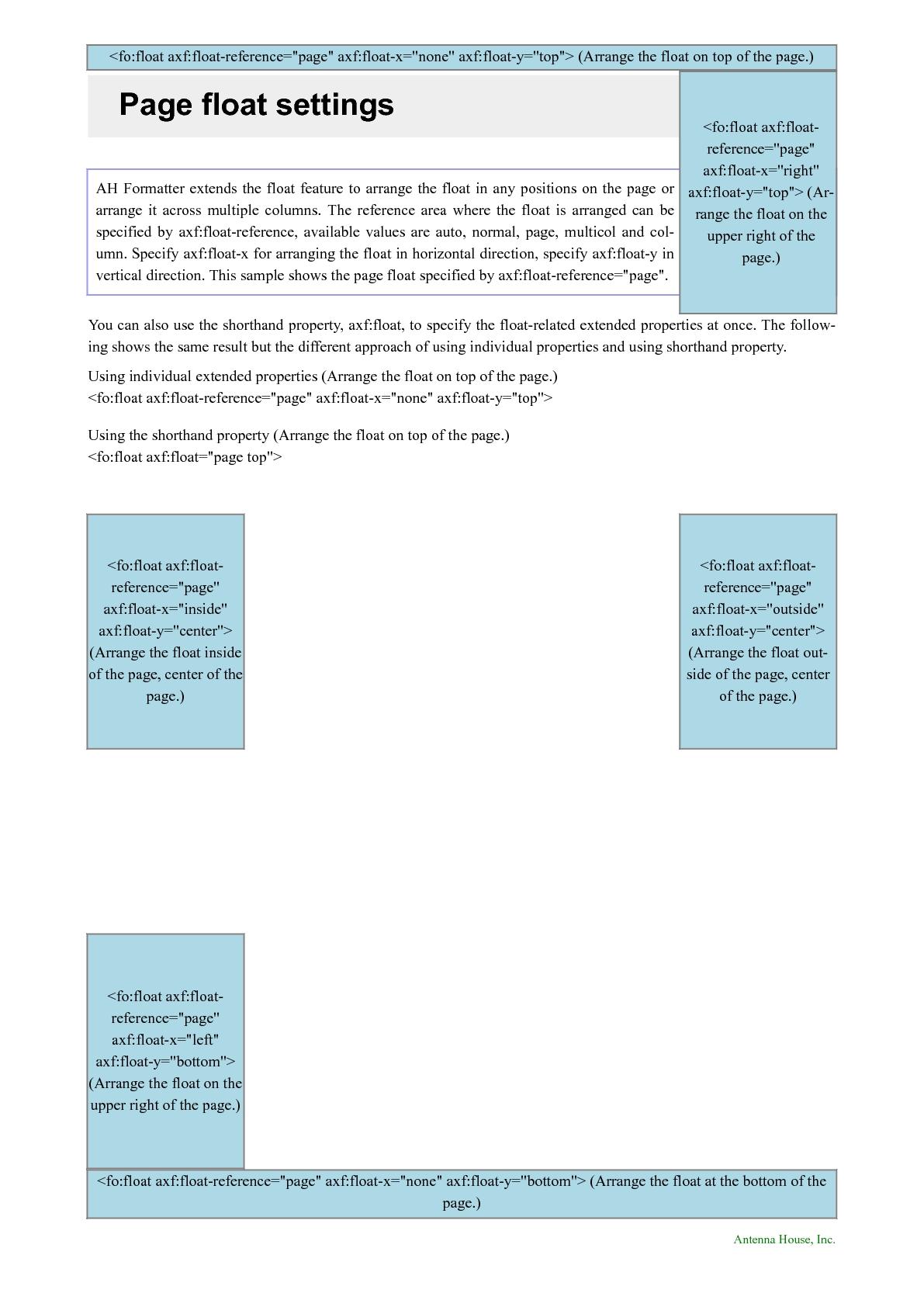
Exemple XSL-FO :
<fo:root xml:lang="en" xmlns:fo="http://www.w3.org/1999/XSL/Format" xmlns:cpfo="http://www.compart.net/xmlns/cpfo" xmlns:svg="http://www.w3.org/2000/svg" xmlns:axf="http://www.antennahouse.com/names/XSL/Extensions">
<axf:document-info name="document-title" value="Page float settings"/>
<axf:document-info name="author" value="Antenna House, Inc."/>
<fo:layout-master-set>
<fo:simple-page-master page-height="297mm" page-width="210mm" margin-top="10mm" margin-left="20mm" margin-right="20mm" margin-bottom="10mm" master-name="PageMaster1">
<fo:region-after extent="7mm"/>
<fo:region-body margin-top="0mm" margin-left="0mm" margin-right="0mm" margin-bottom="10mm"/>
</fo:simple-page-master>
</fo:layout-master-set>
<fo:page-sequence master-reference="PageMaster1">
<fo:static-content flow-name="xsl-region-after">
<fo:block font-size="0.8em" text-align="right" color="green">
<fo:basic-link external-destination="http://www.antennahouse.com/">
Antenna House, Inc.
</fo:basic-link>
</fo:block>
</fo:static-content>
<fo:flow flow-name="xsl-region-body" font-family="serif" font-size="1em" line-height="1.4" axf:hyphenate-hyphenated-word="false" hyphenate="true">
<fo:block span="all" font-family="sans-serif" font-size="2em" font-weight="bold" line-height="2" space-before="1em" space-after="1em" space-before.conditionality="retain" space-after.conditionality="retain" background-color="#EEEEEE">
<fo:block start-indent="1em" end-indent="1em">
Page float settings
</fo:block>
</fo:block>
<fo:block span="all" space-before="1em" space-after="1em" space-after.conditionality="retain" text-indent="0em" border="1pt solid #9999FF" start-indent="0.5em" end-indent="0.5em" padding="0.5em" text-align="justify">
AH Formatter extends the float feature to arrange the float in any positions on the page or arrange it across multiple columns. The reference area where the float is arranged can be specified by axf:float-reference, available values are auto, normal, page, multicol and column. Specify axf:float-x for arranging the float in horizontal direction, specify axf:float-y in vertical direction. This sample shows the page float specified by axf:float-reference="page".
</fo:block>
<fo:block text-align="justify" space-after="0.5em">

You can also use the shorthand property, axf:float, to specify the float-related extended properties at once. The following shows the same result but the different approach of using individual properties and using shorthand property.
</fo:block>
<fo:block>
Using individual extended properties (Arrange the float on top of the page.)
</fo:block>
<fo:block space-after="1em">
<fo:float axf:float-reference="page" axf:float-x="none" axf:float-y="top">
</fo:block>
<fo:block>
Using the shorthand property (Arrange the float on top of the page.)
</fo:block>
<fo:block>
<fo:float axf:float="page top">
</fo:block>
<fo:float axf:float-reference="page" axf:float-x="none" axf:float-y="top">
<fo:block-container height="1.5em" background-color="lightblue" text-align="center" border="1pt solid gray">
<fo:block>
<fo:float axf:float-reference="page" axf:float-x="none" axf:float-y="top"> (Arrange the float on top of the page.)
</fo:block>
</fo:block-container>
</fo:float>
<fo:float axf:float-reference="page" axf:float-x="right" axf:float-y="top">
<fo:block-container width="10em" height="15.5em" margin-left="0.3em" background-color="lightblue" text-align="center" display-align="center" border="1pt solid gray">
<fo:block>
<fo:float axf:float-reference="page" axf:float-x="right" axf:float-y="top"> (Arrange the float on the upper right of the page.)
</fo:block>
</fo:block-container>
</fo:float>
<fo:float axf:float-reference="page" axf:float-x="left" axf:float-y="bottom">
<fo:block-container width="10em" height="15em" background-color="lightblue" text-align="center" display-align="center" border="1pt solid gray">
<fo:block>
<fo:float axf:float-reference="page" axf:float-x="left" axf:float-y="bottom"> (Arrange the float on the upper right of the page.)
</fo:block>
</fo:block-container>
</fo:float>
<fo:float axf:float-reference="page" axf:float-x="outside" axf:float-y="center">
<fo:block-container width="10em" height="15em" background-color="lightblue" text-align="center" display-align="center" border="1pt solid gray">
<fo:block>
<fo:float axf:float-reference="page" axf:float-x="outside" axf:float-y="center"> (Arrange the float outside of the page, center of the page.)
</fo:block>
</fo:block-container>
</fo:float>
<fo:float axf:float-reference="page" axf:float-x="inside" axf:float-y="center">
<fo:block-container width="10em" height="15em" background-color="lightblue" text-align="center" display-align="center" border="1pt solid gray">
<fo:block>
<fo:float axf:float-reference="page" axf:float-x="inside" axf:float-y="center"> (Arrange the float inside of the page, center of the page.)
</fo:block>
</fo:block-container>
</fo:float>
<fo:float axf:float-reference="page" axf:float-x="none" axf:float-y="bottom">
<fo:block-container height="3em" background-color="lightblue" text-align="center" border="1pt solid gray">
<fo:block>
<fo:float axf:float-reference="page" axf:float-x="none" axf:float-y="bottom"> (Arrange the float at the bottom of the page.)
</fo:block>
</fo:block-container>
</fo:float>
</fo:flow>
</fo:page-sequence>
</fo:root>Résultat :