Tecnologías XML / XSL-FO / Referencia / Extensiones XSL de Antenna House Formatter / Propiedades / float-reference
(Extracto de «XSL-FO ― Die Referenz» de Manuel Montero Pineda & Steffen Herkert, 2016, dpunkt.verlag)
A | B | C | D | E | F | G | H | I | J | K | L | M | N | O | P | Q | R | S | T | U | V | W | X | Y | Z
Categoría Propiedades de ampliación de flotantes >> axf:float-y / CSS -ah-float-y
Especifica el área de referencia donde se coloca el flotante.
Valor: | auto | normal | page | column | multicol |
Valor inicial: | auto |
Se aplica a: | fo:float / elementos flotantes |
Heredado: | no |
Porcentajes: | N/A |
Los valores tienen los significados siguientes.
auto | Igual que normal. Sin embargo, cuando float-y es none en CSS, la posición del flotante se ve afectada por las sangrías del bloque que contiene su ancla. |
normal | El flotante se coloca en el área de referencia actual. |
page | El flotante se coloca en el área de página (region-body). |
column | El flotante se coloca en el área de columna. |
multicol | El flotante se coloca en el área de varias columnas. |
Cuando float-y es none, se establece el área de referencia en el eje x.
En CSS, si float-y es none y float-reference es auto la posición del flotante depende de las sangrías del bloque que contiene su ancla. Sin embargo, al especificar normal, page, o column, es posible colocar los flotantes independientemente de las sangrías del bloque.
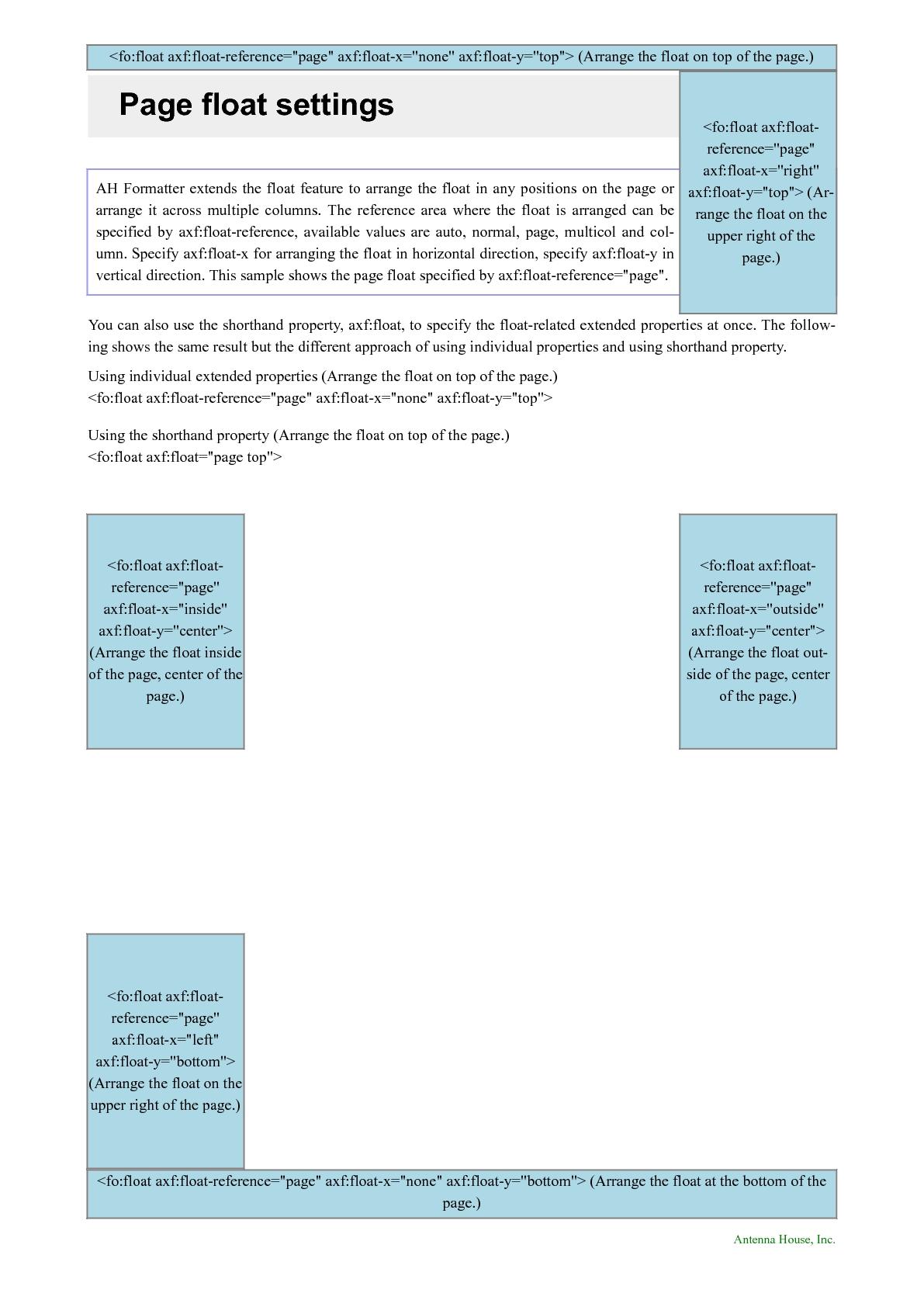
Ejemplo XSL-FO:
<fo:root xml:lang="en" xmlns:fo="http://www.w3.org/1999/XSL/Format" xmlns:cpfo="http://www.compart.net/xmlns/cpfo" xmlns:svg="http://www.w3.org/2000/svg" xmlns:axf="http://www.antennahouse.com/names/XSL/Extensions">
<axf:document-info name="document-title" value="Page float settings"/>
<axf:document-info name="author" value="Antenna House, Inc."/>
<fo:layout-master-set>
<fo:simple-page-master page-height="297mm" page-width="210mm" margin-top="10mm" margin-left="20mm" margin-right="20mm" margin-bottom="10mm" master-name="PageMaster1">
<fo:region-after extent="7mm"/>
<fo:region-body margin-top="0mm" margin-left="0mm" margin-right="0mm" margin-bottom="10mm"/>
</fo:simple-page-master>
</fo:layout-master-set>
<fo:page-sequence master-reference="PageMaster1">
<fo:static-content flow-name="xsl-region-after">
<fo:block font-size="0.8em" text-align="right" color="green">
<fo:basic-link external-destination="http://www.antennahouse.com/">
Antenna House, Inc.
</fo:basic-link>
</fo:block>
</fo:static-content>
<fo:flow flow-name="xsl-region-body" font-family="serif" font-size="1em" line-height="1.4" axf:hyphenate-hyphenated-word="false" hyphenate="true">
<fo:block span="all" font-family="sans-serif" font-size="2em" font-weight="bold" line-height="2" space-before="1em" space-after="1em" space-before.conditionality="retain" space-after.conditionality="retain" background-color="#EEEEEE">
<fo:block start-indent="1em" end-indent="1em">
Page float settings
</fo:block>
</fo:block>
<fo:block span="all" space-before="1em" space-after="1em" space-after.conditionality="retain" text-indent="0em" border="1pt solid #9999FF" start-indent="0.5em" end-indent="0.5em" padding="0.5em" text-align="justify">
AH Formatter extends the float feature to arrange the float in any positions on the page or arrange it across multiple columns. The reference area where the float is arranged can be specified by axf:float-reference, available values are auto, normal, page, multicol and column. Specify axf:float-x for arranging the float in horizontal direction, specify axf:float-y in vertical direction. This sample shows the page float specified by axf:float-reference="page".
</fo:block>
<fo:block text-align="justify" space-after="0.5em">

You can also use the shorthand property, axf:float, to specify the float-related extended properties at once. The following shows the same result but the different approach of using individual properties and using shorthand property.
</fo:block>
<fo:block>
Using individual extended properties (Arrange the float on top of the page.)
</fo:block>
<fo:block space-after="1em">
<fo:float axf:float-reference="page" axf:float-x="none" axf:float-y="top">
</fo:block>
<fo:block>
Using the shorthand property (Arrange the float on top of the page.)
</fo:block>
<fo:block>
<fo:float axf:float="page top">
</fo:block>
<fo:float axf:float-reference="page" axf:float-x="none" axf:float-y="top">
<fo:block-container height="1.5em" background-color="lightblue" text-align="center" border="1pt solid gray">
<fo:block>
<fo:float axf:float-reference="page" axf:float-x="none" axf:float-y="top"> (Arrange the float on top of the page.)
</fo:block>
</fo:block-container>
</fo:float>
<fo:float axf:float-reference="page" axf:float-x="right" axf:float-y="top">
<fo:block-container width="10em" height="15.5em" margin-left="0.3em" background-color="lightblue" text-align="center" display-align="center" border="1pt solid gray">
<fo:block>
<fo:float axf:float-reference="page" axf:float-x="right" axf:float-y="top"> (Arrange the float on the upper right of the page.)
</fo:block>
</fo:block-container>
</fo:float>
<fo:float axf:float-reference="page" axf:float-x="left" axf:float-y="bottom">
<fo:block-container width="10em" height="15em" background-color="lightblue" text-align="center" display-align="center" border="1pt solid gray">
<fo:block>
<fo:float axf:float-reference="page" axf:float-x="left" axf:float-y="bottom"> (Arrange the float on the upper right of the page.)
</fo:block>
</fo:block-container>
</fo:float>
<fo:float axf:float-reference="page" axf:float-x="outside" axf:float-y="center">
<fo:block-container width="10em" height="15em" background-color="lightblue" text-align="center" display-align="center" border="1pt solid gray">
<fo:block>
<fo:float axf:float-reference="page" axf:float-x="outside" axf:float-y="center"> (Arrange the float outside of the page, center of the page.)
</fo:block>
</fo:block-container>
</fo:float>
<fo:float axf:float-reference="page" axf:float-x="inside" axf:float-y="center">
<fo:block-container width="10em" height="15em" background-color="lightblue" text-align="center" display-align="center" border="1pt solid gray">
<fo:block>
<fo:float axf:float-reference="page" axf:float-x="inside" axf:float-y="center"> (Arrange the float inside of the page, center of the page.)
</fo:block>
</fo:block-container>
</fo:float>
<fo:float axf:float-reference="page" axf:float-x="none" axf:float-y="bottom">
<fo:block-container height="3em" background-color="lightblue" text-align="center" border="1pt solid gray">
<fo:block>
<fo:float axf:float-reference="page" axf:float-x="none" axf:float-y="bottom"> (Arrange the float at the bottom of the page.)
</fo:block>
</fo:block-container>
</fo:float>
</fo:flow>
</fo:page-sequence>
</fo:root>Resultado: