

XML technologies / ePUB / Open Publication Structure / Pages and page-dependent structures / Running titles
(Excerpt from “E-Books mit ePUB ─ Von Word zum E-Book mit XML” by Dr. Victor Wang)
A running title provides orientation, relating the current passage to the hierarchy it reflects. This matters particularly in deeply structured works, perhaps even more in e-books, where page numbers and book thickness otherwise provide no orientation.
It therefore makes sense to expose the context of the current text by other means. Since a chapter usually is the lowest unit, put this information at its beginning, perhaps as a path through its parent chapters.
Consider the earlier specialist-book example, figure Layout of three book-hierarchy levels. Its logical hierarchy yields the context shown below.
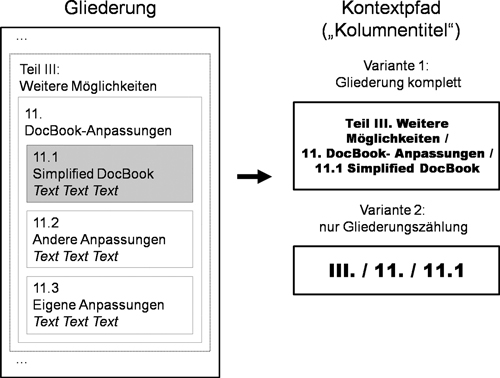
Figure: Generating a context path schematically.
We follow this approach, generating during OPS conversion an extra paragraph, marked with a suitable class attribute class="Kolumnentiteltext" before the chapter heading.
<?xml version="1.0" encoding="UTF-8"?>
<!DOCTYPE html PUBLIC "-//W3C//DTD XHTML 1.0 Strict//EN" "http://www.w3.org/TR/xhtml1/DTD/xhtml1-strict.dtd">
<html xmlns="http://www.w3.org/1999/xhtml" xml:lang="de">
  <head>
    <title>Seitenangaben in XHTML</title>
  </head>
  <body>
    <div class="Gliederungsebene">
      <h1>Kolumnentitel (generiert)</h1>
        <div class="Teil">
          <h1><a id="teil-III"/>Teil III: Weitere Möglichkeiten</h1>
          <div class="Abschnitt">
            <h2><a id="teil-III-kap-11"/>11. DocBook-Anpassungen</h2>
            <p>In einigen Fällen ist die komplette DocBook-DTD mit ihrer Vielzahl an Elementen und Attributen für viele Benutzer zu komplex. Es ist nicht nur aufwändiger, Dokumente zu schreiben, die den vollen Umfang der DocBook-DTD nutzen, es ist auch schwieriger, Anwendungen zu entwickeln, die die komplette DocBook-DTD unterstützen.</p>
            <div class="Kapitel">
              <p class="Kolumnentiteltext"><a href="teil-III">Teil III: Weitere Möglichkeiten</a> / <a href="teil-III-kap-11">11. DocBook-Anpassungen</a> / 11.1 Simplified DocBook</p>
              <h3>11.1 Simplified DocBook</h3>
              <p>Die wichtigste und verbreiteste Anpassung der DocBook-DTD nennt sich Simplified DocBook, also vereinfachtes DocBook. Die Popularität kommt daher, dass die Ziele bei der Entwicklung dieses DocBook-Subsets die Anforderungen vieler Benutzer gut trafen und dass diese DTD durch OASIS, dieselbe Organisation, die auch DocBook herausgibt, spezifiziert wurde.</p>
              <p>. . .</p>
            </div>
          </div>
        </div>
    </div>
  </body>
</html>
Code example: Running-title markup
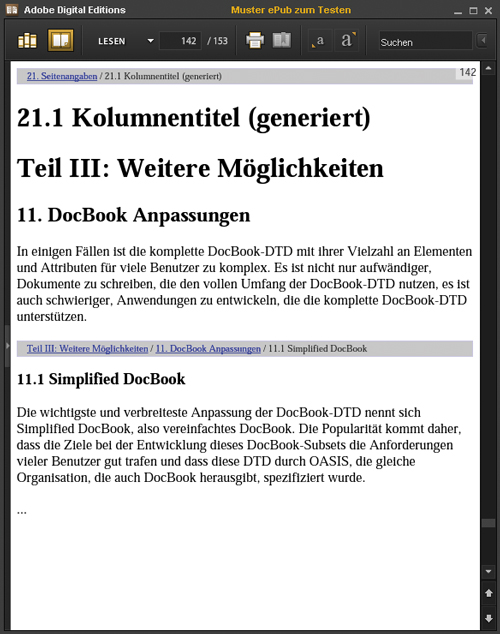
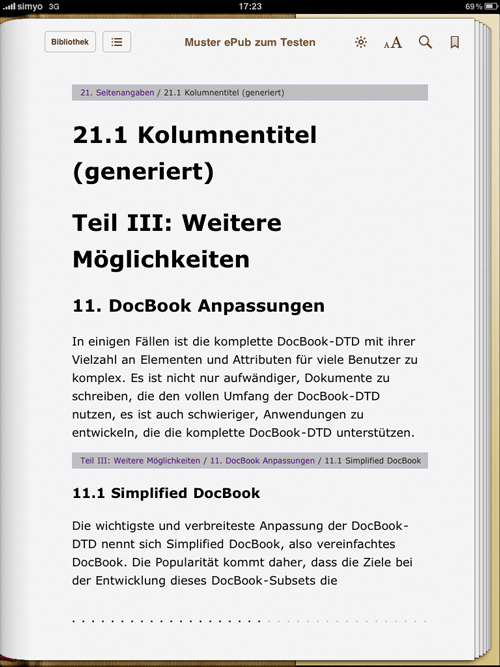
Figures: Context path before section 11.1 (Adobe Digital Editions and iBooks)
OPS does provide for headers. CSS is extended with two values for the property display:
display: oeb-page-head;— marks headers or running titles
display: oeb-page-foot;— marks footers
Neither extension is supported by any reader known to the author.
Copyright © mitp 2011
You may print the online version for your private use.
Otherwise, this chapter from “E-Books mit ePUB” is subject to the same terms as the printed edition: the work and all its parts are protected by copyright. All rights reserved, including reproduction, translation, microfilming, and storage and processing in electronic systems.
Verlagsgruppe Hüthig Jehle Rehm GmbH, Im Weiher 10, 69121 Heidelberg, kundenbetreuung(at)hjr-verlag.de
back to top