

XML technologies / ePUB / Open Publication Structure / References, footnotes and notes / Notes and footnotes
(Excerpt from “E-Books mit ePUB ─ Von Word zum E-Book mit XML” by Dr. Victor Wang)
A note is additional text referring to a passage. Print commonly uses a footnote or endnote: a marker points to text at the page or document end. Marginal information appears alongside the passage without necessarily needing a marker. Sources and bibliographic entries serve similarly, expanding citations in a bibliography. Notes thus usually entail reference logic.
The two OPS vocabularies, XHTML and DTBook, treat notes very differently. XHTML is purely online, without dedicated note elements; each implementation needs its own link-target structure.
DTBook follows print books more closely, offering sometimes overlapping structures: notes (<note>/<noteref>), annotations (<annotation>/<annoref>), producer’s notes or sources (<prodnote>) and supplementary information (<sidebar>).
Before examining DTBook-only structures, consider alternatives for electronic print footnotes:
Show note text as a block while retaining its marker, at paragraph end, document end or publication end, perhaps an appendix.
Show note text inline at the marker position.
Show it inline but wrapped by other text, requiring a stylesheet.
Options 2 and 3 suit only few, short notes. Otherwise use option 1.
For approach 1, consider this example:
<?xml version="1.0" encoding="UTF-8"?>
<!DOCTYPE html PUBLIC "-//W3C//DTD XHTML 1.0 Strict//EN" "http://www.w3.org/TR/xhtml1/DTD/xhtml1-strict.dtd">
<html xmlns="http://www.w3.org/1999/xhtml" xml:lang="de">
  <head>
    <title>Anmerkungen und Fußnoten XHTML</title>
  </head>
  <body>
    <div class="Gliederungsebene">
      <h1>Beispiel 2: Block-Fußnote mit Rücklink</h1>
      <p><strong>Fußnotentext als Block separat von Fußnotenreferenz mit Rücklink</strong>:</p>
      <p>Im Jahre 1863 hat ein Engländer W. Watkiss Lloyd dem Moses von Michelangelo ein kleines Büchlein gewidmet <a class="footnote" href="#fn-11" id="fnpos-11">[11]</a>. Als es mir gelang, dieser Schrift von 46 Seiten habhaft zu werden, nahm ich ihren Inhalt mit gemischten Empfindungen zur Kenntnis. Es war eine Gelegenheit, wieder an der eigenen Person zu erfahren, was für unwürdige infantile Motive zu unserer Arbeit im Dienste einer großen Sache beizutragen pflegen. Ich bedauerte, dass Lloyd so vieles vorweggenommen hatte, was mir als Ergebnis meiner eigenen Bemühung wertvoll war, und erst in zweiter Instanz konnte ich mich über die unerwartete Bestätigung freuen. An einem entscheidenden Punkte trennen sich allerdings unsere Wege.</p>
      <p class="Quelle">Quelle: <cite>Sigmund Freud: Der Moses des Michelangelo, in: Imago. Zeitschrift für Anwendung der Psychoanalyse auf die Geisteswissenschaften III (1914). S. 15–36.</cite> (Text zitiert nach dem Gutenberg-Projekt)</p>
      <hr/>
      <p><a id="fn-11" href="#fnpos-11" class="footnote-text">[11]</a> <cite>W. Watkiss Lloyd, The Moses of Michelangelo. London, Williams and Norgate, 1863</cite>.</p>
    </div>
  </body>
</html>
Code example: Block footnote in XHTML
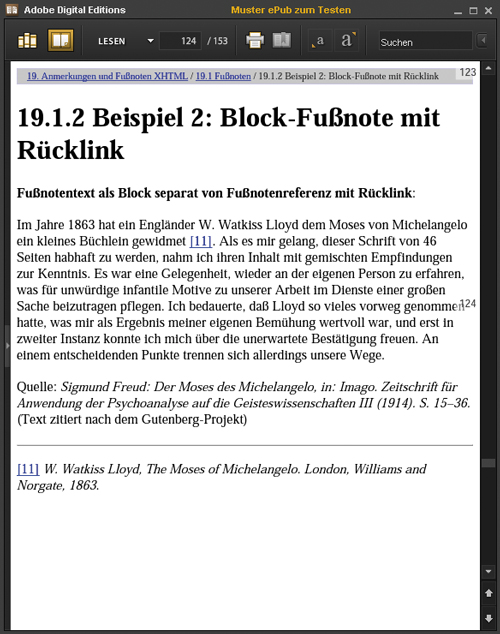
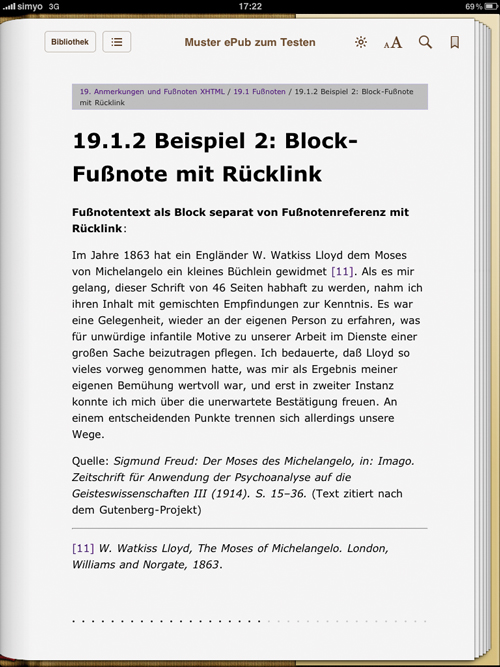
Figures: Block footnote (Adobe Digital Editions and iBooks)
The approach 2 puts bracketed note text at the marker, retaining the marker only for citation. Put the note in a separate inline element <span>:
<?xml version="1.0" encoding="UTF-8"?>
<!DOCTYPE html PUBLIC "-//W3C//DTD XHTML 1.0 Strict//EN" "http://www.w3.org/TR/xhtml1/DTD/xhtml1-strict.dtd">
<html xmlns="http://www.w3.org/1999/xhtml" xml:lang="de">
  <head>
    <title>Anmerkungen und Fußnoten XHTML</title>
  </head>
  <body>
    <div class="Gliederungsebene">
      <h1>Beispiel 3: Inline-Fußnote</h1>
      <p><strong>Fußnotentext wird am Ort der Fußnotenreferenz inline eingebunden</strong>:</p>
      <p>Im Jahre 1863 hat ein Engländer W. Watkiss Lloyd dem Moses von Michelangelo ein kleines Büchlein gewidmet <span class="inline-footnote">([12] <cite>W. Watkiss Lloyd, The Moses of Michelangelo. London, Williams and Norgate, 1863</cite>)</span>. Als es mir gelang, dieser Schrift von 46 Seiten habhaft zu werden, nahm ich ihren Inhalt mit gemischten Empfindungen zur Kenntnis. Es war eine Gelegenheit, wieder an der eigenen Person zu erfahren, was für unwürdige infantile Motive zu unserer Arbeit im Dienste einer großen Sache beizutragen pflegen. Ich bedauerte, dass Lloyd so vieles vorweggenommen hatte, was mir als Ergebnis meiner eigenen Bemühung wertvoll war, und erst in zweiter Instanz konnte ich mich über die unerwartete Bestätigung freuen. An einem entscheidenden Punkte trennen sich allerdings unsere Wege.</p>
      <p class="Quelle">Quelle: <cite>Sigmund Freud: Der Moses des Michelangelo, in: Imago. Zeitschrift für Anwendung der Psychoanalyse auf die Geisteswissenschaften III (1914). S. 15–36</cite> (Text zitiert nach dem Gutenberg-Projekt)</p>
    </div>
  </body>
</html>
Code example: Inline footnote in XHTML
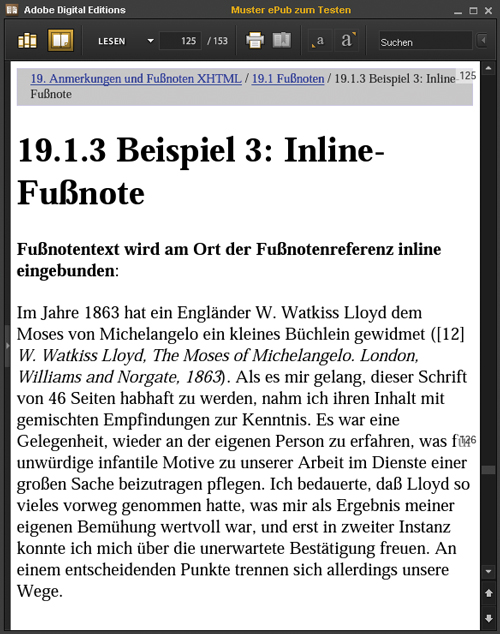
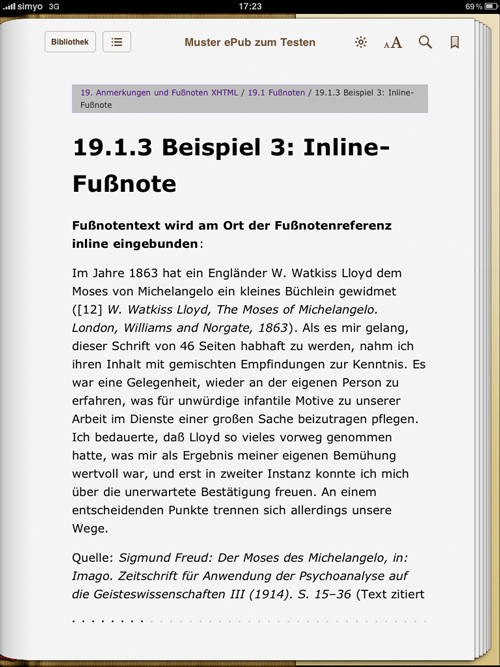
Figures: Inline footnote (Adobe Digital Editions and iBooks)
For third display option, wrap the note at the right edge, omitting the two parentheses from the previous example.
Extend the CSS stylesheet with a class rule. This example reduces note text size, uses 30% width and a border open on the right:
span.inline-footnote {
   float: right;
   clear: right;
   width: 30%;
   font-size: 0.85em;
   padding: 0.5em 0 0.5em 0.5em;
   margin: 0.5em 0 0.25em 1em;
   border-top: 2px solid #999;
   border-left: 2px solid #999;
   border-bottom: 2px solid #999
   }
Code example: CSS for wrapped inline footnotes
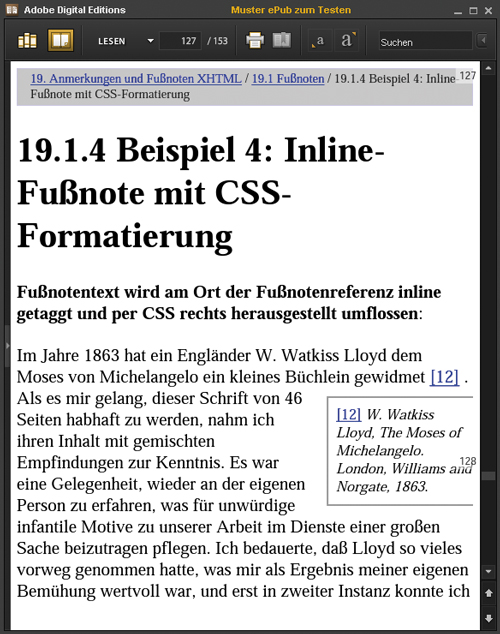
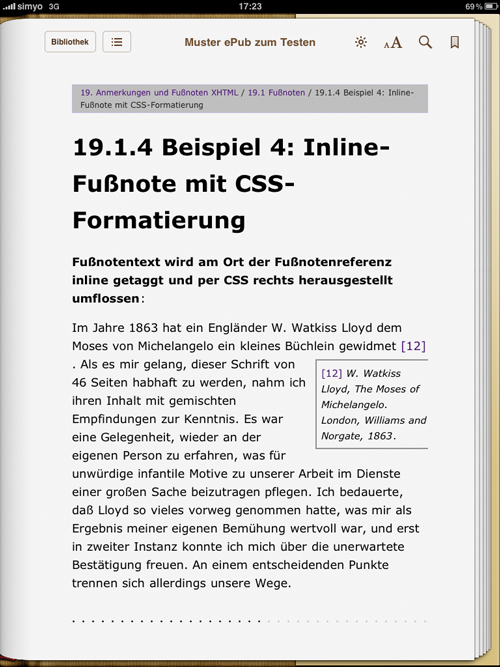
Figures: Wrapped inline footnote (Adobe Digital Editions and iBooks)
Copyright © mitp 2011
You may print the online version for your private use.
Otherwise, this chapter from “E-Books mit ePUB” is subject to the same terms as the printed edition: the work and all its parts are protected by copyright. All rights reserved, including reproduction, translation, microfilming, and storage and processing in electronic systems.
Verlagsgruppe Hüthig Jehle Rehm GmbH, Im Weiher 10, 69121 Heidelberg, kundenbetreuung(at)hjr-verlag.de
back to top