

XML technologies / ePUB / Open Container Format / The container’s role
(Excerpt from “E-Books mit ePUB ─ Von Word zum E-Book mit XML” by Dr. Victor Wang)
The Open Container Format is container technology combining source files into one file. This container is easy to send, transport and distribute. A clear internal file structure also helps data management and controlled access to individual files.
Many applications therefore use containers, particularly with XML. We have already seen Office 2007’s XML formats, especially Word’s DOCX format and Excel’s XLSX format. Open Office and others do likewise. OCF is not restricted to ePUB and could also carry other content.
What does such a container look like? OCF distinguishes abstract and physical containers. An abstract container is a file-system model with a defined directory and file structure. Its root must contain all files required for the ePUB format. This file system is unwieldy for exchange, so the model is converted into one file, the physical container. Unlike proprietary OEBPS-generation formats such as Mobipocket or Microsoft Literature, OCF uses the ZIP format, the de facto industry standard for compression and bundling, as its physical container, illustrated below.
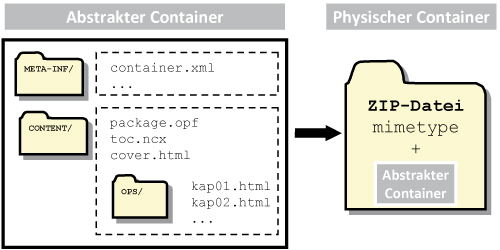
Figure: OCF abstract and physical container concept.
Copyright © mitp 2011
You may print the online version for your private use.
Otherwise, this chapter from “E-Books mit ePUB” is subject to the same terms as the printed edition: the work and all its parts are protected by copyright. All rights reserved, including reproduction, translation, microfilming, and storage and processing in electronic systems.
Verlagsgruppe Hüthig Jehle Rehm GmbH, Im Weiher 10, 69121 Heidelberg, kundenbetreuung(at)hjr-verlag.de
back to top