

XML technologies / DITA / Migrating to DITA / DITA maturity model
(Excerpt from “DITA - Der neue Standard für Technische Dokumentation” by Johannes Hentrich)
Considering a move to DITA inevitably raises the question of cost. There is no general answer: it depends largely on how thoroughly DITA is adopted. The more features used, the greater the migration effort. What does it cost? This section examines in detail how cost depends on the features used.
Michael Priestley and Amber Swope’s DITA maturity model also guides expected investment. It identifies six stages toward full adoption and use:
Content migration
Content reuse and output
Specialization and customization
Automation and integration
Semantics on demand
Universal DITA ecosystem
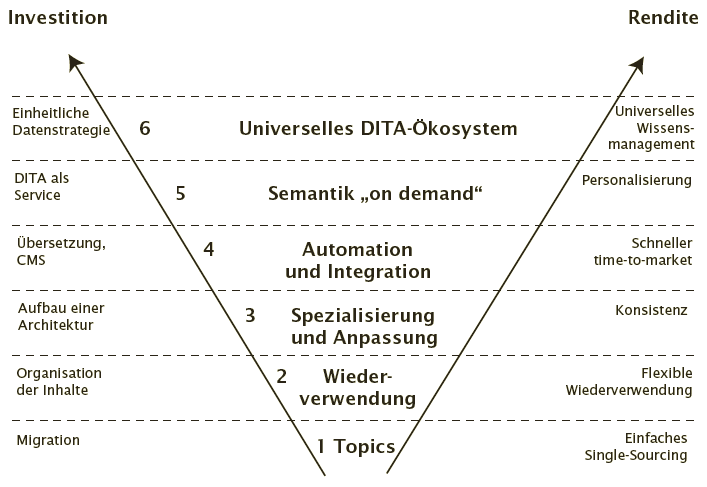
Figure: DITA maturity model.
Content migration
A move to DITA almost always begins by migrating existing content into its XML-based topic structure. Adobe’s document Migrating from Unstructured to Structured FrameMaker is entirely right: migration is both an opportunity and a challenge.
Existing content (legacy content) may be structured or unstructured and stored in formats such as Word, FrameMaker or InDesign.
Structure matters more than file format for DITA migration. Well-structured Word content may be easier to migrate than unstructured FrameMaker content.
Even structured content can be difficult to migrate if few or no structural elements resemble topics. Claims that more structure always makes migration easier therefore need caution.
Word-to-DITA conversion illustrates the many migration options. Word is often called the best tool for unstructured documents, but mandatory styles used to format or mark content can also produce very well-structured documents.
At the time of this book’s publication, Word-to-DITA conversion is indirect. Two practical routes have become established:
Save Word as HTML, then convert the HTML with the toolkit’s migration tool
h2dto DITA.Import Word into FrameMaker, then convert with Omni Systems’
Mif2Goto DITA.
HTML carries far less structure than DITA XML, so little structural information survives migration. The FrameMaker and Mif2Go route is little different.
Migration can thus be automated only to a limited extent. It provides a foundation, but many further steps remain before content suits DITA. Manual intervention by technical writers is almost always necessary.
Migration mainly means converting existing content to DITA topics, enabling future topic-based editing. But the new structure also usually means writers must:
use new tools, such as XML editors;
adopt a new documentation approach requiring structured, topic-based work;
learn technologies such as XSL to produce the desired output media.
Migration, the first stage, is often the hardest. Conversion costs are underestimated and schedules too optimistic. Training writers in the new approach and maintaining their commitment when difficulties arise are also often underestimated. The writing team must commit to DITA.
Consider not only technical issues but also the personal aspects that always accompany change.
If no migration is needed, start with stage two: an environment for convenient topic reuse and output processing.
Content reuse and output
After migration, content exists as individual topics. Stage two develops reuse strategies for topics and their content and establishes production matching the organization’s corporate design in the desired output media.
Reuse is central to DITA. As described in Reusing content with maps and conref, it uses two mechanisms:
Using maps, references organize topics hierarchically, for example to generate an online help table of contents.
The
conrefmechanism marks content through its elements for referenced reuse in other topics.
Whatever the mechanism, a strategy must track and communicate where topics are referenced, newly created or updated. The priority is an environment where topics and content can be found. Underestimating topic counts often produces environments where finding content is difficult.
A simple filesystem may suffice for a few documents and certainly for testing DITA with one or two. Further approaches can develop as experience grows.
With several writers, version-control software such as Subversion can replace it, offering check-in/check-out, metadata and versioning. Costs remain low because open source Subversion has no license fees.
Content management systems provide more convenience. As shown in Content management, choosing one to match requirements is difficult. At publication time few open source systems suit DITA. Costs include not only licenses but customization for authoring systems or XML editors and writer training.
DITA authoring environments and Content management guide the creation of a suitable DITA working environment.
Output generation is linked to the choice of topic management tool. Except for a plain filesystem, a processing environment such as the DITA Open Toolkit can already be integrated into the tool.
Subversion, for example, works with the Eclipse IDE, which also integrates the toolkit.
XML editors and content management systems can likewise be customized to produce the desired output
media from within the system. Costs depend chiefly on integration depth.
Wherever the toolkit is used or integrated, stylesheets must be adapted to meet design requirements. As DITA Open Toolkit shows, several customization mechanisms exist, though documentation is not always sufficient.
Plan customization for every output medium: CSS for HTML, for example, and XSLT files for PDF.
Output can also be produced without the toolkit. If FrameMaker is used as DITA’s XML editor, it can generate PDFs, but its layout must still be customized to corporate design. No formatter supplies that design automatically.
Specialization and customization
The first two maturity stages use DITA elements almost unchanged. Content is migrated into existing types and marked using standard domains; existing mechanisms provide reuse.
Stage three adapts DITA to individual requirements, creating new structures through specialization rather than using only the defaults. Specialization is needed when:
Additional topic types are required. The general task, concept, reference and glossary types may suffice for software and other documentation, but practice often requires refinements.
Additional markup domains are needed. Standard domains target software documentation; other fields inevitably require domain specialization.
Structures need adaptation for output media. DITA 1.1 introduced bookmaps, a specialization of map, for organizing book topics. Other media such as mobile devices may need similar specialization.
Estimating specialization effort requires two considerations:
Existing DTDs and modules must be modified or new ones created, using originals as templates. As Specialization shows, their technical creation is relatively simple. Agreeing what to specialize and how is much more demanding in practice.
Stylesheets, whether Cascading Stylesheets for HTML or XSLT for PDF, may need changes. Specialization does not necessarily require toolkit stylesheet changes: new elements are processed like their base elements. Different output behavior does require changes, often technically harder than specializing a DTD. Processing integration depth and editors’ WYSIWYG support, for example, must be considered.
In summary, DTD or module specialization chiefly requires a suitable strategy rather than technical implementation. Adapting production processing puts technical issues first.
Automation and integration
Once specialization adapts DITA to capture and process content as required, publication processes can be considered for automation.
Information can then serve marketing or training as well as documentation. DITA should be integrated into all company communication, extending reuse across the organization.
Automation, translation integration, lower documentation costs, corporate communication and optimized or actively managed document lifecycles are often considered even before DITA adoption.
In practice, automation and integration become possible only after the first three stages.
Stage four makes a content management system unavoidable: effective publication and workflow control is barely possible without a central system.
Introducing one requires substantial money and implementation effort. Questions include:
who reuses which information;
who may produce which output;
how translation processes are integrated;
which workflows writers and teams need;
which metadata must be captured during information creation and editing.
Organizational questions dominate automation and integration. DITA has no version-control or workflow mechanism, so external components need a suitable concept implemented in the management system.
The same applies to translation: DITA provides no translation-management structures or concepts. External implementation again requires substantial conceptual work.
Semantics on demand
DITA planning initially focuses on managing internal information. But no company exists alone: almost all receive external content and must provide information to other companies.
Incoming content may be DITA, but is more often structured or less structured material unrelated to DITA.
Once an internal DITA system exists, external information must be addressed, especially regular or large deliveries. Its integration into the ecosystem needs investigation.
Options include:
Specializing elements to contain structured external content. DITA provides the
<data>element, for example. Domain specialization supplies semantics on demand.Providing wrappers for unstructured documents. A map could wrap an unstructured Word document, recording its title, metadata and reference. The document becomes searchable in a system managing structured data.
Integrating external DITA through generalization and supplied semantics.
A second problem is supplying external companies. They often need output media, but may require original XML for further processing instead.
If direct reuse is impossible, transform DITA into the required semantics: again, semantics on demand.
DITA content can also produce RSS feeds, which act like news tickers with headlines, short previews and links to the original topic. RSS feeds are themselves XML files.
Whether integrating external files or producing new XML, the management system must adapt. Technical changes usually pose the fewest problems. Organizational structures supporting writers at the interfaces are more important.
Universal DITA ecosystem
Priestley and Swope’s final stage envisions a DITA-based semantic ecosystem exchanging data across companies and standards, explicitly including publishers and government agencies whose information products are not primarily technical documentation.
DITA must expand considerably to meet this vision. Its software-documentation origins remain obvious. Extension efforts exist, but a universal exchange standard is still far away.
Beyond XML infrastructure, the greater challenge is establishing XML exchange outside technical documentation. Even within documentation, where XML and structure are natural choices, XML adoption is far from automatic and often requires a compelling need.
The vision should not be dismissed: the more companies exchange through a universal standard, the more valuable each company’s data becomes. The familiar network effect matters here too.
Companies considering DITA should therefore look beyond their boundaries, both to find partners offering help and to increase DITA’s benefits.
Copyright © 2008 XLcontent Verlag
You may print the online version for your private use.
Otherwise, this chapter from “DITA - Der neue Standard für Technische Dokumentation” is subject to the same conditions as the bound edition. The work, including all its parts, is protected by copyright. All rights reserved, including reproduction, translation, microfilming, and storage and processing in electronic systems.
XLcontent Verlag, Pflegerstraße 40, 81247 München