

XML technologies / XPath / XPath 2.0: language reference / Path expressions: axes
(Excerpt from "XSLT 2.0 & XPath 2.0" by Frank Bongers, chapter 4.)
Navigation through a document tree follows axes. Each step of a path expression can select only a subset of the nodes on its specified axis.
XPath and XQuery support different numbers of axes. XQuery supports only some XPath axes; among reverse axes, only parent is available. In particular, the namespace axis is not supported in XQuery. XPath support depends on the version: XPath 1.0 fully supports the namespace axis; XPath 2.0 deprecates it (deprecated), although applications may retain support.
Axis directions
Axes are classified as forward or reverse. Those proceeding from the context node in document order are forward (forward axes); those proceeding against document order are reverse (reverse axes). An axis’s orientation is called its principal direction.
Axis direction affects the context position assigned to an item in the sequence selected by the axis step.
Principal direction and sequence order (item numbering):
A sequence on a forward axis numbers its nodes in document order; otherwise, numbering is reversed.
As usual in XPath, the first item has position 1. If the document node is included, it is first for a forward axis and last for a reverse axis.
Forward axes
An axis containing only the context node, or the context node and nodes following it in document order, is forward.
The following axes are forward:
Self axis
Child axis
Descendant axis
Descendant-or-self axis
Following axis
Following-sibling axis
These axes primarily contain element nodes, their principal node kind, but also comment nodes or processing instructions as well as text nodes in the document.
The preceding axes cannot access attribute nodes or namespace nodes. Both node kinds have their own axes, where they are the principal node kind.
Both axes are also forward:
Attribute axis
Namespace axis
Reverse axes
An axis containing nodes preceding the context node in document order, possibly including the context itself, is reverse. Recall that self, containing only the context node, is forward. Reverse axes’ principal direction is opposite to document order.
Reverse axes include:
Parent axis
Ancestor axis
Preceding-sibling axis
Preceding axis
Ancestor-or-self axis
Complete coverage of the document tree
The hierarchical tree is fully covered by forward axes self, descendant and following plus reverse axes ancestor and preceding. These five axes do not overlap and together contain every node, excluding attributes and namespaces outside the hierarchy.
Here and in subsequent diagrams, the document node’s special role is shown by a dashed circle. The arbitrarily chosen context node has a light-gray background.
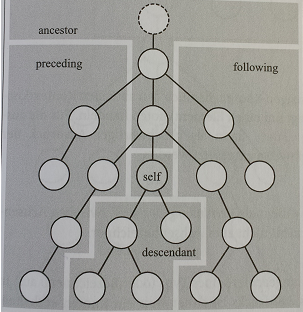
Figure: complete document-tree coverage using five axes.
Copyright © Galileo Press, Bonn 2008
You may print the online version for private use.
Otherwise, this chapter from "XSLT 2.0 & XPath 2.0 ― Das umfassende Handbuch" is subject to the same terms as the bound edition: the work and all its parts are protected by copyright. All rights reserved, including reproduction, translation, microfilming, storage and processing in electronic systems.
Galileo Press, Rheinwerkallee 4, 53227 Bonn