

XML technologies / XML / XML in a Nutshell / About the book
XML in a Nutshell
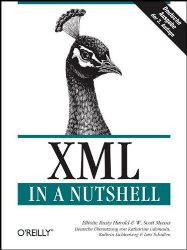
| Authors: Elliotte Rusty Harold & W. Scott Means German translation by Katharina Udemadu, Kathrin Lichtenberg, Lars Schulten Third edition, January 2005 ISBN 978-3-89721-339-5 718 pages e-book format: PDF The printed edition is no longer available! |
Contents
XML, the Extensible Markup Language, has established itself in recent years as a universal format for data and data exchange. Its strength is flexibility: XML can readily be adapted to applications as varied as web pages, wireless devices, voicemail systems, and web services. Like its many application areas, the standards, specifications, and interfaces of the extensive XML family continue to evolve rapidly. The new edition of XML in a Nutshell takes these developments into account. It retains its unique combination of descriptions of all major XML technologies and accompanying reference sections. All information has been thoroughly updated; coverage now includes, for example, XML 1.1 and XInclude.
This third edition of the standard reference XML in a Nutshell is aimed at developers and serious XML users who already have some experience and need a well-structured reference for their daily work. In addition to basic syntax rules and creating DTDs and schemas, the book covers, among many other topics, XSLT transformations and programming interfaces for processing XML documents. Whether you are a web designer using XML to produce web pages and PDF files or a C++ programmer using REST and SOAP to move data between systems, XML in a Nutshell provides the tools you need.
Contents include:
Introductions to the core XML standards: well-formed XML (including XML 1.1), DTDs, Namespaces, Unicode, RDDL and W3C XML Schema.
Presentation and linking techniques: XSLT, XPath, XLink, XPointer, XML Base, XInclude, CSS and XSL-FO.
Tools and APIs for developing XML processing programs: the event-based Simple API for XML (SAX2) and the tree-based Document Object Model (DOM Levels 2 and 3).
Detailed reference chapters on XML, DTDs, XPath, XSLT, SAX and DOM, together with the available character sets, round out this useful book.
(Source: O'Reilly Verlag)
Copyright © 2005 O'Reilly Verlag GmbH & Co. KG
You may print the online version for your private use.
Otherwise, this chapter from the book "XML in a Nutshell" is subject to the same conditions as the printed edition: the work and all its parts are protected by copyright. All rights reserved, including reproduction, translation, microfilming, and storage and processing in electronic systems.
O’Reilly Verlag GmbH & Co. KG, Balthasarstraße 81, 50670 Köln, kommentar(at)oreilly.de