

XML technologies / DITA / Processing information / Metadata
(Excerpt from “DITA – Der neue Standard für Technische Dokumentation” by Johannes Hentrich)
Metadata is crucial when processing electronically captured information. Distinguish metadata used directly for processing from that used indirectly, chiefly for management. DITA’s specification often does not separate these clearly, causing confusion, especially about whether metadata belongs in an attribute or an element.
The next two sections discuss both types, highlighting DITA’s particular definitions.
Managing data
Metadata is information about information. It adds information not explicitly visible in the document and therefore not directly accessible to its user. This classical definition also applies in DITA.
Today metadata generally means data added to electronic documents or files. The principle, however, is centuries old. Libraries, among other things classifying books, developed schemes for managing book data early: metadata for books.
Software development also uses metadata: source-code components not evaluated by the compiler can be called metadata, serving, for example, to document the code.
Web pages also contain metadata describing their subject matter or important keywords. It no longer fulfills this purpose today: website creators abused content metadata so extensively that search engines now practically ignore it.
Since 1994, the Dublin Core Metadata Initiative (DCMI) has proposed standardized conventions for describing internet documents. Although several working groups now develop the standard, this metadata has not become established in practice, at least on the web.
As libraries illustrate, metadata chiefly classifies and manages large amounts of data. Electronic searches can examine metadata as well as actual document content. Metadata can include synonyms to help users find documents.
Metadata can apply at any scale, from whole documents to individual words. Word or OpenOffice documents, for example, can receive metadata such as title, author, category and keywords.
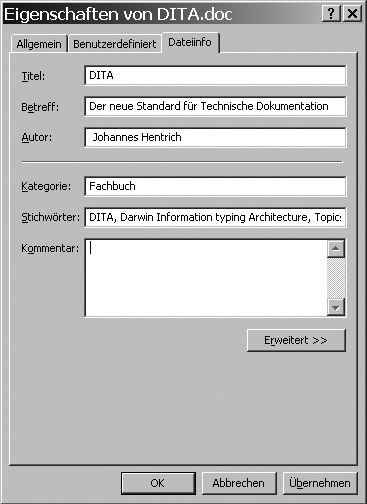
Figure: Metadata for a Word document.
Assigning metadata to individual sections or words requires them to be separable, that is, individually identifiable. XML documents are therefore especially suitable: their elements provide appropriate metadata structures.
Few metadata standards have been developed, mainly in fields managing large data volumes over very long periods.
The web particularly shows that arbitrarily used metadata does little to help search engines or users categorize pages meaningfully.
For DITA files, define guidelines specifying required metadata and its form, and what remains optional. Although not explicitly visible, metadata requires at least as much care as actual content. Systems interpreting it need every assistance to make stored information accessible later. If you are certain today that you can always find your topic by its content, wait until after your next holiday: you will appreciate metadata then.
If you expect to manage large numbers of topics, consider specializing DITA’s DTDs to make metadata mandatory. Metadata elements are optional in DITA. This is particularly worth considering when using content management systems.
There is no simple rule for the information volume at which metadata becomes necessary. At the latest, start collecting it when DITA XML files are managed through version control or a content management system.
Processing data
Metadata in electronic documents can be linked to particular processing operations. As in DITA, it can filter content (filtering) or flag it (flagging), marking it with a color or graphic.
In DITA, metadata influencing XML processing is assigned through attributes. The processing mechanism, the DITA Open Toolkit, evaluates them and generates output with content filtered and flagged. DITA calls this conditional processing. As Automated processing showed, this requires suitable tools.
Calling data stored in attributes metadata is somewhat unusual, since information-management metadata normally uses elements. Such elements occur not only in DITA but also, for example, in Extensible Name and Address Language. DITA’s xNAL domain incorporates many of its elements for recording address metadata.
This reveals another distinction. Processing metadata is tied to a specific process and useful only if that process can interpret it. Management metadata can be meaningful in a much broader context. Address metadata recorded through xNAL elements is an excellent example.
Copyright © 2008 XLcontent Verlag
You may print the online version for your private use.
Otherwise, this chapter from “DITA - Der neue Standard für Technische Dokumentation” is subject to the same conditions as the bound edition. The work, including all its parts, is protected by copyright. All rights reserved, including reproduction, translation, microfilming, and storage and processing in electronic systems.
XLcontent Verlag, Pflegerstraße 40, 81247 München