

XML technologies / Regular expressions / Practical regex techniques / A few short examples / Nested pairs of parentheses
(Excerpt from "Regular expressions" by Jeffrey E. F. Friedl)
Matching paired elements such as parentheses, angle brackets, square brackets, or braces is a common problem, especially when processing configuration files or programs. Suppose we want to extract a function’s argument list from a C program. Arguments follow the function name and are parenthesized, but may themselves contain parentheses, either in nested function calls or in algebraic expressions. Ignoring nested parentheses at first, we might try: ˹\bfoo\([^)]*\)˼, but this does not work.
In good C tradition, the example function is of course called foo. The highlighted part of the regex is intended to match the function’s arguments. With subject text such as foo(2,●.0) and foo(somevar,●3.7) this works as intended. Unfortunately, the regex also finds foo(bar(somevar),●3.7), which is not what we want. We need something “smarter” than ˹[^)]*˼; possible approaches include:
| regex | Description |
|---|---|---|
1. |
| Literal parentheses with anything between them |
2. |
| From an opening parenthesis to the next closing parenthesis |
3. |
| From an opening parenthesis to the next closing parenthesis, with no parentheses between them |
The following figure shows what these expressions would find in sample text.
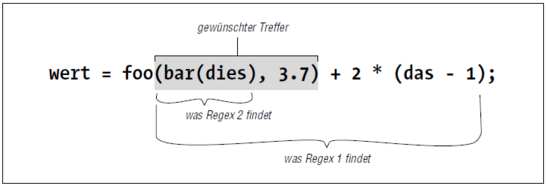
Figure: what our sample expressions would find.
As you can see, regex 1 matches too much text. (Note: ˹.*˼ should set off an alarm: are you sure the dot is what you want to quantify with a star? Sometimes it is, but ˹.*˼ is often misused.) Regex 2 matches too little. Regex 3 does not match at all: in isolation, ›(dies)‹ would match, but the opening parenthesis must immediately follow the function name foo. Thus none of the three expressions serves our purpose.
There is a reason for this: Regular expressions cannot match arbitrarily nested parentheses. It simply cannot be done. Until recently, this was universally true. More recently, however, Perl, the .NET languages, and PCRE/PHP offer constructs that do make this possible (see Matching nested pairs with dynamic regular expressions, Matching nested constructs and Parsing text with nested parentheses).
Even without these extensions, a regular expression can be constructed that works up to a certain nesting depth, though not for arbitrary nesting depths. For example, this regex allows just one level of nesting:
˹\([^()]*(\([^()]*\)[^()]*)*\)˼
The thought of allowing deeper nesting already becomes daunting. Yet the following short Perl fragment builds the corresponding regex for a nesting depth $depth. It uses the “string x count” operator to build a string consisting of count concatenated copies of the string.
$regex = '\(' . '(?:[^()]|\(' x $depth . '[^()]*' . '\))*' x $depth . '\)';The analysis is left to you.
German edition copyright © 2008 by O’Reilly Verlag GmbH & Co. KG
You may print the online version for private use.
Otherwise, this chapter from "Reguläre Ausdrücke" is subject to the same terms as the bound edition: the work and all its parts are protected by copyright. All rights reserved, including reproduction, translation, microfilming, storage and processing in electronic systems.
O’Reilly Verlag GmbH & Co. KG, Balthasarstr. 81, 50670 Köln
back to top