

XML technologies / RSS & Atom / What are newsfeeds? / Semantics: the RSS model / Minimum information
(Excerpt from "Newsfeeds with RSS and Atom" by Heinz Wittenbrink, published by Galileo Press, 2005)
Structure: channel and item or feed and entry
All RSS formats have two kinds of information objects: collections of new information and individual new items. Collections are called channel (RSS 1.0, RSS 2.0) or feed; an object within a collection is called item or entry. Both levels, channel/feed and entry/item, contain content, metadata, and information identifying and linking the objects.
Description: title – link – description
Besides the two levels of channel and individual information object, that is, channel and item, all feed formats share three characteristic pieces of information: title, link, and description. The RSS elements holding them are named title, link and description. They occur at both levels, channel and item.
A feed document generally describes another Web resource, identified by the content of the element link. Because it both represents and describes a Web resource, feed formats may be called metadata formats, although the distinction between data and metadata is difficult to define precisely.
The required presence of the element named link, and thus an identifiable document being referenced, distinguishes feed documents from formats such as HTML. Like all files accessible over HTTP, HTML elements and feed documents represent the resource identified by their access URI. That resource is abstract, never identical to the data sent by the server. URIs such as "http://www.spiegel.de" make this clear: they identify something without directly naming particular files or servers. Even an image URI identifies the image independently of a filesystem location. A mechanism must always resolve the URI and deliver specific data to the user.
The element link identifies what the RSS document describes; it is not the description itself. RSS defines the description as generally as possible, simply as a description. Every syndication vocabulary has an element for it; in RSS 1.0 and 2.0 it is called description. Only a title is additionally required, identifying for people what the URI in link identifies for machines. These same three elements recur for individual information objects described in the newsfeed as parts of the resource. They may, but need not, use their own element link to reference the information they describe.
All syndication vocabularies thus repeat, at the level of the item, a feed’s component, the whole feed’s minimal description. All additional elements extend this model, which could hardly be reduced further. They allow resources to be described with rich metadata and content to be carried in the feed document.
Displaying newsfeeds in feed readers and aggregators
Documents with this simple structure, channel and item for organization, title, link and description for description, contain the minimum information a reader or aggregator needs. The screenshot shows a typical newsreader’s display; the document is also on the page Basic structure of an RSS 2.0 document.
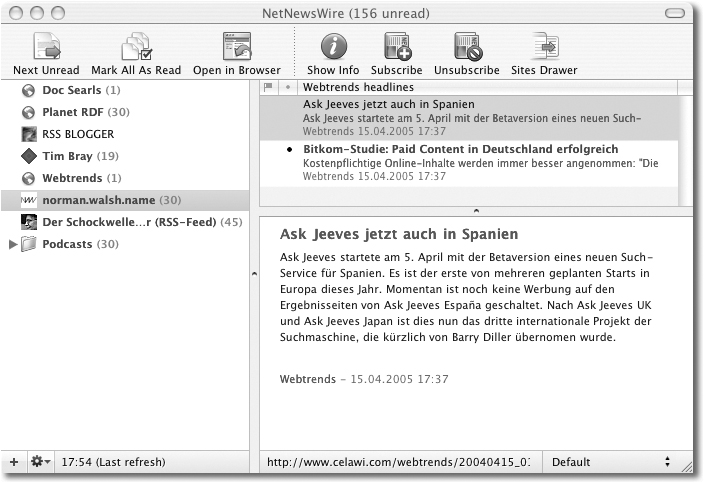
Figure: simple RSS 2.0 document in a newsreader (three-pane view)
The left side lists feeds, with a sample selected for display. On the right, the upper pane shows headlines, the content of the element title, and other item properties. The lower pane shows the selected item: its title at the top, again the content of the element title, followed by the content of the element description; the feed title appears below the description. The following timestamp was generated by the newsreader.
This so-called three-pane view is not the only way to display RSS documents. As the following example shows, all information can also appear in a single list:
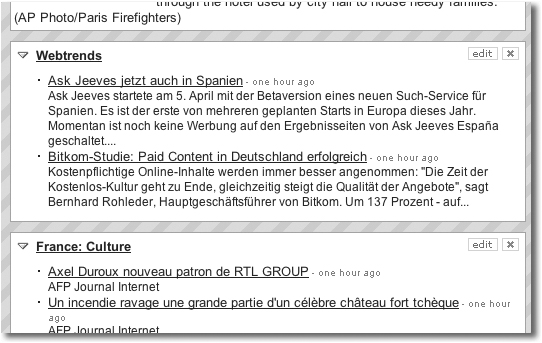
Figure: simple RSS 2.0 document in MyYahoo!’s list view
Additional properties of the entire channel are shown by selecting the feed properties command in a context menu, as illustrated below:
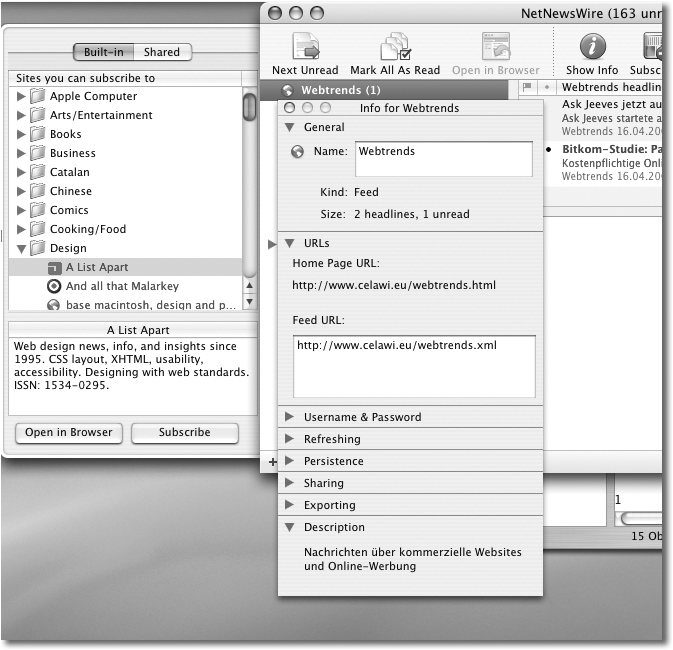
Figure: displaying RSS 2.0 channel properties in NetNewsWire
The popup on the right shows the contents of the elements link and description belonging to channel. The drawer on the left shows titles and descriptions of feeds preset in NetNewsWire. The newsreader thus also acts as an aggregator and lets users share subscriptions.
The basic functions of a newsreader and aggregator can therefore be implemented with only a few feed vocabulary elements.

This work is licensed under a Creative Commons Attribution-ShareAlike 3.0 Unported License.