

XML technologies / Schematron / Schematron cookbook / Databases I
(Excerpt from "Schematron - Effiziente Business Rules für XML-Dokumente", chapter 8)
Database applications often exchange data through XML. This example uses a book-sales portal: a reporting tool lists sellers, groups turnover by currency and account, and includes every book sold. The basic document structure is:
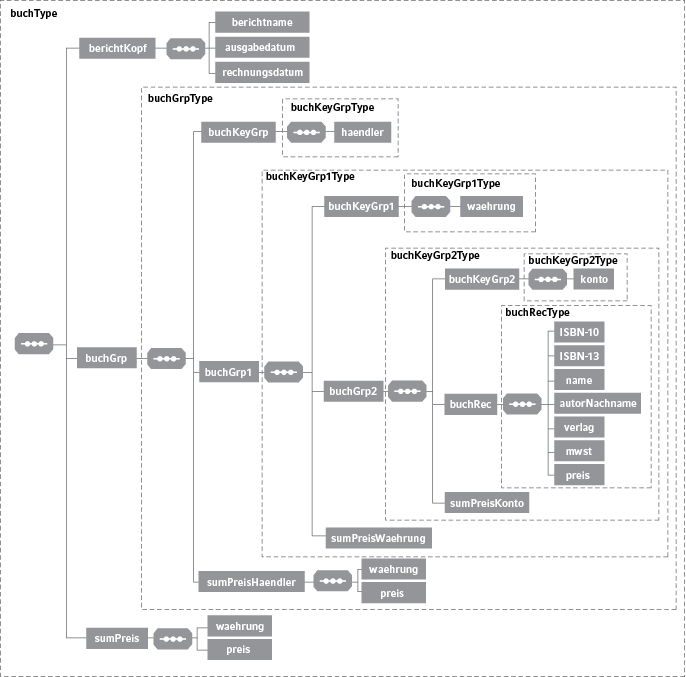
Figure: database schema of an online book portal
The report header contains metadata such as issue date, report name and invoice date. Grouping levels each have a container (for example <buchGrp1>), with a grouping key (for example <buchKeyGrp1>).
The final level lists book details without further grouping (<ISBN-10>, <ISBN-13>, <name>, <autorNachname>, <verlag>, <mwst> and <preis>).
Each group ends with its turnover total, for example per account <sumPreisKonto> or per seller <sumPreisHaendler>. This structure imports directly into Excel without further conversion.
The figure shows such a view:
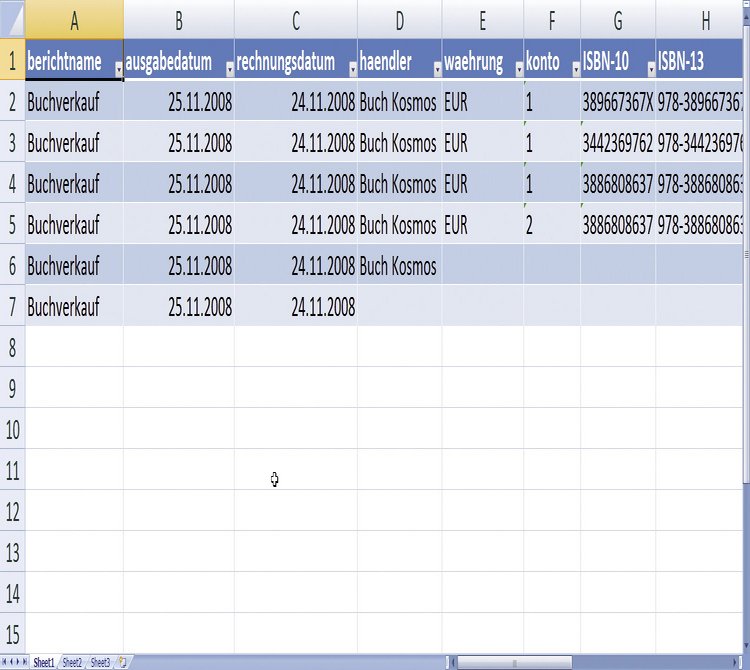
Figure: importing XML into Excel
Even thoughtful, complex structures have recurring problems involving implicit content constraints. Here are examples of such dependencies:
<buch xmlns:xsi="http://www.w3.org/2001/XMLSchema-instance" xsi:noNamespaceSchemaLocation="buch.xsd">
  <berichtKopf>
    <berichtname>Buchverkauf</berichtname>
    <ausgabedatum>2008-11-25</ausgabedatum>
    <rechnungsdatum>2008-11-24</rechnungsdatum>
  </berichtKopf>
  <buchGrp>
    <buchKeyGrp>
      <haendler>Buch Kosmos</haendler>
    </buchKeyGrp>
    <buchGrp1>
      <buchKeyGrp1>
        <waehrung>EUR</waehrung>
      </buchKeyGrp1>
      <buchGrp2>
        <buchKeyGrp2>
          <konto>1</konto>
        </buchKeyGrp2>
        <buchRec>
          <ISBN-10>389667367X</ISBN-10>
          <ISBN-13>978-3896673671</ISBN-13>
          <name>Der Katalane</name>
          <autorNachname>Gordon</autorNachname>
          <verlag>Blessing</verlag>
          <mwst>7</mwst>
          <preis>19.95</preis>
        </buchRec>
        <buchRec>
          <ISBN-10>3442369762</ISBN-10>
          <ISBN-13>978-3442369768</ISBN-13>
          <name>Hals über Kopf</name>
          <autorNachname>Reichs</autorNachname>
          <verlag>Blanvalet</verlag>
          <mwst>7</mwst>
          <preis>8.95</preis>
        </buchRec>
        <buchRec>
          <ISBN-10>3886808637</ISBN-10>
          <ISBN-13>978-3886808632</ISBN-13>
          <name>Außer Dienst: Eine Bilanz</name>
          <autorNachname>Schmidt</autorNachname>
          <verlag>Siedler</verlag>
          <mwst>7</mwst>
          <preis>22.95</preis>
        </buchRec>
        <sumPreisKonto>41.85</sumPreisKonto>
      </buchGrp2>
      <buchGrp2>
        <buchKeyGrp2>
          <konto>2</konto>
        </buchKeyGrp2>
        <buchRec>
          <ISBN-10>3886808637</ISBN-10>
          <ISBN-13>978-3886808632</ISBN-13>
          <name>Außer Dienst: Eine Bilanz</name>
          <autorNachname>Schmidt</autorNachname>
          <verlag>Siedler</verlag>
          <mwst>7</mwst>
          <preis>22.95</preis>
        </buchRec>
        <sumPreisKonto>22.95</sumPreisKonto>
      </buchGrp2>
      <sumPreisWaehrung>74.80</sumPreisWaehrung>
    </buchGrp1>
    <sumPreisHaendler>
      <waehrung>CHF</waehrung>
      <preis>74.80</preis>
    </sumPreisHaendler>
  </buchGrp>
  <sumPreis>
    <waehrung>EUR</waehrung>
    <preis>74.80</preis>
  </sumPreis>
</buch>
Implicit rules
Element <sumPreisKonto> must contain the sum of all <preis> elements within its parent <buchGrp2>, the account container. This pattern checks the sum:
<pattern id="sum">
  <rule context="sumPreisKonto">
    <assert test="format-number(sum(parent::*/.//preis),'###0.00')=.">Die Summe stimmt an dieser Stelle nicht. Sie müsste <value-of select="format-number(sum(parent::*/.//preis),'###0.00')"/> lauten.</assert>
  </rule>
</pattern>
Next check whether a seller traded in currencies differing from the total’s currency. Here the seller traded in EUR but the total uses CHF.
<buchGrp1>
  <buchKeyGrp1>
    <waehrung>EUR</waehrung>
  </buchKeyGrp1>
  <buchGrp2>
  …
    <sumPreisHaendler>
      <waehrung>CHF</waehrung>
      <preis>74.80</preis>
    </sumPreisHaendler>
This pattern reports the discrepancy:
<pattern id="waehrung">
  <rule context="sumPreisHaendler">
    <assert test="parent::buchGrp/buchGrp1/buchKeyGrp1/waehrung=current()/waehrung">Es werden hier unterschiedliche Währungen verwendet.</assert>
  </rule>
</pattern>
Another implicit rule requires knowledge of business processes. Here the principle is that <konto>2</konto> may be used for non-euro transactions. This pattern checks it:
<pattern id="konto">
  <rule context="konto[text()='2']">
    <report test="ancestor::buchGrp1/*/waehrung='EUR'">Im Konto 2 darf die Währung nicht EUR sein!</report>
  </rule>
</pattern>
Copyright © dpunkt.verlag GmbH 2011
You may print the online version for private use. Otherwise, this chapter from "Schematron - Effiziente Business Rules für XML-Dokumente" is subject to the same terms as the printed edition: the work and all its parts are protected by copyright. All rights reserved, including reproduction, translation, microfilming, and storage and processing in electronic systems.
dpunkt.verlag GmbH, Ringstraße 19B, 69115 Heidelberg, phone 06221-14830, fax 06221-148399, hallo(at)dpunkt.de