

AI & XML / RAG benchmarking / Weighting and evaluation
Publications do not all contain the same document forms. Scholarly publishers need different priorities from legal publishers, educational providers or businesses mainly using simple text documents. Benchmark weights can and should therefore be adjusted.
Weights from 0 to 3
Weight | Meaning | Effect |
|---|---|---|
0 | The document form does not occur. | Exclude the category from the total score. |
1 | The document form occurs but is secondary. | It contributes with low importance. |
2 | The document form is regularly relevant. | It receives medium weight. |
3 | The document form is business-critical. | Errors strongly affect the result. |
Adjust weights by publisher, product line, document collection or project. Existing test results can also be rescored with new weights without asking all questions again.
Weighted total = sum of category score times weight, divided by the sum of weights used.
Appropriate weighting depends on the publication
Scholarly publications
Formulas, tables, citations, figures and source evidence receive high weights.
Legal information
Footnotes, marginal numbers, citability, references and exact locations are central.
Educational media
Images, illustrations, lists, tables and understandable source links are especially important.
Fiction or simple text collections
Body text, chapter structure and reading order can receive high weights; formulas can be excluded with weight 0.
Example calculator with adjustable weights
This calculator uses fictitious examples. Change weights to see how the total changes.
Category | Example result | Weight |
|---|---|---|
Body text | 96 % | 0123 |
Footnotes | 82 % | 0123 |
Citations | 88 % | 0123 |
Tables | 69 % | 0123 |
Images | 73 % | 0123 |
Formulas | 45 % | 0123 |
Weighted example score: 0,0 % Active categories: 0
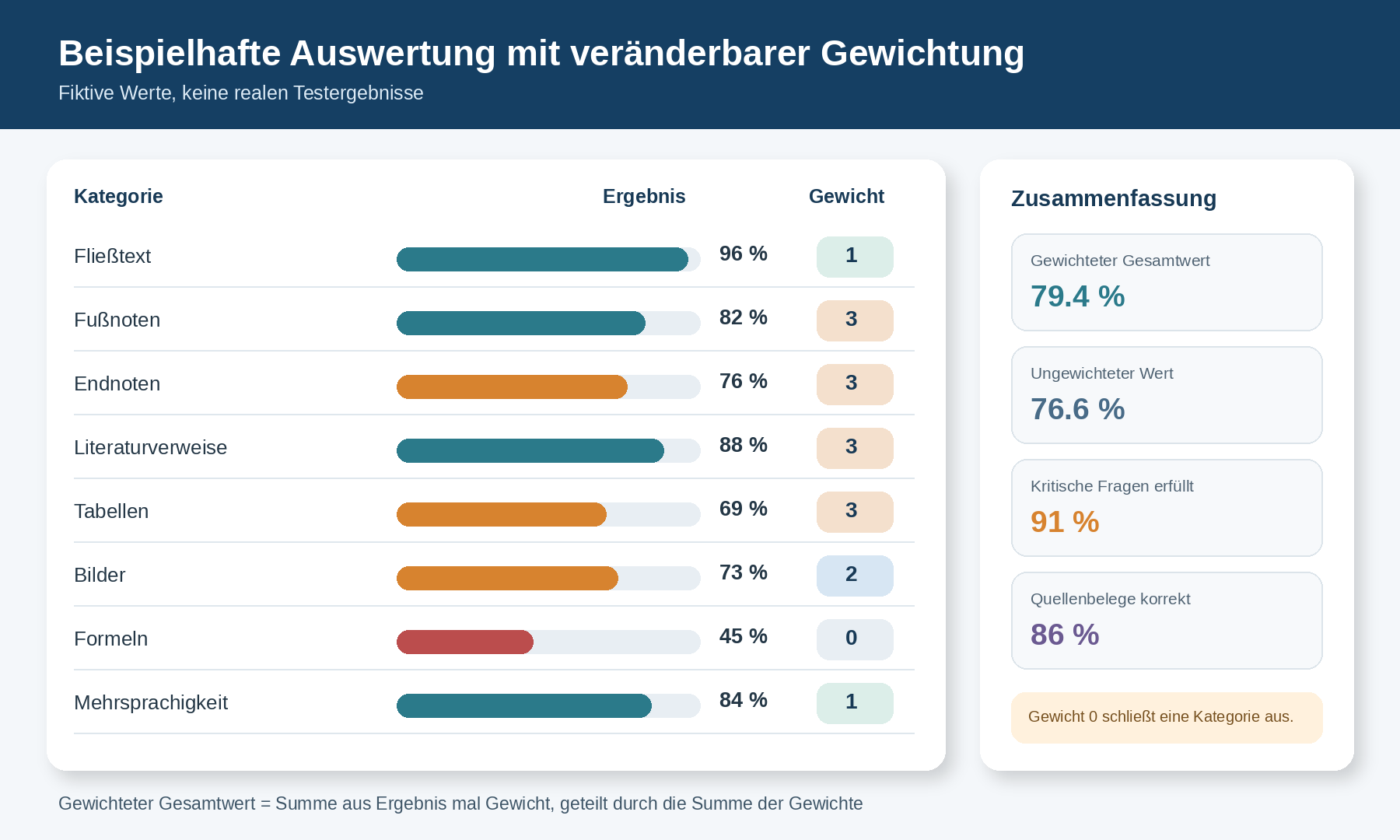
Example using fictitious values. Weight 0 excludes a category; higher weights increase its importance.
Assess content, source evidence and critical requirements separately
An answer may seem correct yet rely on an incorrect or missing source. Assign at least content and evidence points separately. Completeness, structural association, document fidelity, reproducibility and response time can also be assessed.
Critical categories may also have minimum scores. Good body-text results must not compensate for consistently misassigned footnotes or invented sources. Such requirements can be minimum scores or exclusion criteria.