Technologies XML / XSL-FO / Référence / Extensions XSL d’Antenna House Formatter / Propriétés / line-number
(Extrait de « XSL-FO ― Die Referenz » de Manuel Montero Pineda & Steffen Herkert, 2016, dpunkt.verlag)
A | B | C | D | E | F | G | H | I | J | K | L | M | N | O | P | Q | R | S | T | U | V | W | X | Y | Z
Catégorie Numérotation des lignes
La propriété axf:line-number définit s’il faut afficher les numéros de ligne. [no-LT]
Valeur : | none | show | hide |
Valeur initiale : | none |
S’applique à : | tous les objets de mise en forme de niveau bloc descendants de fo:flow, fo:table-column V6.3 |
Hérité : | oui (sauf pour fo:table-column) |
Pourcentages : | N/A |
Les valeurs ont les significations suivantes.
none | Les numéros de ligne ne sont pas générés. |
show | Les numéros de ligne sont affichés. |
hide | Les numéros de ligne ne sont pas affichés, mais les lignes sont comptées. |
Les lignes sont comptées à l’intérieur du bloc où axf:line-number="show" ou axf:line-number="hide" est spécifié.
Si axf:line-number est spécifié sur fo:table-column, une numérotation indépendante est ajoutée à la colonne du tableau. Les mêmes réglages que pour fo:page-sequence peuvent être spécifiés. La référence par id peut être spécifiée sur fo:table-column sous la forme axf:line-number-initial="#xxx." L’id doit être identique à celui du fo:table-column existant. La valeur définie sur cette colonne est reprise comme valeur par défaut des informations de numérotation des lignes. Une référence vers l’arrière n’est pas valide. V6.3
Cette propriété n’est pas disponible dans AH Formatter V6.3 Lite.
Exemple XSL-FO :
<fo:root xml:lang="en" xmlns:fo="http://www.w3.org/1999/XSL/Format" xmlns:cpfo="http://www.compart.net/xmlns/cpfo" xmlns:svg="http://www.w3.org/2000/svg" xmlns:axf="http://www.antennahouse.com/names/XSL/Extensions">
<axf:document-info name="document-title" value="Line number orientation"/>
<axf:document-info name="author" value="Antenna House, Inc."/>
<fo:layout-master-set>
<fo:simple-page-master page-height="150mm" page-width="210mm" margin-top="10mm" margin-left="20mm" margin-right="20mm" margin-bottom="10mm" master-name="PageMaster">
<fo:region-before extent="15mm"/>
<fo:region-after extent="15mm"/>
<fo:region-body margin-top="0mm" margin-left="0mm" margin-right="0mm" margin-bottom="0mm"/>
</fo:simple-page-master>
</fo:layout-master-set>
<fo:page-sequence axf:line-number-format="01" axf:line-number-initial="1" axf:line-number-interval="1" axf:line-number-orientation="90" writing-mode="from-page-master-region()" master-reference="PageMaster">
<fo:static-content flow-name="xsl-region-after">
<fo:block font-size="0.8em" text-align="right" color="green">
<fo:basic-link external-destination="http://www.antennahouse.com/">
Antenna House, Inc.
</fo:basic-link>
</fo:block>
</fo:static-content>
<fo:flow flow-name="xsl-region-body" font-family="serif" font-size="1em" line-height="1.4" axf:hyphenate-hyphenated-word="false" hyphenate="true">
<fo:block span="all" font-family="sans-serif" font-size="2em" font-weight="bold" line-height="2" space-before="1em" space-after="1em" space-before.conditionality="retain" space-after.conditionality="retain" background-color="#EEEEEE">
<fo:block start-indent="1em" end-indent="1em">
Line number orientation
</fo:block>
</fo:block>
<fo:block span="all" space-before="1em" space-after="1em" space-after.conditionality="retain" text-indent="0em" border="1pt solid #9999FF" start-indent="0.5em" end-indent="0.5em" padding="0.5em" text-align="justify">
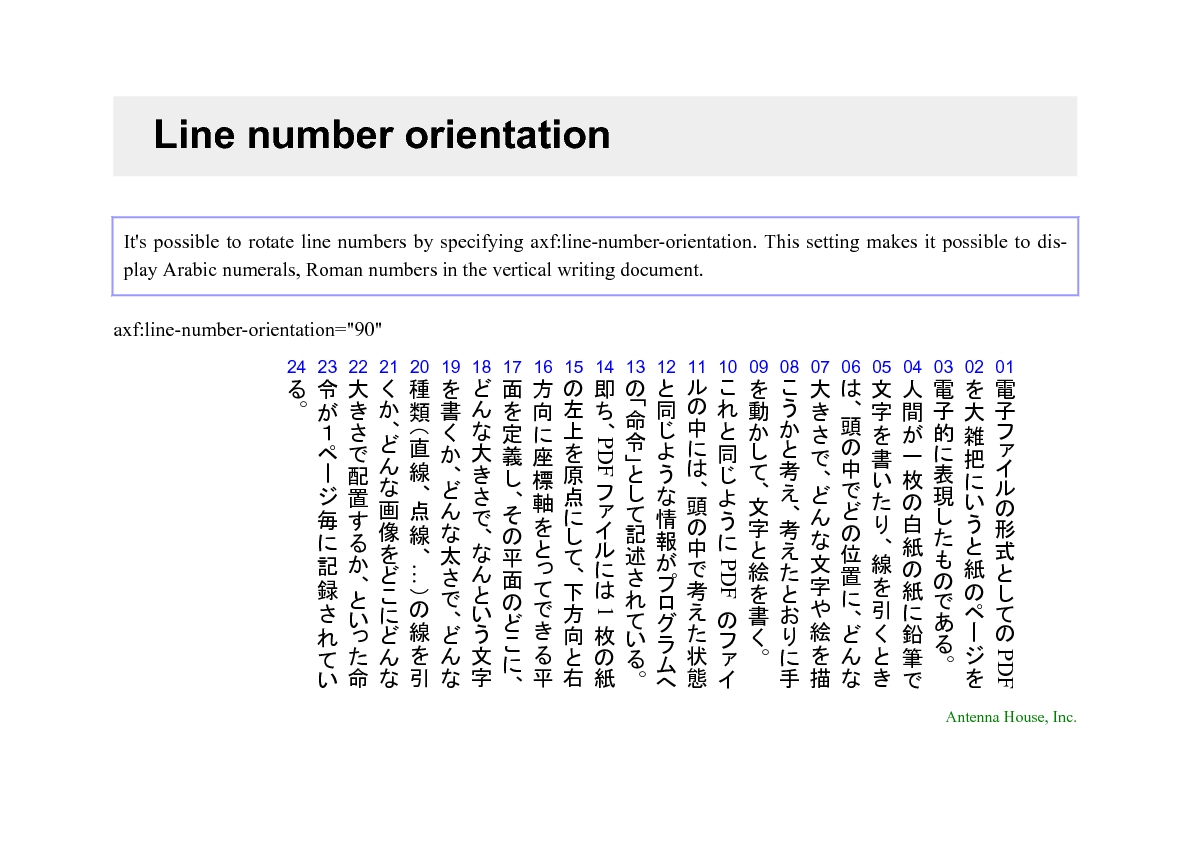
It's possible to rotate line numbers by specifying axf:line-number-orientation. This setting makes it possible to display Arabic numerals, Roman numbers in the vertical writing document.
</fo:block>
<fo:block>
axf:line-number-orientation="90"
</fo:block>
<fo:block-container space-before="1.5em" writing-mode="tb-rl" width="160mm" height="55mm" font-size="1.1em" text-align="justify" axf:line-number="show" axf:line-number-font-family="Arial" axf:line-number-font-size="0.8em" axf:line-number-font-style="normal" axf:line-number-font-weight="normal" axf:line-number-color="blue" axf:line-number-offset="3pt" axf:line-number-text-align="auto" axf:line-number-text-decoration="none" axf:line-number-width="20pt" xml:lang="ja">
<fo:block>
電子ファイルの形式としてのPDFを大雑把にいうと紙のページを電子的に表現したものである。
</fo:block>
<fo:block>
人間が一枚の白紙の紙に鉛筆で文字を書いたり、線を引くときは、頭の中でどの位置に、どんな大きさで、どんな文字や絵を描こうかと考え、考えたとおりに手を動かして、文字と絵を書く。
</fo:block>
<fo:block>
これと同じようにPDF のファイルの中には、頭の中で考えた状態と同じような情報がプログラムへの「命令」として記述されている。
</fo:block>
<fo:block>
即ち、PDFファイルには1 枚の紙の左上を原点にして、下方向と右方向に座標軸をとってできる平面を定義し、その平面のどこに、どんな大きさで、なんという文字を書くか、どんな太さで、どんな種類(直線、点線、…)の線を引くか、どんな画像をどこにどんな大きさで配置するか、といった命令が1ページ毎に記録されている。
</fo:block>
</fo:block-container>
</fo:flow>
</fo:page-sequence>
</fo:root>Résultat :