

Tecnologías XML / ePUB / Open Publication Structure / Elementos semánticos en línea / Citas
(Extracto de «E-Books mit ePUB ─ Von Word zum E-Book mit XML» de Dr. Victor Wang)
Las citas pueden marcarse como bloques o elementos en línea:
Una cita en su propia línea utiliza el elemento de bloque
<blockquote>.Dentro del texto, utilice el elemento en línea
<q>(«quotation»).
Una referencia bibliográfica a otro texto utiliza el elemento en línea
<cite>.
En DTBook pueden utilizarse así:
<p><strong>Blockzitat:</strong> Faust (siehe <cite>Goethe, Faust 1</cite>) war der folgenden Meinung:</p>
<blockquote>
   <linegroup>
       <line>Habe nun, ach! Philosophie,</line>
       <line>Juristerei und Medizin,</line>
       <line>Und leider auch Theologie</line>
       <line>Durchaus studiert, mit heißem Bemühn.</line>
       <line>Da steh ich nun, ich armer Tor!</line>
       <line>Und bin so klug als wie zuvor;</line>
   </linegroup>
   <author>Johann Wolfgang von Goethe</author>
</blockquote>
<p><strong>Inlinezitat:</strong> Mephisto sagte dazu, dass <q cite="Goethe, Faust 1">"das den meisten Leuten so ginge"</q>.</p>
Ejemplo de código: citas en DTBook
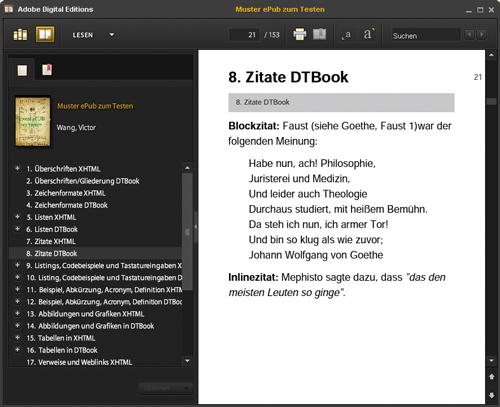
Figura: citas DTBook (Adobe Digital Editions)
En XHTML el ejemplo es casi idéntico, sin elementos de línea ni marcado de autor:
<p><strong>Blockzitat:</strong> Faust (siehe <cite>Goethe, Faust 1</cite>) war der folgenden Meinung:</p>
<blockquote>
   <p>Habe nun, ach! Philosophie,</p>
   <p>Juristerei und Medizin,</p>
   <p>Und leider auch Theologie</p>
   <p>Durchaus studiert, mit heißem Bemühn.</p>
   <p>Da steh ich nun, ich armer Tor!</p>
   <p>Und bin so klug als wie zuvor;</p>
   <div class="Autor">Johann Wolfgang von Goethe</div>
</blockquote>
<p><strong>Inlinezitat:</strong> Mephisto sagte dazu, dass <q cite="Goethe, Faust 1">"das den meisten Leuten so ginge"</q>.</p>
Ejemplo de código: citas en XHTML
Copyright © mitp 2011
Puede imprimir la versión en línea para uso privado.
En los demás casos, este capítulo de «E-Books mit ePUB» está sujeto a las mismas condiciones que la edición impresa: la obra y todas sus partes están protegidas por derechos de autor. Todos los derechos reservados, incluidos reproducción, traducción, microfilmación y almacenamiento y procesamiento en sistemas electrónicos.
Verlagsgruppe Hüthig Jehle Rehm GmbH, Im Weiher 10, 69121 Heidelberg, kundenbetreuung(at)hjr-verlag.de
volver arriba